The Martian environment presents extreme conditions that make it difficult for delicate elements to persist. Intense radiation reaches the ground, while the chemical composition of the surface continually degrades fragile molecules.
For this reason, the presence of complex carbon, capable of indicating the existence of life, is considered unlikely on the surface of Mars, with any traces expected to be deeply buried and inaccessible.
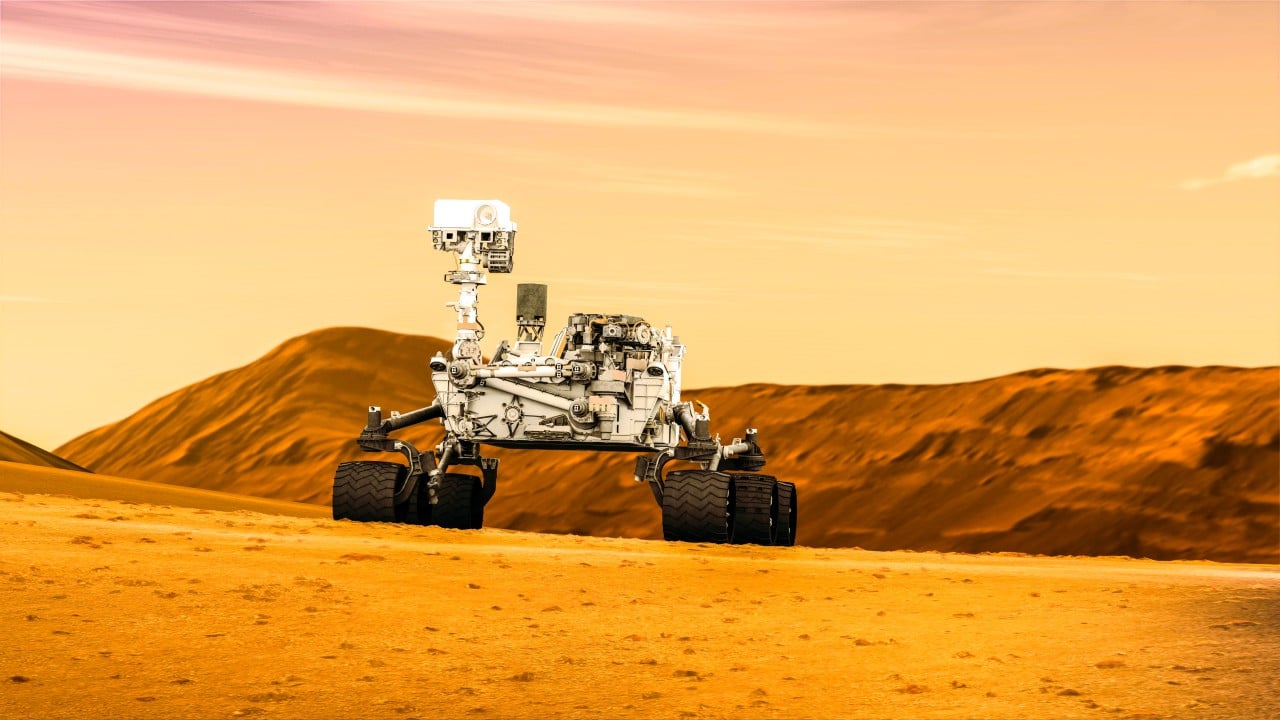
Contrary to these expectations, an exploration vehicle from the American Space Agency (NASA) made a surprising discovery. Without the need for excavation or drilling, the rover identified a significant volume of complex carbon on the exposed surface of a rock, a place where its presence was not expected.
Exploring Jezero Crater in search of signals
Billions of years ago, Jezero Crater was home to a large lake. Rivers flowed into this area, depositing sediments that gradually formed a delta, a geological structure created by the meeting of running water and still water.
Since 2021, NASA’s Perseverance rover has been investigating this dry basin, analyzing various rock formations for any signs of life. Ashley Murphy, a geologist at the Planetary Science Institute (PSI) in Arizona, was the leader of the new study describing this discovery.
The team’s attention focused on a strip of light-colored rock located on the edge of the ancient delta known as the Bright Angel rock outcrop. This area is considered suitable for preserving traces of life, as water accumulated there in the past.
A slab in this area, called Cheyava Waterfall, had previously attracted interest. Its surface displays dark-edged spots that resemble marks left by microorganisms on terrestrial rocks, a pattern that a 2025 study considered a possible indication of past life.
Identification of the largest carbon accumulation to date
To analyze the composition of the rocks, the exploration vehicle uses a method that projects light onto the surface and measures the way it is reflected, revealing the molecules present inside.
By directing its equipment at two Bright Angel clay shale formations, rocks formed by hardened mud and silt, the rover continually detected the presence of carbon.
The carbon found was not common, but macromolecular — large, interconnected molecules, composed of multiple carbon atoms joined together. This is a more complex form of the element.
Perseverance recorded hundreds of impacts on the two rocks, representing the largest amount of carbon ever located on the surface of Mars.
As carbon is the basis of all known life, its discovery in such complexity and volume is remarkable. However, this detection alone does not confirm the existence of life on Mars.
Unexpected location of carbon on the Martian surface
The biggest surprise of the discovery was the exact location of the carbon. It was found on the natural surface of the rock, covered only by a thin layer of dust, without the need for drilling or removing the weathered rock.
Until then, no trace of macromolecular carbon had been detected in such a superficial form in exposed Martian rocks.
Kyle Uckert, an astrobiologist at NASA’s Jet Propulsion Laboratory (JPL), described this discovery as the most superficial detection of organic matter ever made on Mars.
This fact is considered strange due to the aggressive nature of the Martian surface, where radiation is constant and soil chemistry degrades fragile carbon molecules. A structure as complex as macromolecular carbon should have been destroyed much earlier.
Two hypotheses are considered to explain the persistence of carbon: it may have been exposed recently, before being degraded by the surface, or nearby minerals may have protected it from radiation. The team cannot yet determine which explanation is correct.
Possible origins of the identified carbon
However, the discovery presents a challenge: the carbon signal captured by the rover is identical, regardless of whether its origin is biological (linked to living beings) or abiotic (not linked to life).
On Earth, carbon with this same molecular “fingerprint” is found both in the crushed remains of ancient microbial mats and in coal, both formed from organic life.