Falcon 9 rocket stage will collide with the lunar surface and create a dust cloud
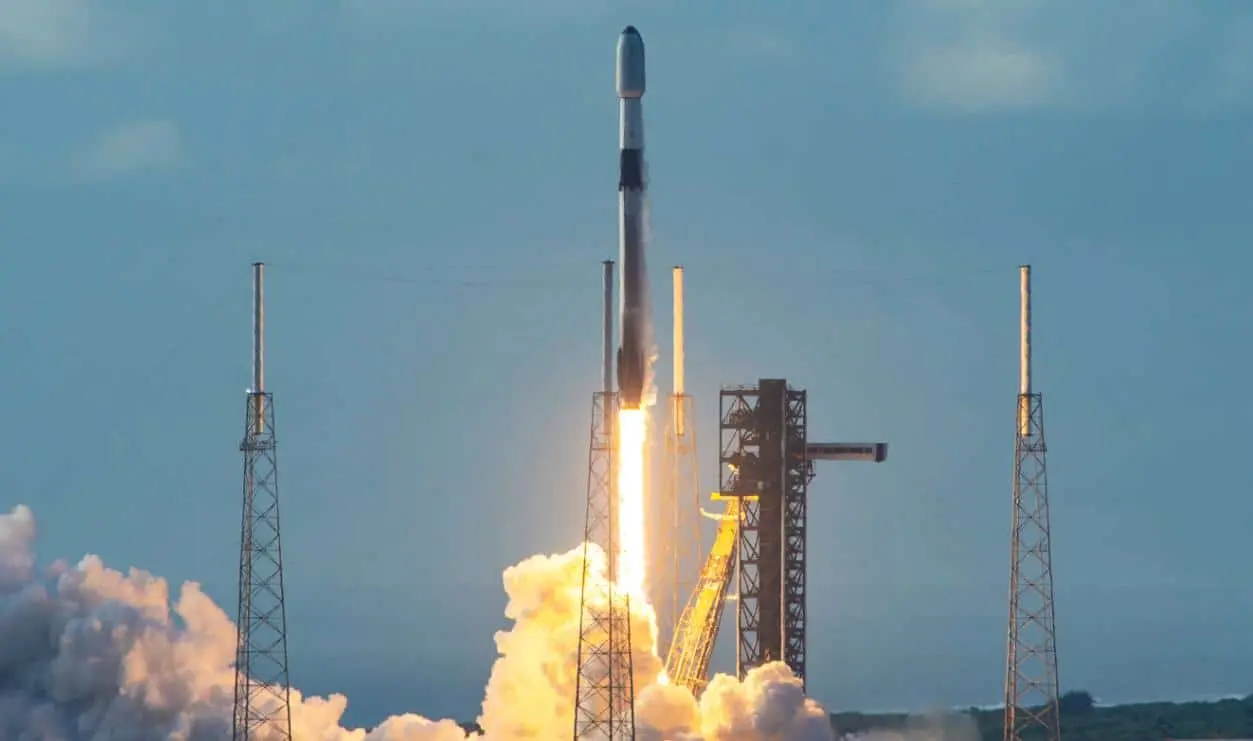
A massive piece of metal built by humanity has an appointment with our natural satellite on August 5th. It is an upper stage of a Falcon 9 launch vehicle, operated by the company SpaceX, which has lost its original orbit and is now traveling uncontrollably through the vacuum. Specialists in celestial mechanics have calculated that the structure will hit the lunar soil at very high speed, lifting a colossal amount of material from the surface. This accidental collision turned into a rare opportunity for astronomers around the world to prepare their observation equipment.
Details about the original launch and payloads sent into space
This entire scenario began to take shape on January 15, 2025, the date on which the equipment left the terrestrial platform. The main mission of that day was to boost cutting-edge technologies developed by private initiatives seeking to establish a commercial presence beyond Earth. The cargo compartment carried the Blue Ghost-1 landing module, manufactured by the North American company Firefly Aerospace, which has contracts to explore the extraterrestrial environment.
More on this story: SpaceX rocket fragment crashes into the Moon at high speed after months adrift
Alongside him, Mission 2 of the Hakuto-R initiative, officially named Resilience, was also traveling. This second artifact consists of a robotic explorer designed by iSpace, a corporation based in Japan that is trying to consolidate its landing technology after previous attempts. After fulfilling the role of accelerating these machines out of Earth’s gravity, the rocket part ran out of fuel, lost its maneuverability and became another item on the growing list of space junk roaming the inner solar system.
Region mapped for the fall and visual characteristics of the impact
Calculations refined by an international team of scientists indicate that the piece of Falcon 9 will fall on the western face of the lunar globe. The exact point of intersection is sandwiched between two geological formations known as Einstein and Bell craters. A detailed study of the trajectory was recently published in the scientific repository arXiv, revealing that the kinetic energy of the crash will instantly pulverize rocks and soil, creating an artificial crater at the site.
On the same topic: SpaceX rocket collides with the Moon in an event monitored by NASA, which eliminates risks to Earth
As there is no atmosphere to stop the particles, the ejected dust will travel freely, forming a temporary curtain over the desolate landscape. Researchers believe this cloud will reflect sunlight intensely against the darkness of deep space. Professionals equipped with highly sensitive telescopes positioned on Earth will have a short window of time to capture images of the phenomenon directly from the edge of the lunar disk, requiring precision in monitoring times.
See Also

Islam Makhachev confirms unanimous decision victory over Ian Machado Garry at UFC 330

Amazon guarantees 17% discount on advance purchases of Grand Theft Auto VI

UFC 330: Mackenzie Dern defends title and keeps Brazil with only belt
- The terminal velocity of the object at the time of the impact will exceed thousands of kilometers per hour, instantly fragmenting the metal.
- Material ejected from the ground will create a reflective curtain that will contrast sharply with the dark background of the universe.
- Ground-based observatories will need accurate trackers to focus on the exact western region during the crucial minutes of the event.
Mathematical projections indicate the height reached by the pulverized material
To understand the exact dynamics of what will happen in August, researchers needed to turn to supercomputers and complex physical models. William Jo, who serves as a graduate research assistant at the University of Texas at Austin, led a group focused on simulating the physics of impact. The data processed by the team shows that the violence of the impact will push the debris far from the ground, creating an imposing visual structure.
The group’s most solid estimates indicate that the dust plume will reach an impressive altitude, ranging between 75 and 100 kilometers above ground zero. For comparison purposes, this distance is equivalent to somewhere between 47 and 60 miles, a massive spread that is only possible due to the low local gravity, which corresponds to about one-sixth of Earth’s gravitational force. This behavior of fluids and solids in the lunar environment is completely different from any explosion that could occur on our planet.
Experts’ expectations about the brightness generated in the first seconds
The luminosity generated by the reflection of light in suspended dust grains is one of the factors that most attracts the attention of the astronomical community. Researcher William Jo explained that the numbers extracted from the simulations suggest an intense glow shortly after the disintegration of the rocket stage. According to the expert, the initial cloud will stand out very clearly against the background of the night sky, making it easier to identify the exact moment of the shock.
Learn more: SpaceX rocket debris hits the Moon after wandering for more than a decade
Despite his enthusiasm for the calculations, the scientist made a point of keeping expectations under control, warning about the unpredictable nature of the cosmos. He clarified that the model created represents an optimistic hypothetical scenario and that real conditions at the time of the shock could change visibility drastically. The researcher reinforced that, regardless of the visual beauty or the ease of observation by amateurs, the real gain lies in the raw data that will be collected by professional instruments.
Knowledge gained will help in planning future inhabited bases
Monitoring unintentional collisions like this provides information that no terrestrial laboratory could accurately replicate. Tracking the spread of the ejection plume allows space engineers to fine-tune their equations about the density and behavior of lunar regolith. William Jo called the episode a rare chance to test physical theories using a real, large-scale event, something fundamental to the advancement of planetary science.
Understanding how dust spreads after a violent impact has become a top priority for forward-looking government agencies and private companies. Ambitious projects planning to build permanent habitats need to know exactly how the soil reacts to constant landings and takeoffs of heavy spacecraft. Data collected during the Falcon crash in August will be used to create better shields, protecting sensitive equipment and astronaut suits from abrasion caused by microscopic flying particles over the coming decades of exploration.
Full coverage: Latest News (EN)