SpaceX rocket fragment crashes into the Moon at high speed after months adrift

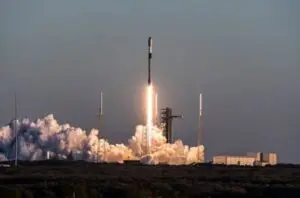
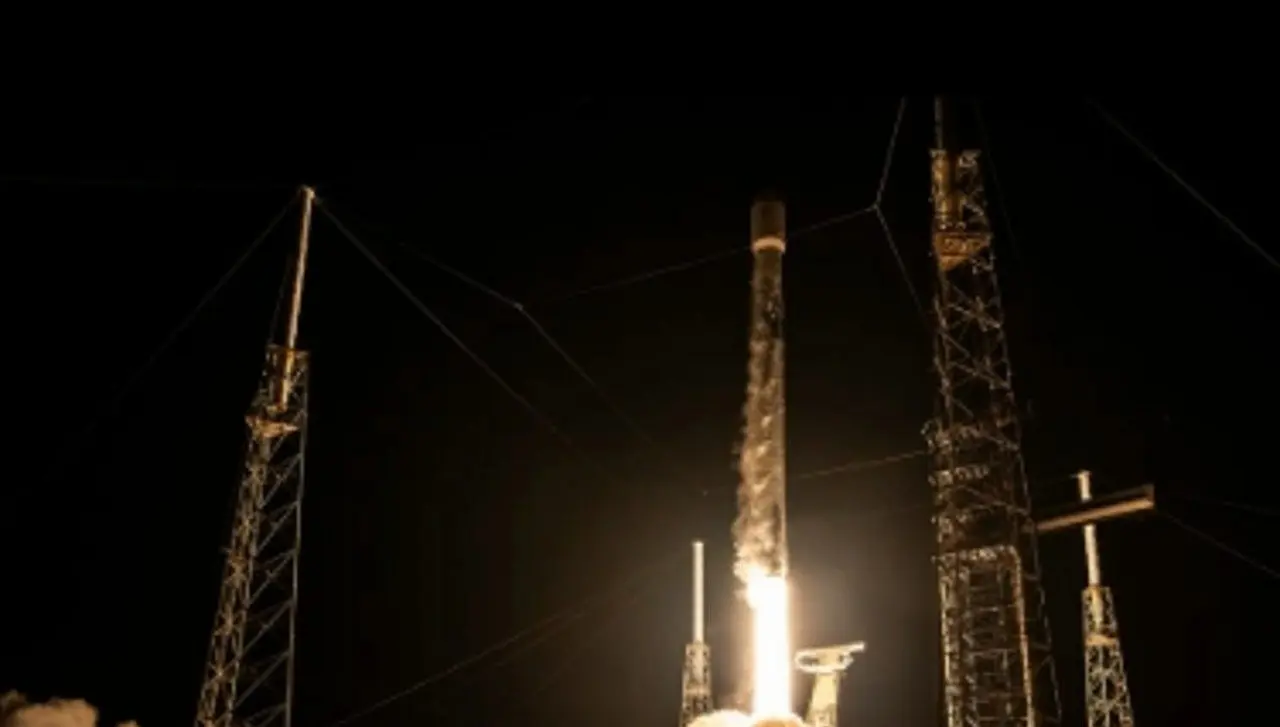
A SpaceX Falcon 9 rocket, carrying Firefly Aerospace’s Blue Ghost and ispace’s Resilience lunar modules, was launched from Launch Complex 39A at the Kennedy Space Center in Florida on January 15, 2025. Firefly, from the United States, and ispace, from Japan, have lunar exploration objectives for these payloads.
The launch of SpaceX’s Falcon 9 took place from the Kennedy Space Center, located in Cape Canaveral, Florida, during the month of January 2025.
Astronomers confirmed, on August 5, 2026, that a piece of a SpaceX rocket, which had been wandering in space since 2025, hit the Moon at high speed. The object joins the list of meteoroids, rogue ships and other space debris that have bombarded the lunar surface for centuries.
With dimensions comparable to those of a school bus, the object represents the second stage of a SpaceX Falcon 9 rocket, used to propel a Firefly Aerospace lunar landing module towards the Moon, also in January 2025.
The collision with the Moon, which was already predicted, generated great expectation among astronomers and space aficionados, curious to follow the outcome of the event.
The rocket body, weighing 4,000 kg, collided with the Moon at approximately 7:35 am Irish time while traveling at a speed of 8,690 km/h.
At the time of the collision, the few spacecraft orbiting the Moon were not in the appropriate position to record images close to the impact.
However, at the Paranal Observatory, located in Chile, the Very Large Telescope (VLT) of the European Southern Observatory (ESO) managed to capture flashes of light related to the moment of the shock.
An ESO spokesperson stated that “we can confirm that the telescope detected spectral lines of sodium and lithium gas in the impact plume for 5 to 10 minutes after impact.”
More on this story: Falcon 9 rocket stage will collide with the lunar surface and create a dust cloud
An image of the Moon captured by the crew of the Artemis II mission.
NASA’s Artemis II manned mission performed a lunar flyby and returned to our planet in April 2026.
The point of impact on the Moon was close to the terminator line, which marks the border between the face illuminated by the Sun and the hidden portion of the satellite.
As with previous impacts on the Moon, the rocket stage kicked up a cloud of lunar dust that received sunlight for a short period but was difficult to see with the naked eye from Earth.
The interaction of the impact plume with sunlight provided astronomers with important clues about its composition.
Carl Schmidt, lead astronomer for the impact observations, reported that the sodium gas found in the spectra likely originated from lunar soil, while traces of lithium may have come from the rocket stage itself.
Mr Schmidt added that “this observation was not perfect and this is a very rudimentary analysis, but I wanted to share something quickly, and we will be able to talk more about these results over time.”
On the same topic: Impact on the Moon: SpaceX Falcon 9 rocket fragment causes collision
SpaceX stated that the impact occurred accidentally. The expectation was that the rocket fragment would reach the Einstein crater, located on the western edge of the Moon, a region that is usually difficult to see from Earth.
Several cosmic forces propelled the fragment to the lunar surface.
See Also

Pokémon Go users report massive failures with login and connection to the game server

Instability in the Nubank application affects customers and service is normalized in a few hours

Tsitsipas overcomes initial challenge in Cincinnati and prepares for duel against Aliassime
Generally, rocket stages return to the Earth’s atmosphere, where they disintegrate, or fall into the ocean after fulfilling their function of propelling the rocket’s payload into a specific orbit.
However, the lunar landing mission carried out in January required a greater thrust than necessary for missions closer to Earth. For this reason, the rocket’s second stage remained in space, drifting aimlessly amid thousands of other space debris that pose a risk to active satellites.
Only in early 2026 were astronomers able to determine that the rocket stage, after exhausting its fuel and losing control, was following an orbital trajectory that would culminate in an impact with the Moon.
Julianna Scheiman, director of science for NASA and SpaceX’s Dragon programs, explained to reporters that “what happened was essentially a combination of solar activity and gravitational forces that put it on a trajectory toward the Moon.”
Bill Gray, developer of the renowned astronomy software Project Pluto, who apparently was the pioneer in calculating and releasing a report predicting the impact in April, commented that “this may have some scientific interest – probably small – and we can learn a few things from it.”
Mr Gray added to his speech, saying that “in January, I was almost certain that I would be successful, although I only had a vague idea of where it would be. By April, I was confident enough to publish an advert.”
Mr Gray also emphasized that the impact poses no danger to anyone, “although it highlights a certain lack of care in how space debris is disposed of.”
Learn more: SpaceX rocket collides with the Moon in an event monitored by NASA, which eliminates risks to Earth
Space debris impacts on the Moon are uncommon. In March 2022, a Chinese rocket stage had already collided with the Moon after completing a lunar test mission.
NASA in 2009 carried out an intentional launch of a rocket stage against the Moon with the aim of analyzing the resulting plume of lunar material, which led to the crucial discovery that lunar dust contains traces of water ice.
In recent years, several spacecraft that aimed to land softly on the Moon ended up colliding with other celestial bodies.
The Russian nuclear-powered Luna-25 mission lost control and crashed in 2023. Its small power source, containing plutonium-238, is expected to remain harmless on the Moon’s surface.
In 2019, India’s Chandrayaan-2 mission had an accident, and Israel’s Beresheet mission also suffered a crash in the same period.
Among the cargo that the Israeli landing module carried were tiny tardigrades, microscopic beings famous for their ability to survive extreme environments and radiation, and which are possibly still found on the lunar surface.
As early as the 1970s, NASA purposely launched stages of its Saturn V rocket onto the Moon to investigate the seismic effects caused by the impacts.
Ms. Scheiman reported that NASA and SpaceX are in discussions to find ways to avoid future lunar impacts.
The American space agency intends to build a lunar base and send astronauts on regular missions to the surface of the Moon from the end of 2029, as part of its Artemis program, which has already cost billions of dollars.
The company expressed that it would not want fragments of space debris to reach its future assets on the Moon.