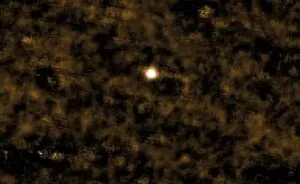
James Webb Telescope captures methane gas on interstellar comet 3I/ATLAS

An unprecedented milestone in space exploration has just been recorded with the identification of methane jets emanating from 3I/ATLAS, a celestial body coming from outside our solar system. Captured by the powerful lenses of the James Webb Space Telescope (JWST) at the end of 2025, the chemical anomaly shows a concentration of this organic gas much higher than the amount of water, something that completely deviates from the pattern of local comets. This finding reinforces how alien the composition of this lonely traveler is, providing crucial clues about the chemistry of distant worlds and remote star systems.
Unprecedented presence of organic gas in a visitor from outside the solar system
The confirmation of this substance in 3I/ATLAS represents a watershed for modern astrophysics. Until then, no other interstellar body tracked by astronomers transiting our neighborhood had demonstrated any trace of methane in its structure. The chemical compound only began to be visibly expelled after the star reached its perihelion — the moment of maximum approach to our Sun — during the month of October 2025. This late behavior encourages researchers to rethink theories about how matter organizes and survives in planetary systems located in other corners of the Milky Way.
On the same topic: Lack of NASA data on comet 3I/ATLAS generates race among astronomers
How a Space Telescope Technical Failure Helped Collect Crucial Data
All initial mapping was conducted by the Mid-Infrared Instrument (MIRI) attached to the James Webb Space Telescope, operating between December 15th and 16th, 2025. In that time window, the celestial body was sailing at a distance of 330 million kilometers from our main star. However, an unexpected failure in a guide star’s locking system forced scientists to reschedule part of the scan for December 27th. On this new date, the target had already moved even further away, reaching the mark of 380 million kilometers from solar heat.
What appeared to be an operational obstacle turned into a tremendous scientific advantage. The two reading batteries occurred less than sixty days after the star reached its peak solar proximity. The extreme heat generated by this encounter acted as a thermal trigger, forcing the violent evaporation of volatile materials trapped in the object’s crust, even though this activity was already in the process of slowing down due to its continuous distance towards deep space.
The impact of freezing water and crossing the thermal boundary in space
During the analysis, MIRI’s sensors captured clouds of water vapor expanding to colossal distances from the comet’s center, a phenomenon caused by the sublimation of ice particles that form its coma — the diffuse cloud that covers the rocky core. When the second round of observations took place in late December 2025, the graphs showed a drastic decline in this aqueous emission. The reason was simple: 3I/ATLAS crossed the so-called “snow line”, an invisible boundary where solar radiation weakens enough to allow water to return to its solid state and remain frozen.
Scientist Matthew Belyakov, a Caltech researcher and project leader, detailed the thermal dynamics in his official publication. He clarified that the water freezing boundary in our system is in the range of 2.5 astronomical units, and as soon as the interstellar traveler reached this mark, the surface ice stopped melting. On the other hand, elements such as carbon dioxide and methane have much lower evaporation points, remaining in full gaseous activity. In addition to these compounds, Webb’s equipment surprised by recording traces of nickel vapor, validating the thesis that the object is rich in carbon and metals, but poor in free water.
See Also

Electrical discharge knocks man off roof in Jaguaruana after contact with power lines

Global auction raises US$11.9 million and Brazil’s historic currency reaches record value

Former fighter Prichard Colón dies at age 33 after decade in a vegetative state
More on this story: Methane emission from comet 3I/ATLAS exposes relic origins from before the Sun
Mystery about the deep storage of gases and the star’s violent past
The fact that methane only appeared on radars after perihelion added an extra layer of complexity to the study. The main hypothesis is that this gas was not on the surface, but rather trapped in the rocky bowels of the cometary nucleus. The Sun’s thermal energy needed weeks to penetrate the outer layers and reach the inner pockets, heating the material to the point of sublimation. This indicates that whatever surface reserves of methane the body had in its youth were swept away by the cosmic winds eons ago.
The study authors argue that this structural configuration points to a turbulent past. The theory suggests that 3I/ATLAS suffered intense heating within its own solar system of origin, which fried its outer layer even before it was thrown into the freezing vacuum of interstellar space. Consequently, the remaining primordial methane ice was protected in the deep core, waiting billions of years for our star’s heat wave to awaken it again.
What alien chemistry teaches us about the evolution of other planetary systems
Compared to celestial bodies orbiting the Sun, the overwhelming proportion of carbon and methane over water in 3I/ATLAS is a glaring anomaly. However, this exotic chemical signature was likely the norm in the stellar nursery where he was born, an event that astronomers estimate occurred between 11 and 12 billion years ago. These data prove that the environment in which this intruder formed had radically different physical and chemical properties than the dust cloud that gave rise to Earth and its cosmic neighbors.
Learn more: Disintegration of comet MAPS frustrates astronomers after solar approach
Findings of this magnitude reinforce the vital role that interstellar fragments play in modern science. They function as true armored time capsules, delivering into our hands direct samples of planetary formation processes that occur light years away and that we could never physically access. By deciphering the anatomy of these visitors, humanity gains a new perspective to understand the peculiarities and privileges that allowed the emergence of our own solar system.
Summary of technical data collected during the celestial body’s passage
- Official identification:Interstellar body cataloged as 3I/ATLAS (C/2025 N1).
- Data capture window:Readings carried out on December 15, 16 and later on December 27, 2025.
- State-of-the-art equipment:James Webb Space Telescope (JWST), operating the MIRI infrared sensor.
- Mapped chemical signatures:Methane gas (unheard of for outside visitors), carbon dioxide, water vapor and nickel vapor trails.
- Structural difference:Atypical concentration of carbon and methane exceeding water levels, demonstrating a distant origin.
- Maximum solar approach:Perihelion recorded on October 29, 2025.
- Freezing boundary:Approximate distance of 2.5 astronomical units from the Sun.
- Birth Estimate:Formation calculated in the range of 11 to 12 billion years in the past.