Health emergency forces Delta plane bound for São Paulo to land in the Caribbean
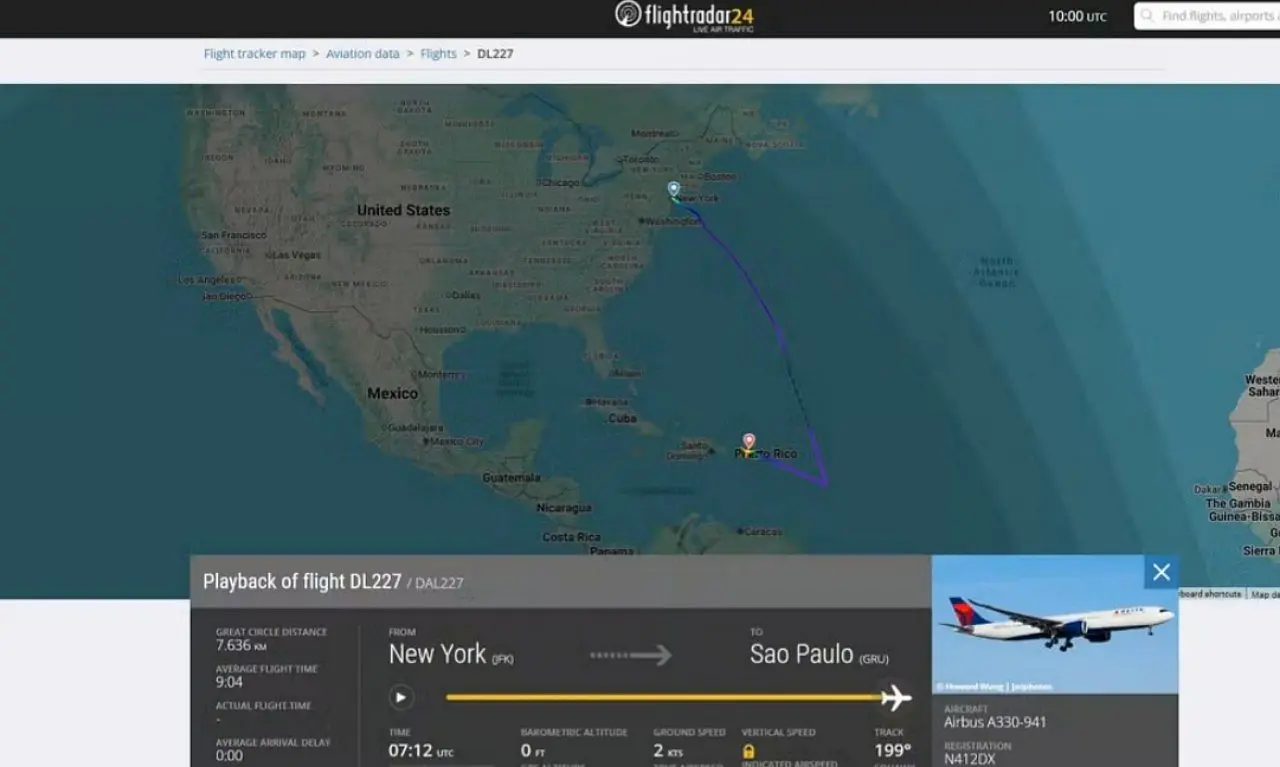
An unforeseen health situation drastically altered the path of hundreds of travelers who left the United States for Brazil. A commercial plane operated by Delta Airlines had to interrupt its original route towards Guarulhos International Airport, in the metropolitan region of São Paulo, to make an unscheduled landing in Puerto Rico. The incident occurred in the early hours of August 2, 2026, when air monitoring radars recorded the aircraft’s sudden turn while flying over the waters of the Caribbean Sea. The crew’s quick and imperative decision aimed to guarantee immediate medical attention to an occupant who presented a serious clinical condition on board, prioritizing human life over the flight schedule.
Managing medical crises at thousands of meters of altitude requires extreme coordination between pilots and ground teams. When a passenger presents severe symptoms, flight attendants provide first aid while the captain contacts specialized medical services via satellite. These shore-based doctors evaluate the symptoms described and recommend the best course of action. In the case of this specific flight, the seriousness of the situation did not allow the aircraft to continue its journey of several hours to South American territory, forcing the immediate search for a runway with large hospital infrastructure nearby.
On the same topic: Medical emergency forces Delta flight to Guarulhos to land in Puerto Rico
Details of the interrupted path over Caribbean airspace
The initial schedule provided for a direct, non-stop trip between North America and the state of São Paulo. Takeoff took place in New York City at exactly 10:40 pm on August 1, 2026, considering the Brasília time zone. Everything went perfectly normally in the first hours of the flight, with passengers settled in for the long night crossing. However, at around 2:50 am the following morning, the pilots declared the need to change course and began descent procedures.
The Puerto Rican capital, San Juan, became the closest and most viable safe haven to safely receive the jet. Airports located on Caribbean islands often serve as strategic support points for long routes connecting the northern hemisphere to South America. The San Juan international terminal has runways long enough to accommodate heavy intercontinental aircraft, in addition to having emergency teams on standby 24 hours a day, essential features for the success of an unplanned landing.
Immediate hospital care after landing in San Juan
As soon as the landing gear touched the asphalt of the Puerto Rican airport, a rescue team was already waiting for the aircraft on the maneuvering yard. The North American airline confirmed, through an official statement, that the diversion was solely motivated to preserve the physical integrity of the affected passenger. Local healthcare professionals entered the cabin, stabilized the patient while still in the plane’s aisle, and arranged for the traveler’s safe removal from the aircraft.
An ambulance equipped with advanced life support quickly transported the passenger to a hospital in the region, where he received specialized treatment. International aviation protocols determine that, in the event of a suspected heart attack, stroke or other critical conditions, the commander has complete autonomy to abort the route. The passenger’s identity and specific details about his health status were kept confidential, respecting medical privacy laws.
More on this story: Attack at Latam check-in in Guarulhos raises questions about employee protection and compensation
See Also

Electrical discharge knocks man off roof in Jaguaruana after contact with power lines

Global auction raises US$11.9 million and Brazil’s historic currency reaches record value

Former fighter Prichard Colón dies at age 33 after decade in a vegetative state
Crew fatigue regulations prevent immediate resumption of travel
Although the medical problem was resolved with the patient’s disembarkation, the plane could not simply refuel and continue its journey to Brazil. The company justified the retention of the aircraft on Caribbean soil by citing the strict regulations on crew working hours limitations. Global aeronautical laws strictly prohibit pilots and flight attendants from exceeding a maximum limit of hours worked uninterruptedly, an essential measure to avoid fatigue and guarantee the operational safety of all commercial flights.
As the route deviation, emergency landing, medical care and bureaucratic procedures on the ground consumed a considerable amount of time, the original team exceeded its legal operating limit. Consequently, the company was unable to take off immediately. The technical solution required the company to activate a reserve crew or wait the mandatory regulatory rest time in a hotel before moving the jet again towards South America.
Relocation schedule and new schedules defined for travelers
To minimize the disruption caused by the unexpected interruption, the carrier organized a logistics task force to get customers to their final destination safely. The solution found by the company’s operational control center was to transfer passengers to a new operation. Independent flight tracking platforms detailed the updated schedule for completing the route to Brazil.
Learn more: Delta aircraft makes emergency landing in Guarulhos after severe engine failure
- The original flight, which operated under the identification DL227, was now listed as definitively canceled on the information panels at the Puerto Rican terminal.
- The company generated a new flight code, designated as DL9927, exclusively to complete the transportation of stranded passengers.
- The new takeoff from San Juan was scheduled for 9:15 pm on August 2, 2026, synchronized with Brasília time.
- Arrival at Guarulhos International Airport was scheduled for 3:45 am on August 3, 2026.
- At the time of the latest updates to the airport systems in the Caribbean, the new flight code was still awaiting official insertion into the electronic boarding signs.
Cases like this highlight the complexity behind the scenes of modern commercial aviation. A single health event triggers a chain reaction that involves air traffic controllers from multiple countries, ground crews, paramedics and route coordinators. Passengers affected by the delay receive assistance from the airline during the long wait in the Caribbean, complying with the international airline industry’s consumer protection guidelines. The episode reinforces the unpredictability of long-distance travel and the priority that airlines give to safety above punctuality.