How the Moon can become a giant ally in the search for gravitational waves
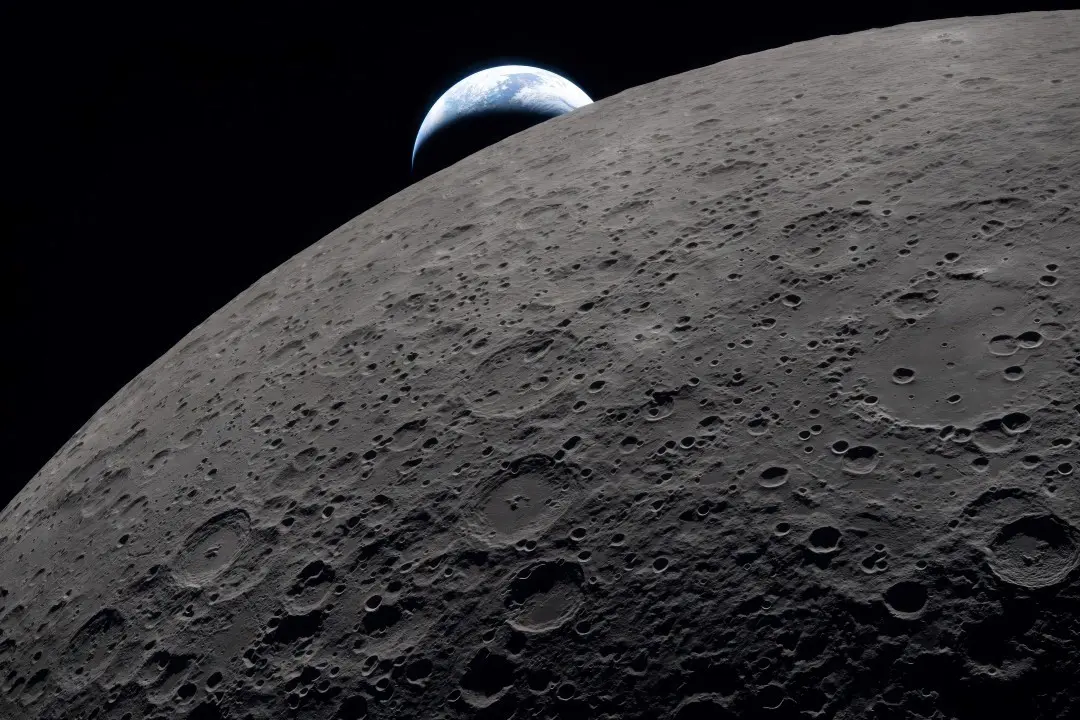
Recent research details the possibility of using the Moon, Earth’s natural satellite, as an immense gravitational wave detector, weighing around 73 quintillion tons. The scientists involved suggest that the celestial body would be capable of amplifying the seismic signals generated by the passage of these waves.
For a better understanding, gravitational waves are distortions in space-time, initially predicted by Albert Einstein in 1916 as part of his theory of general relativity.
Physicist Barry C. Barish, Nobel laureate and linked to the California Institute of Technology, explained in an article that, within this theory, clusters of mass or energy alter space-time. Variations in the shape or location of these objects cause a distortion that spreads throughout the universe at the speed of light, characterizing a gravitational wave.
Detecting these waves is not a simple task; only in 2015 were they identified and confirmed for the first time by the Laser Interferometer Gravitational Wave Observatory (LIGO).
Equipment like LIGO, although it requires a considerable size to operate, has an operating principle that is relatively easy to understand.
Professor Ed Daw from the University of Sheffield explained in a paper that to build a gravitational wave interferometer you only need two beams of light traveling between pairs of mirrors in tubes oriented in different directions, such as north and west.
The passage of a gravitational wave causes space to stretch in one direction and contract in a perpendicular direction.
Learn more: Long March 7A rocket takeoff in China ends in explosion 85 seconds later
On Earth, this action would cause the mirrors to move minimally, decreasing the distance between one pair and increasing it between another. This movement is, in fact, the mirrors’ reaction to the stretching and compression of space-time.
How, then, can the Moon be transformed into such equipment? The concept does not involve building a detector on its surface, but rather using the natural satellite itself as a sensor, with the support of seismology.
When gravitational waves pass through the Moon, the celestial body is expected to stretch and compress slightly. The central premise is to record this deformation by measuring the resulting seismic vibrations that reach an installed seismometer.
Jan Harms, from the Gran Sasso Science Institute, explained that the gravitational wave would come from a very distant place, like the early universe, reach the Moon and make it vibrate like a bell. According to him, it would be possible to position sensors on the lunar surface to detect its deformations or vibrations.
This conception, in fact, is not recent, dating back to the Apollo era. NASA’s Apollo 17 mission, for example, installed the Lunar Surface Gravimeter Experiment on the Moon with the purpose of detecting gravitational waves through this method.
See Also

Electrical discharge knocks man off roof in Jaguaruana after contact with power lines

Global auction raises US$11.9 million and Brazil’s historic currency reaches record value

Former fighter Prichard Colón dies at age 33 after decade in a vegetative state
However, the equipment did not operate satisfactorily after installation, and no gravitational waves were identified during its passage through the Moon.
How to consider irregularities on the lunar surface
In a recent study, researchers from the Chinese Academy of Sciences and Peking University sought to improve the modeling of how a detector of this nature works.
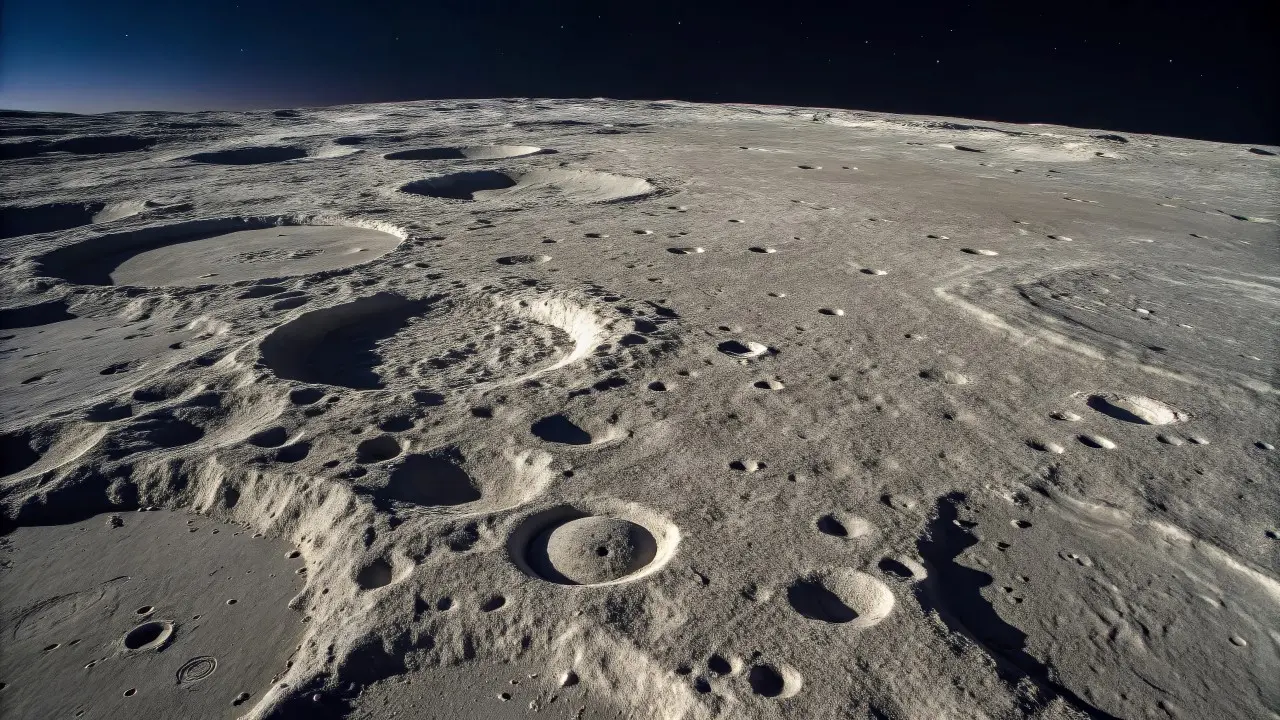
While previous attempts employed idealized models of the Moon, disregarding its craters and irregular surface, this team developed a new, more faithful representation of the natural satellite.
Full coverage: Latest News (EN)
In their article, the group of scientists points out that theoretical models indicate the Moon as a potential resonant detector, but the unknown influence of its rugged surface and heterogeneous interior made it difficult to accurately model its response. They claim to have resolved this long-standing uncertainty by creating the first high-resolution, two-dimensional model of the lunar response to gravitational waves, considered more realistic than previous ones.
With the help of the model, the team was able to determine the locations on the Moon where gravitational wave signals would be most easily detectable. The objective is to assist in choosing the landing point for the Chinese Chang’e-7 mission, which will carry the first broadband lunar seismometer.
During this procedure, the researchers discovered the existence of regions capable of significantly amplifying signals, especially for gravitational wave frequencies that are challenging or impossible to investigate with current ground-based detectors.
The team clarifies that, on average, the seismic signal can have an amplification of 10% in areas with thicker crust. In certain restricted frequency ranges, this amplification can exceed even an order of magnitude.
Additionally, they highlighted that areas with thicker crust, notably the highlands on the far side of the Moon, consistently show an amplification of the gravitational wave signal, thus offering better prospects for their detection.
Although more research is needed into the development of seismometers and the accuracy of landing sites, it is credible that humanity could begin detecting gravitational waves using the entirety of the Moon.
Xian Chen, professor of astrophysics at Peking University, added that the Moon may “resonate more intensely” in response to gravitational waves than previously thought. He explained that, historically, the missing factor in the analyzes was the variation in the thickness of the lunar crust. The expert considers that the current work is fundamental for choosing locations to install future lunar seismometers, and better-informed decisions would significantly improve the scientific return from lunar seismology projects.