Detailed observations of the Sun reveal plasma and advance understanding of space weather
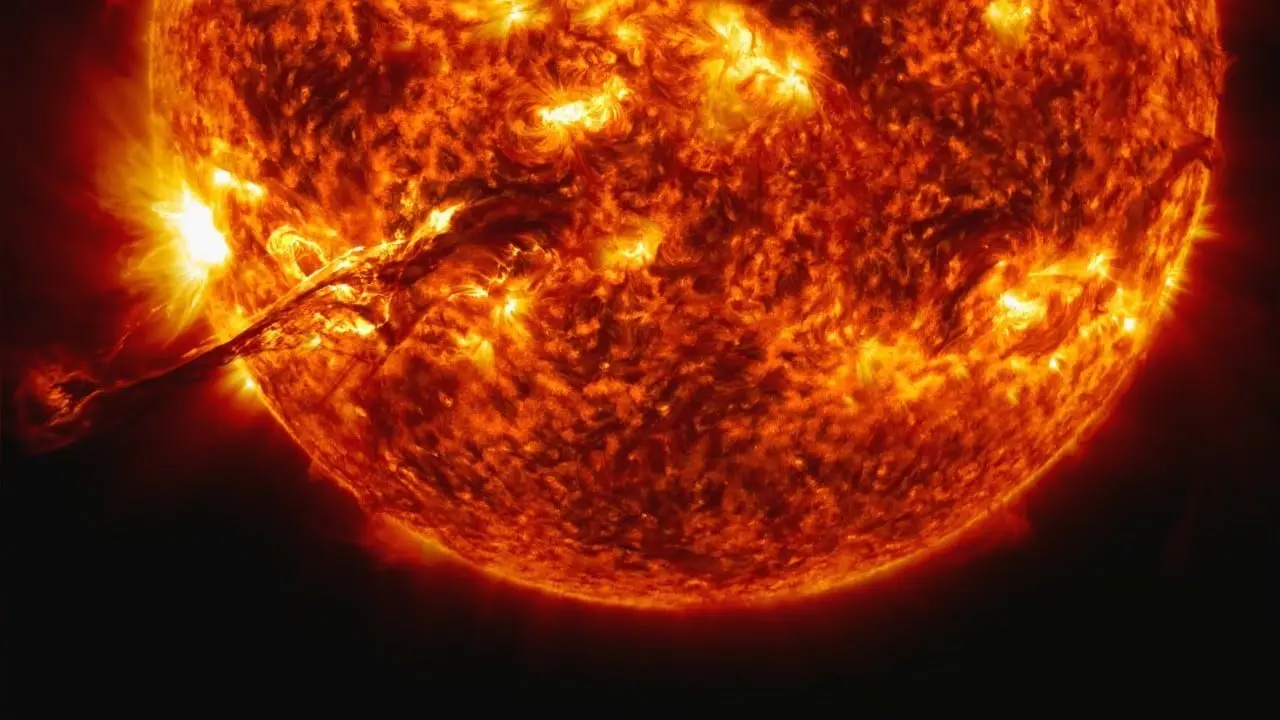
Scientists have recorded the most detailed images ever taken of the solar surface, revealing microscopic structures and plasma swirls never before seen with such precision. The discovery, published in the journal Nature on August 6, 2026, was made possible thanks to the Daniel K. Inouye solar telescope, located in Hawaii, the most advanced equipment in the world dedicated to the study of the star. These records offer important clues to one of the biggest mysteries in solar physics: why the Sun’s outer atmosphere is millions of degrees hotter than its surface.
Unprecedented images reveal the complexity of the solar surface
The new records feature wavy patterns and small swirls of plasma, with a striking resemblance to waves crashing at sea. These formations arise from the movement of streams of superheated material at different speeds on the star’s surface. As stated by Friedrich Wöger, scientist at the United States National Solar Observatory and co-author of the study, these are the images of the solar surface with the highest spatial resolution ever obtained. The scientific team identified the structures as Kelvin-Helmholtz instabilities, a physical phenomenon known in terrestrial fluids, but whose observation at this level of detail on the Sun is unprecedented.
The dynamics behind Kelvin-Helmholtz instabilities
When zooming in on observations, researchers came across extremely small formations, including vortices and turbulent waves. David Kuridze, another author of the work, expressed surprise at the level of detail achieved. He said his initial reaction was one of astonishment, questioning how such tiny and thin structures could be seen on the Sun, something that had never been observed before. Kelvin-Helmholtz instabilities represent turbulent flows that occur when there is a significant difference in velocity between two adjacent layers of fluids. In the solar context, this turbulence indicates a complex and energetic dynamic.
Understanding the solar corona enigma and energy transfer
The scientific team believes that the movement of these instabilities plays a crucial role in transferring energy and reorganizing the Sun’s magnetic fields. The accumulation of this energy, generated by these turbulent movements, can lead to solar explosions, coronal mass ejections and other eruptions capable of launching charged particles into interplanetary space. Understanding the Sun’s physics on these tiny scales is key to unraveling why the star’s outer atmosphere, known as the corona, reaches temperatures of millions of degrees Celsius, while its surface is “only” about 5,500°C. This intriguing phenomenon has defied scientific understanding for decades, as heat, theoretically, should decrease with distance from the main source, the solar core. The new observations provide a promising path toward resolving this fundamental question.
Impacts on Earth: Improving space weather forecasting
In addition to a significant scientific advance in understanding the Sun, the interpretation of these solar phenomena can drastically improve the prediction of so-called space weather. Extreme solar events, such as geomagnetic storms and other solar flares, pose direct and growing risks to our planet’s technological infrastructure.
See Also

Steam: Classic and modern RPGs go on sale with up to 90% off

Genshin Impact Update 7.0 releases Snezhnaya on August 12 and ends main arc

Pokémon Legends: ZA will have Mega Dimension DLC in physical version with code
- The main impacts of space weather on Earth include:
- Interference with communication and observation satellites.
- Failures in GPS navigation systems and other positioning technologies.
- Disturbances in long-distance radio communications, affecting aviation and maritime operations.
- Potential damage to electrical networks, causing blackouts and overloads in transformers.
- Increased risk for astronauts on space missions due to radiation.
David Boboltz, a researcher at the National Solar Observatory, highlighted the importance of understanding the physics of the Sun on the smallest possible scales to better predict space weather. This anticipation allows agencies and industries to take preventive measures, protecting critical systems and minimizing disruptions.
On the same topic: Mercury retrograde: uncover the illusion that confuses the heavens and the reason for popular fear
The Daniel K. Inouye telescope: a new window to observe the Sun
The Daniel K. Inouye Solar Telescope, located on the island of Maui, Hawaii, is currently the world’s most powerful instrument dedicated to observing the Sun. Its ability to capture images with unprecedented spatial resolution has allowed scientists to view details of the solar surface that were previously unattainable by any other equipment. Equipped with a four-meter-diameter primary mirror, the telescope can detect and analyze features as small as 30 kilometers on the star’s surface. This cutting-edge technology is essential for further studies on solar behavior and its interactions with the Earth.
The research that culminated in these images is part of an ongoing effort to observe the Sun in increasingly detailed ways. With the Inouye Telescope in full operation, scientists hope to continue to unlock the mysteries of our star, improving not only fundamental knowledge but also the ability to protect life and technology on Earth from its most energetic effects.
More on this story: Daniel K. Inouye Telescope reveals vortices on the Sun’s surface never seen before