Escaped supermassive black hole RBH-1 elucidates secrets of ancient galactic mergers
A supermassive black hole, known as RBH-1, has provided an unprecedented perspective for understanding galactic mergers that occurred millions of years ago. Detected traveling at nearly a thousand kilometers per second, this cosmic object is allowing researchers to reconstruct galaxy collision events that would otherwise be impossible to observe directly. A recent study, published on August 5, 2026, offers details about how RBH-1 was ejected from its host galaxy and what it reveals about the history of the universe.
The enigmatic black hole RBH-1 and its unusual speed
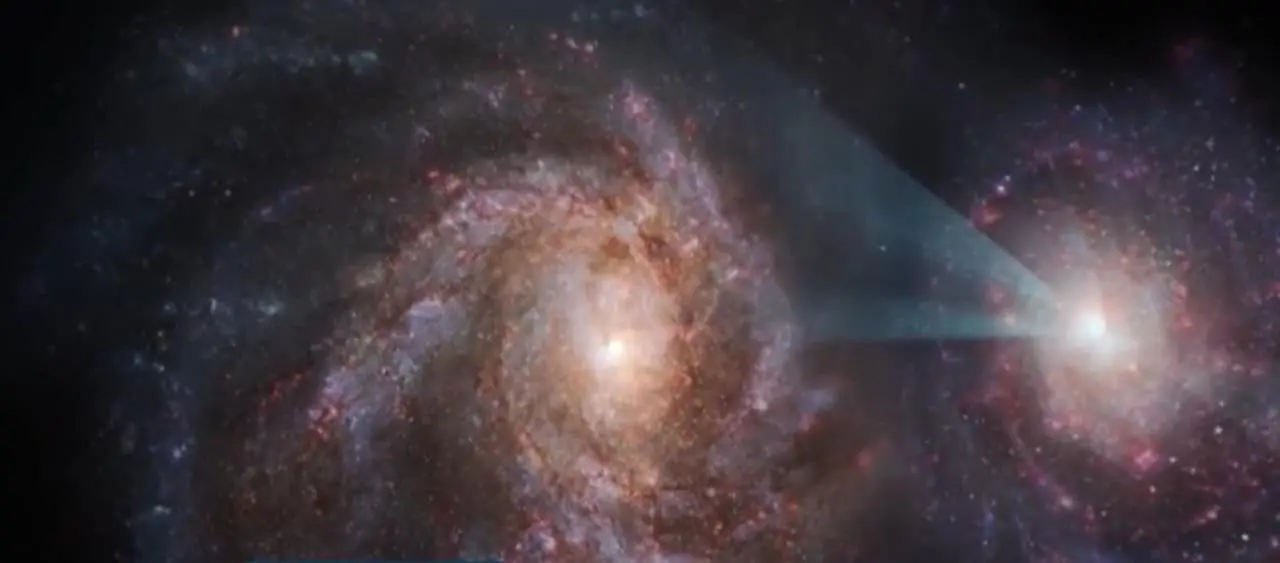
Supermassive black holes are colossal cosmic structures, with masses that can reach billions of times that of our Sun, and are generally found in the centers of galaxies. About three years ago, astronomers identified a “fugitive” specimen, RBH-1, moving at a speed of approximately one thousand kilometers per second through space. This celestial body was observed by the James Webb (JWST) and Hubble (HST) space telescopes, two of the most advanced observatories ever built, standing out for their atypical behavior.
On the same topic: James Webb discovery reveals supermassive black hole roaming 954 km/s in distant cosmos
New research unravels the origin of RBH-1
Scientists from the Kavli Institute for Theoretical Physics (KITP), the University of California-Santa Barbara (UCSB) and the University of Texas at Austin have dedicated themselves to investigating the origins of this moving black hole. Their paper, published in the journal Physical Review Letters, proposes that RBH-1 may have been launched into space following the merger of two supermassive black holes. Tousif Islam, first author of the work, said that RBH-1 represents the first convincing example of a supermassive black hole ejected from the center of its galaxy, probably as a result of a powerful recoil of gravitational waves. “It’s a spectacular confirmation of one of the most fascinating predictions of Einstein’s theory of general relativity,” Islam explained.
How scientists reconstructed the RBH-1 galactic merger
In previous studies, Islam and his team had already demonstrated that a black hole left over from a merger can be expelled into space with a high recoil speed, reaching up to five thousand kilometers per second. This hypothesis became crucial in explaining RBH-1’s speed. In collaboration with Tejaswi Venumadhav and Digvijay Wadekar, Islam led the reconstruction of the black hole merger that would have generated the gravitational “kick” that propelled RBH-1. To achieve this, the researchers combined theory-based simulations and conceptual models.
See Also

Electrical discharge knocks man off roof in Jaguaruana after contact with power lines

Global auction raises US$11.9 million and Brazil’s historic currency reaches record value

Former fighter Prichard Colón dies at age 33 after decade in a vegetative state
More on this story: Gaia satellite confirms merger between Milky Way and Andromeda with 90% probability
- The team began by estimating the speed of RBH-1 after its ejection from the galaxy.
- They used theoretical models of binary black hole mergers, developed from simulations of numerical relativity and black hole perturbation theory.
- They compared millions of possible precursor black hole configurations with the observed characteristics of RBH-1.
This analysis revealed that the merger likely involved two supermassive black holes with a mass ratio of less than 6:1, where the larger black hole was rapidly rotating. Furthermore, the pair would be in precession before the union.
The importance of using escaping black holes to understand the history of the universe
This study demonstrates that reconstructing supermassive black hole mergers can be a valuable tool for discovering the physical properties that led to the emergence of specific objects. By employing this approach, Islam, Venumadhav and Wadekar were able to infer the characteristics of the two black holes that merged to create RBH-1, gaining deeper insight into the galactic merger that brought them together. Islam highlighted that the work shows how astronomical observations and theoretical models based on Einstein’s general relativity can be combined to “turn back the clock” and unravel the history of extraordinary cosmic events.
Next steps in research and future space observations
The research team seeks to further improve the modeling of binary black hole mergers by developing more accurate theoretical models. The intention is to apply the methods developed to future discoveries of escaping supermassive black holes, which could be made by observatories such as the James Webb Space Telescope and the Nancy Grace Roman Space Telescope. These efforts are expected to complement future direct observations of gravitational waves from supermassive black hole mergers collected by the Laser Interferometer Space Antenna (LISA), a space-based gravitational wave observatory developed by the European Space Agency (ESA) in partnership with NASA. The ultimate goal is to build a more complete picture of the co-evolution of supermassive black holes and their host galaxies.