Astronomical phenomenon of 2026 will bring partial solar eclipse to the Brazilian sky
Scheduled for August 12, 2026, a new astronomical spectacle promises to excite space enthusiasts in Brazil. While nations in the Northern Hemisphere, including Spain, Iceland, Portugal and Greenland, will have the opportunity to witness the total occultation of the star-king, Brazilian territory will record the phenomenon partially. During that Wednesday afternoon, local observers will notice a peculiar decrease in natural luminosity, adding yet another landmark event to the country’s celestial observation calendar.
The mechanics behind this cosmic ballet occur when the Moon crosses the exact imaginary line between the Earth and the Sun, projecting an immense cone of shadow. For those watching from Brazil, the natural satellite will cover only a portion of the stellar disk, drawing an unmistakable silhouette in the daytime sky. However, ophthalmology experts and researchers reinforce that looking directly at the star requires rigorous protective equipment, as the radiation emitted is capable of causing irreversible damage to the retina.
On the same topic: August 2026 astronomical phenomena include two eclipses and meteor spike
Astronomical Differences Between Sunlight Blocking Categories
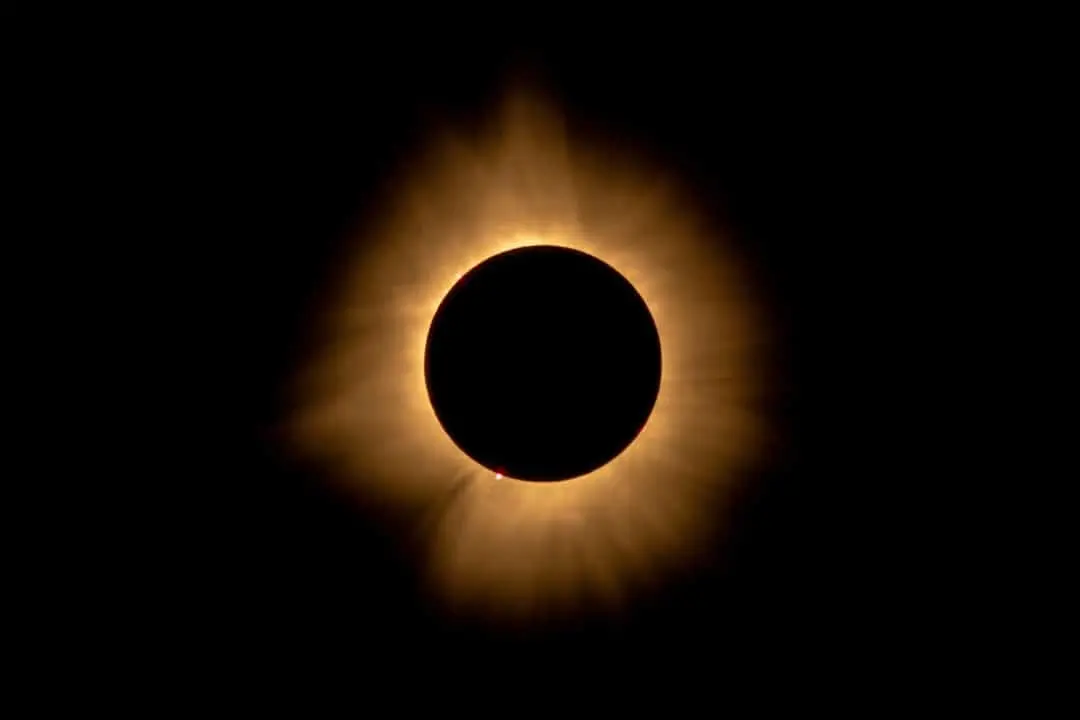
The visual perception of light blocking varies according to the orbital dynamics, dividing these occurrences into three fundamental categories. The format most coveted by eclipse hunters is the total one, which materializes when the Moon is at the exact distance to completely cover the solar sphere. During these rare minutes of daytime darkness, it becomes possible to see the solar corona, an outer layer of superheated plasma that is normally invisible due to the star’s extreme brightness.
The event scheduled to cross Brazilian airspace in 2026 belongs to the partial category, characterized by the moment in which the satellite bites only one edge of the Sun, leaving it with the appearance of a bright crescent moon. There is also the annular model, which occurs when the Moon is at its apogee, its orbit furthest from Earth. Because it appears smaller in the celestial vault, it cannot completely cover the star, creating the famous and dazzling “ring of fire” at the edges of the shadow.
North and Northeast states will have a privileged view of the celestial phenomenon
Although the country will not be completely dark, the observer’s latitude will dictate the intensity of the astronomical experience. Residents of the North and Northeast regions will be in the most favored range, where the lunar overlap will be much clearer in the late afternoon. On the other hand, anyone in the South or Southeast — such as in the capital of São Paulo, where coverage will be minimal compared to cities like Fortaleza — will only notice a subtle drop in clarity, requiring extra attention to identify spatial traffic.
The list of states with the best visibility conditions includes Pernambuco, Paraíba, Rio Grande do Norte, Ceará, Piauí, Maranhão, Pará, Amapá, Roraima and Amazonas. According to astronomers’ calculations, the lunar silhouette will begin to invade the solar disk at around 2:15 pm, Brasília time zone, reaching the peak of obscuration around 3:30 pm. The show should end around 4:30 pm, and the exact fraction of the Sun covered will change drastically depending on the city in which the spectator is located.
More on this story: Solar eclipse becomes laboratory for studies on fauna, flora and the Sun
Mandatory equipment to avoid irreversible damage to eye health
Monitoring the movement of the stars demands responsibility, since facing sunlight without adequate blockers causes severe burns to the macula. Even with part of the star hidden, the violent emission of infrared and ultraviolet rays does not decrease. This load of invisible radiation passes through the structures of the eye and silently destroys the photoreceptor cells, which can cause anything from permanent dark spots in the field of vision to complete blindness, without the person feeling any pain during the process.
See Also

Electrical discharge knocks man off roof in Jaguaruana after contact with power lines

Global auction raises US$11.9 million and Brazil’s historic currency reaches record value

Former fighter Prichard Colón dies at age 33 after decade in a vegetative state
The only method approved by science to observe the sky in these conditions is the use of glasses made with black polymer filters, which must carry the international ISO 12312-2 certification. Ophthalmologists warn that improvised means such as designer sunglasses, x-rays, photo negatives or binoculars without professional sun filters are extremely dangerous. These objects act as magnifying lenses, concentrating light and charring the retina in fractions of a second.
- International certification: only buy glasses from reliable suppliers that can prove the ISO 12312-2 seal printed on the temple.
- Risk of direct observation: never look up at the star without protection, even if the sky appears cloudy or dark.
- Children’s attention: children need strict adult supervision so that they do not remove the safety filters during the excitement.
- Danger of homemade myths: discard any improvised material; even welding mask glass is only safe if it is tinted 14 or higher.
- Safe projection: if you can’t get the right equipment, make a small hole in a piece of cardboard and project the Sun’s shadow onto a smooth surface on the floor.
The historical role of eclipses in advancing astrophysical research
Far beyond the aesthetic allure, the temporary blocking of sunlight serves as an invaluable testing ground for astrophysics. In moments of totality, scientists are able to analyze the dynamics of the solar corona, collecting crucial data to predict geomagnetic storms that threaten satellites and energy distribution networks on Earth. Brazil has a historic milestone in this field: in 1919, the observation of a total eclipse in Sobral, Ceará, made it possible to measure the deviation of starlight, providing definitive proof for Albert Einstein’s Theory of General Relativity.
From a historical and cultural perspective, the daytime disappearance of the Sun was once a reason for panic for ancient civilizations, which created mythologies about celestial beasts devouring the star or omens of the apocalypse. Today, supported by profound knowledge of the mechanics of the universe, primitive fear has given way to educational contemplation. The afternoon of August 12, 2026 will serve as another window of opportunity for the general public to understand the mathematical and gravitational precision that governs our cosmic backyard.
Learn more: Watch the 2026 Total Solar Eclipse
Observation tourism boosts local economies and sets the stage for 2045
The passage of the lunar shadow in 2026 reinforces a promising phase for scientific dissemination in the national territory, encouraging the engagement of young people in the exact sciences. As seen in October 2023, when the northeastern hinterland attracted thousands of tourists to follow the ring of fire, astrotourism proved to be a powerful tool for injecting resources into the economy of small towns. All this mobilization serves as a dress rehearsal for the long-awaited year 2045, when a total solar eclipse will cut Brazil from end to end, promising a spectacle unparalleled in our generation.
While the 2026 alignment does not occur, space enthusiasts can fill their agenda with several other fascinating phenomena, including intense meteor showers, planetary approaches and supermoons. To ensure the best experience in observing these celestial wonders, astronomers’ main tip is to consult updated calendars and travel to rural areas or parks far from metropolises, where the absence of artificial light pollution allows you to see the true immensity and beauty of the Milky Way.