

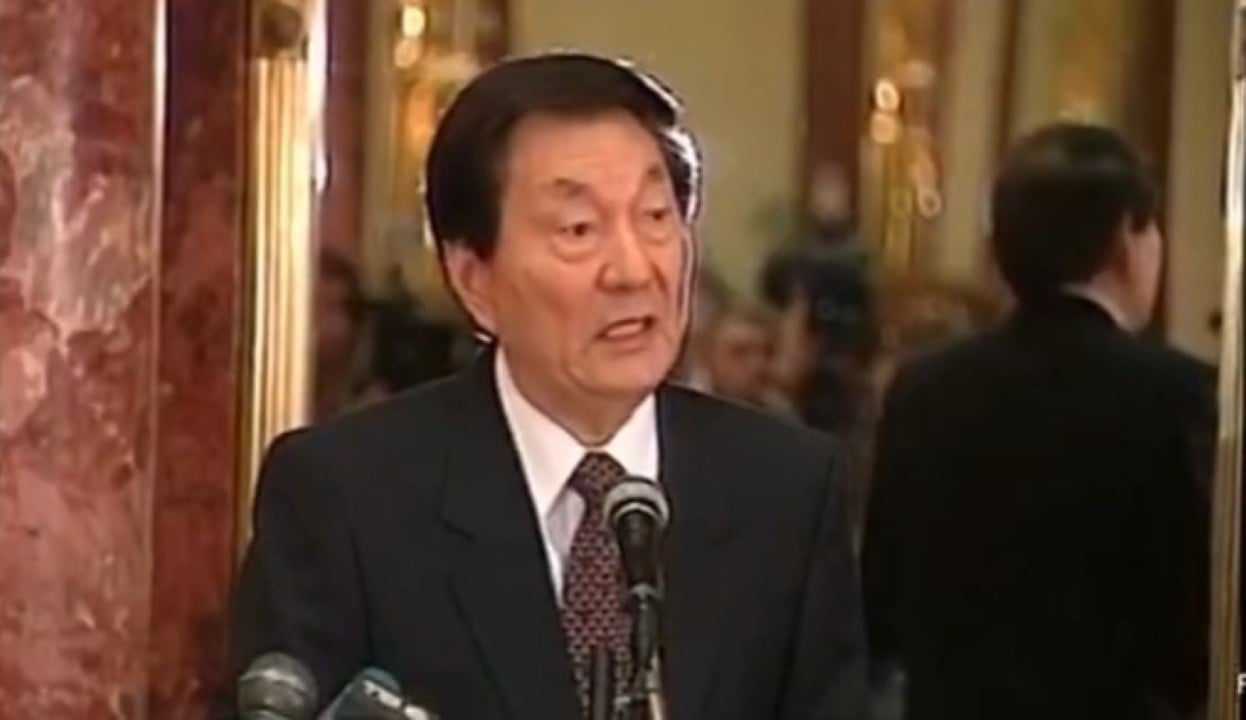
China announced the death of Zhu Rongji, former premier of the State Council and prominent figure of the Chinese Communist Party (CCP), in Beijing on August 12, 2026. He was 98 years old and could not resist a genetic disease for which he was receiving treatment. The official Xinhua news agency released the information, highlighting Rongji’s historical relevance to the country. The official obituary described him as “an outstanding member of the Communist Party of China, a loyal and long-time Communist fighter, an exceptional proletarian revolutionary and statesman, and an outstanding leader of the Party and the State.”
The obituary emphasized Zhu Rongji’s pivotal role in China’s economic transition. During his time as deputy prime minister and later premier of the State Council, the country transitioned from a centralized economy to a socialist market model. With the leadership of the CPC Central Committee, he carried out essential reforms.
Among its initiatives, the restructuring of fiscal and tax systems stands out, which simplified the tax burden and established a revenue sharing model between the central government and local administrations. He also actively pushed forward the modernization of the financial system, regulating the central bank, deepening reforms in commercial banks, foreign exchange and capital markets to create a unified and competitive market system.
Reform of state-owned companies was another priority, with the search for clarity on property rights and defined responsibilities. Zhu Rongji reorganized these companies and was concerned with relocating laid-off workers, as well as strengthening social security. His vision helped shape the modern Chinese economy.
Zhu Rongji’s reforms also encompassed the housing sector, with the monetization of housing allocation and the creation of a multi-faceted supply system focused on affordable housing. In the agricultural sector, he reformed the circulation of grains, guaranteeing the purchase of surpluses at protected prices and the sale by state companies at market prices.
His administration also led major changes in the social security, health and investment systems, paving the way for the fundamental structure of the socialist market economy. He played a crucial role in the negotiations for China’s entry into the World Trade Organization (WTO), intensifying the country’s opening to the outside world. The obituary highlighted his deep affection for the people and his defense that public servants must serve with honesty and responsibility, without seeking privileges or fearing to tell the truth.
In March 2003, Zhu Rongji ended his period as prime minister. Even after stepping away from leadership positions, he maintained his support for the Party Central Committee under the leadership of Hu Jintao and later Xi Jinping. He has always shown concern for socialism with Chinese characteristics and defended the Party’s integrity and the fight against corruption.
A book titled “The Complete Record of Zhu Rongji’s Speeches in Shanghai”, released by the Shanghai People’s and People’s Publishers, contains a speech from April 25, 1988. In it, Zhu Rongji, then a mayoral candidate, shared his personal experiences during the fourth plenary session of the first session of the Ninth Shanghai Municipal People’s Assembly.
In his 1988 speech, Zhu Rongji detailed his trajectory, describing a late entry into the revolution and an experience considered “relatively simple”. Born in Changsha in October 1928, he completed high school in Hunan in 1947 and entered Tsinghua University in Shanghai to study electrical engineering.
Learn more: Sanae Takaichi’s historic victory in Japan paves the way for economic and security reforms
He became involved in student movements and, in 1948, joined the Communist Youth League of China, joining the Chinese Communist Party in 1949. After his graduation in 1951, he was assigned to the Planning Department of the Ministry of Industry of the Northeast People’s Government. In November 1952, he joined the State Planning Commission, where he worked in the areas of electricity and as head of the Integrated Department, in addition to serving as secretary to Zhang Xi, vice president of the Commission.
Continuing his account, Zhu Rongji mentioned that due to Zhang Xi’s cancer diagnosis, he took over as head of the Comprehensive Division of the Machinery Industry Planning Department until 1957, a period that marked the beginning of the “Great Leap Forward” and the Anti-Rightist Campaign.
He recalled being pressured to express opinions to the Party Group and, after expressing them in a “careless” way, he was labeled a right-winger in January 1958. Despite the consequences of being fired as deputy director, administrative demotion and expulsion from the Party, he considered the treatment he received “lenient”, attributing it to the good relationship with the leaders of the State Planning Commission. He remained on the Commission, serving as a professor and later resuming duties in the Industrial Division of the National Office of Economic Planning.
Zhu Rongji expressed gratitude to the Party organization in the State Planning Commission, which prevented him from being sent to the countryside, allowing him to continue working for the Party. During the Cultural Revolution, he spent five years on a Commission farm, which he described as a “great lesson”, providing him with experience in rural life, growing various crops and caring for animals.
After 1975, he returned to Beijing and was assigned to the Power and Telecommunications Engineering Company of the Pipeline Department of the Ministry of Petrochemicals, where he led a team of apprentices. For more than two years, he trained them on complex installations such as utility poles, high-voltage lines and substations, which he called a “great learning experience” and valuable groundwork experience.
In 1978, Ma Hong invited Zhu Rongji to serve as director of the research office at the Institute of Industrial Economics of the Chinese Academy of Social Sciences. Shortly before the Third Plenary Session of the 11th Central Committee of the Communist Party of China, his labeling as right-wing was corrected, and his Party membership and position were reinstated.
He was then invited to return to the State Economic Commission, which had been separated from the State Planning Commission. With the establishment of the new State Economic Commission in 1982, Zhu Rongji became a member and director of the Technical Transformation Department. Later, in 1983, he was promoted to vice-president, and in 1985 he assumed the positions of deputy Party Group secretary and executive vice-president, before moving to Shanghai in early 1988.
When addressing his political achievements, Zhu Rongji commented on the difficulty in discussing the topic. He acknowledged the challenges faced after 1957, but highlighted that the organization’s evaluation of his work had always been positive. He described himself as an independent thinker who expressed his convictions without hesitation.
Rongji, an orphan from an early age, saw the Party as his family and, therefore, was not afraid to speak out about what he considered beneficial, even if it implied personal injustices. The restoration of his political life before the Third Plenary Session of the Eleventh Party Central Committee, according to him, was like a political “rejuvenation”, reinforcing his belief in the Party’s ability to act correctly.
In a self-assessment, Zhu Rongji expressed doubts about being the best candidate for mayor of Shanghai, acknowledging his shortcomings and considering himself inferior to his predecessors, especially Jiang Zemin. He listed three weaknesses, starting with his limited experience in leadership positions, with 25 years at the State Planning Commission and 10 at the State Economy Commission.
Full coverage: Latest News (EN)
The second point of his self-criticism was his lack of experience in local governments, having worked exclusively in the central government in Beijing. Zhu Rongji noticed that in the three months since his arrival in Shanghai, his hair had become whiter, a prediction of Jiang Zemin that he now understood. He described the work as “complicated and difficult”, echoing Jiang Zemin’s perception of having “nerves on edge” in the face of responsibilities.
His experience in basic work was limited to a brief period in the Pipeline Department, contrasting with Jiang Zemin, who had been a factory director since he was young. Rongji also admitted that he did not come from the countryside and, therefore, did not deeply understand the difficulties of the population, which made him fear making mistakes in future decisions in these sectors.
The third deficiency highlighted by Zhu Rongji was his impatience and perception of not having the ideal mindset of a leader. He admitted wanting quick results and being quite demanding and critical of his subordinates, recognizing the need to learn from Jiang Zemin.
He recalled a conversation with Song Ping before going to Shanghai, where he was advised to be strict without being harsh or hurting people. The suggestion was to learn from Premier Zhou, so that his criticism would be perceived as care. Zhu Rongji acknowledged the difficulty in changing his nature, but expressed a commitment to correcting his flaws.
At the first plenary meeting of the State Council on March 24, 1998, Zhu Rongji shared his governance principles, recalling his time as mayor and Party secretary of Shanghai. He was guided by two sayings: “The people do not admire my ability, but my impartiality” and “Officials do not fear my rigidity, but my integrity.”
Historical accounts indicate that Deng Xiaoping made a remark about Zhu Rongji in the late 1980s. During the period from 1988 to 1994, Deng visited Shanghai annually for the Spring Festival, where he was received by Zhu Rongji on four occasions. Deng Xiaoping described him as a “rare talent with opinions, principles, determination, courage and economic knowledge”. In 1998, one year after Deng’s death, Zhu Rongji was appointed Prime Minister of the State Council.
On March 15, 2000, during a press conference at the Third Session of the Ninth National People’s Congress, Zhu Rongji was asked what legacy he wanted to leave for the Chinese people after leaving office. He replied that he hoped that, after his departure, the country’s population would recognize him as an honest and incorruptible official. He declared that he would be “very pleased” with this perception.