Hubble Telescope captures interstellar comet 3I/Atlas 446 million km from Earth
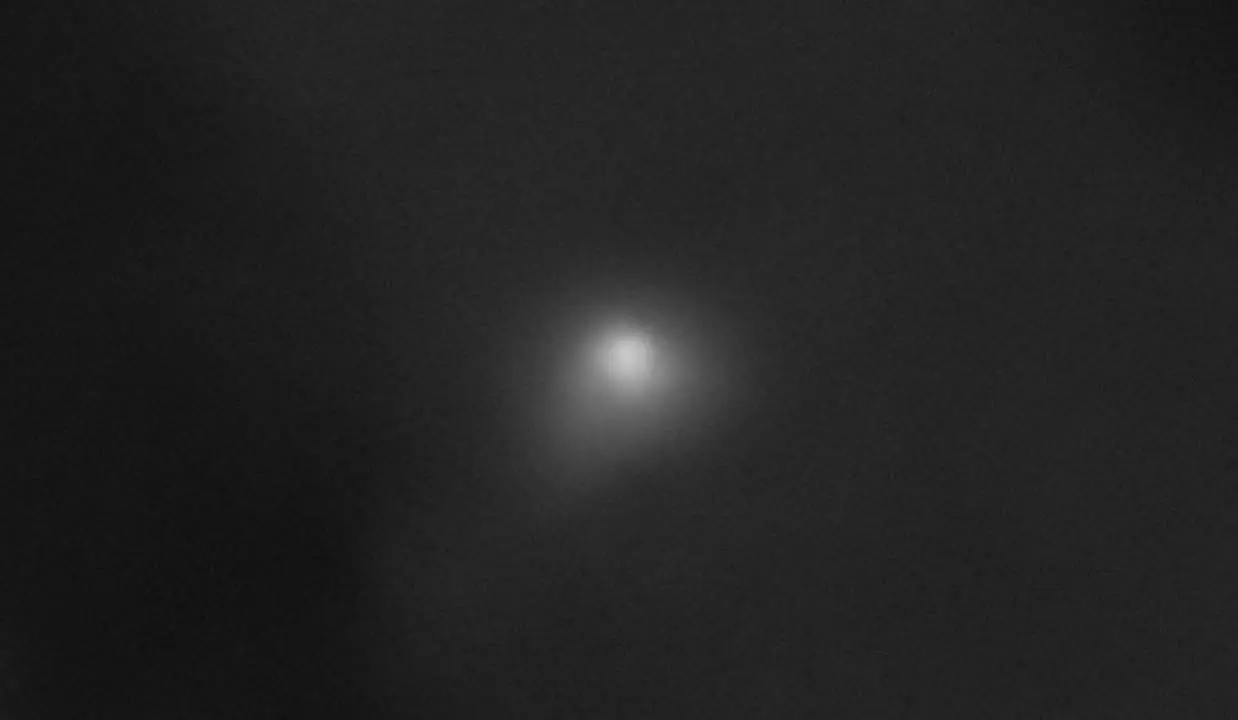
The celestial body 3I/Atlas dominated astronomical discussions throughout 2025 because it carries chemical elements formed long before the birth of the Sun. Photographic records taken by the Hubble telescope on July 21, when the target was 446 million kilometers from our planet — a distance equivalent to three times the distance between the Earth and the Sun — triggered intense debates in the scientific community.
During the approach, several unfounded hypotheses emerged on the internet, including apocalyptic scenarios of global impact and even speculation about extraterrestrial technology aimed at our globe.
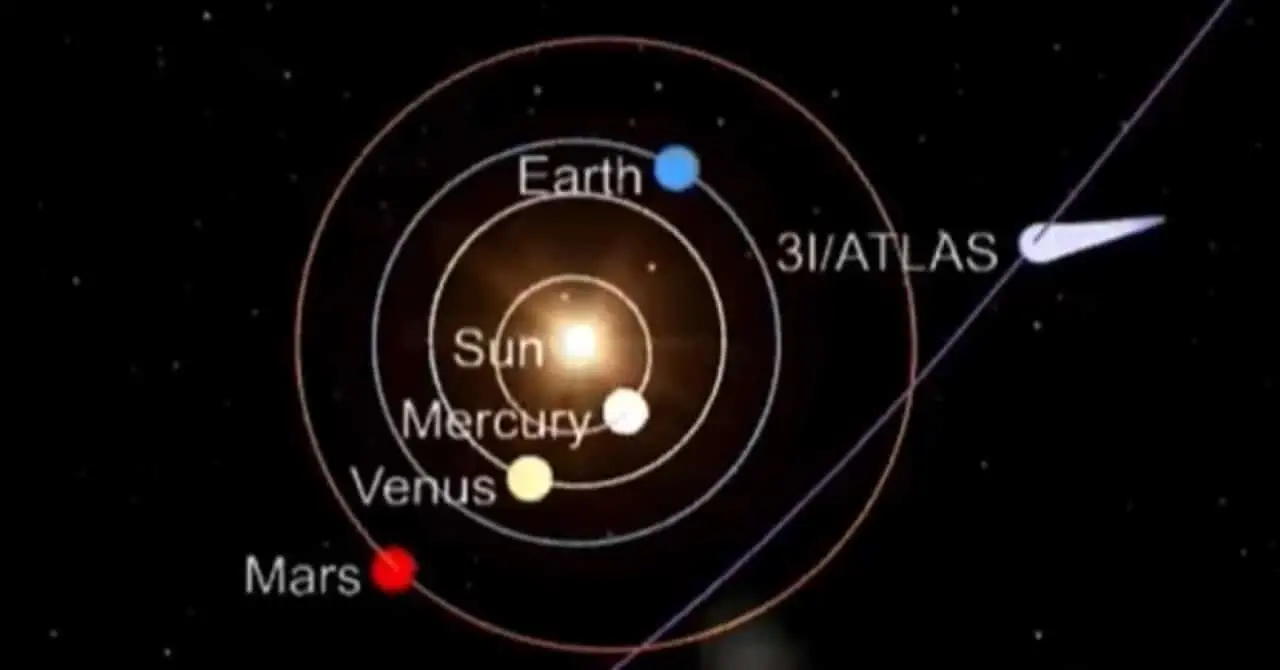
The point of closest proximity to the Earth’s orbit occurred exactly on December 19, 2025, marking a distance considered short only by the measurement standards of the universe.
Such strategic positioning ensured that the world’s main observation centers captured detailed information on its physical structure. The reports generated from this monitoring delivered fundamental answers about the dynamics of distant galaxies, breaking the limitations that scientists face when only monitoring rocks born in our own neighborhood.
Understand how scientists mapped the chemical structure and birthplace of 3I/Atlas
Specialist at the National Observatory, astronomer Jorge Marcio Carvano details that these space rocks are born from the agglomeration of frozen particles and debris on the coldest edges of planetary formations.
The big difference between this specific visitor lies in its place of origin, since the overwhelming majority of celestial bodies cataloged by science to date emerged within the gravitational boundaries of the Sun.
More on this story: August 2026 astronomical calendar brings solar eclipse in Europe and lunar occultation in Brazil
Officially classified as the third interstellar body ever documented, the artifact traveled from deep space to cross our orbit. The initial identification resulted from a joint effort involving multiple laboratories and sky monitoring agencies.
Before him, ground-based radars had only confirmed the passage of Oumuamua, in 2017, and Borisov, recorded by telescope lenses in 2019.
The arrival of this new wandering body gave researchers a rare chance to investigate how worlds are born in regions of the universe that operate under physical and chemical laws different from ours.
As Carvano points out, rocks composed of mineral fragments and frozen water function as perfect time capsules, preserving their original structure precisely because they spent millennia away from solar heat.
Thoroughly analyzing these ice blocks allows laboratories to reconstruct the first million years of our own system, providing direct clues about how Earth and its rocky neighbors took shape.
Several academic studies support the hypothesis that water from Earth’s oceans arrived here through successive impacts, indicating that meteor showers and comets functioned as water transport vehicles in ancient times.
Learn more: James Webb discovers rare chemical elements on interstellar comet 3I/ATLAS
The researcher also mentions the high concentration of organic molecules on the surface of these rocks, a factor that reinforces the thesis that the building blocks of terrestrial biology came from outer space.
In the specific case of 3I/Atlas, these biological and chemical assessments take on unprecedented weight, precisely because the collected material belongs to a foreign galaxy.
The expert emphasizes that the strange nature of the object expands the horizons of science, providing practical tools to decipher the evolution of stars and exoplanets located light years away.
Main technological barriers faced by astronomers when monitoring 3I/Atlas
The entire volume of information extracted from this historical passage required a continuous and prolonged effort from astrophysics teams around the globe.
The work routine included directing satellites to take very high-resolution photographs, rigorous mathematical calculations and long spectrometry decoding cycles in terrestrial laboratories.
The main milestone of this operation occurred on December 19, 2025. On that date, the celestial body reached its maximum point of approach, remaining 270 million kilometers from our soil, a mark that represents almost twice the space that separates us from the Sun.
See Also

Apple prepares changes in macOS 27 to fix visual glitches on Mac screens
Hubble Telescope identifies star of giant planet 19,000 light years from Earth

Scientists discover that Earth is home to up to 20 million species of insects
The observation window ensured that cutting-edge equipment, notably the Hubble Space Telescope, focused its lenses on the target to extract the visitor’s light signature and physical data.
The complexity of space work is evident in basic measurements, which require advanced algorithms to compensate for the visual distortion caused by the immensity of the vacuum.
Defining the volume of the rock illustrates this technical challenge well. In the first reports, NASA worked with a huge margin of error, estimating that the object measured from 300 meters to 5.6 kilometers from end to end.
After refining the data, Professor Carvano confirmed that the updated simulations drastically reduced the body’s proportions, fixing its actual diameter in the range of 600 to 800 meters.
On the same topic: Partial lunar eclipse darkens 93% of the satellite and receives NASA broadcast
The difficulty in nailing the exact size occurred because the rock traveled surrounded by a dense fog of particles and vapors, generated by the increase in ambient temperature.
Frozen bodies undergo a physical process of instantaneous sublimation when they receive the thermal impact of a star, converting their ice reserves directly into a gaseous state without going through the liquid phase.
During this violent evaporation, the rock structure ejects tons of crushed minerals that have been trapped in the core for billions of years.
The visual result of this chemical reaction is the famous luminous tail that streaks across the sky. In the 3I/Atlas episode, exactly this trail of debris generated heated debates outside academic circles.
How the 3I/Atlas tail anomaly generated unfounded theories about extraterrestrial technology
During specific stretches of its route, the visitor presented material ejection dynamics completely outside the standards documented by classical astronomy.
The researcher explains that the force of solar winds and radiation pressure always push the trail of debris away from the system’s central star.
Contrary to the basic rule, the interstellar body fired jets of matter directly towards the Sun, creating a rare visual effect that experts called “reverse tail”.
More on this story: Double phenomenon of Blue Moon and Micromoon occurs in May 2026 with visibility of the star Antares
The atypical behavior served as fuel for internet forums, where users began to argue that the rock was, in fact, a camouflaged space vehicle using directional thrusters.
The international scientific community acted quickly to deny the rumors, presenting mathematical proof that the phenomenon was the result of natural reactions.
In an official statement made in November 2025, NASA representative, Amit Kshatriya, had to publicly intervene to treat the matter as pure digital disinformation.
The space agency executive stated that the target has all the physical and chemical characteristics of a frozen rock, highlighting that the totality of data collected confirms its purely geological nature.
Supporting the American agency’s statement, Carvano points out that visual anomalies are expected when analyzing a fragment shaped in a totally unknown stellar environment.
The Brazilian scientist recalls that the optical illusion of the inverted trail itself has already been documented previously in celestial bodies that were born and orbit within our cosmic neighborhood.
The national laboratory team was already working with the certainty that the visitor’s chemical signature would clash with the local rocks, justifying