
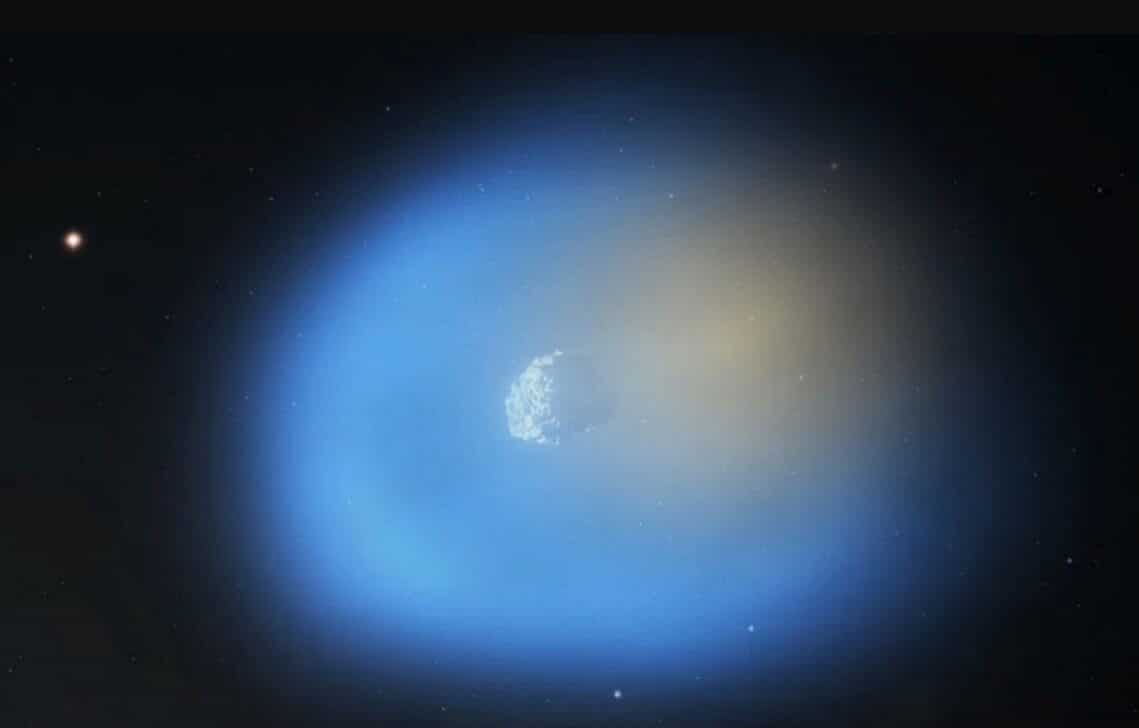
Interstellar wanderer 3I/ATLAS has reached a distance of 1.77 billion kilometers from Earth as it speeds outward into deep space at 209,000 kilometers per hour. Newly released astrochemical evaluations announced on Wednesday (23) indicate that this primordial traveler crystallized under extreme deep-freeze environments below -240 °C, equivalent to roughly 30 Kelvin, along the outer boundaries of a primitive star system.
The latest conclusions rely on spectroscopic readings collected at the Roque de los Muchachos Observatory on La Palma, located in the Canary Islands, along with computational models tracing stellar chemical evolution. “This object gives us a rare chance to study material that formed somewhere completely different to our own Solar System. Finding that it’s so rich in nitrogen tells us it likely formed in extremely cold conditions, far from its home star,” stated lead investigator Léa Ferellec of Northumbria University.
Spectrograph on the William Herschel Telescope detects five distinct ions in plasma tail
Departing from traditional observations centered on the neutral gas shroud surrounding the nucleus, measurements gathered with the 4.2-meter William Herschel Telescope focused directly on the plasma tail that developed after the perihelion passage. Utilizing the advanced WEAVE spectrograph in its Large Integral Field Unit mode, the research team identified five separate ionic species in the stream at the same time: molecular nitrogen, carbon monoxide, carbon dioxide, ionized water, and methylidyne cations, classified respectively as N2+, CO+, CO2+, H2O+, and CH+.

The pronounced presence of molecular nitrogen relative to carbon monoxide served as the definitive benchmark to calculate the thermal threshold of the nursery where the comet formed. Astronomer Cyrielle Opitom of the University of Edinburgh collaborated on the observational campaign tracking the post-perihelion gas discharges, providing essential data confirming that these volatile compounds had remained locked in pristine ice since the object first condensed.
Learn more: Interstellar comet 3I/ATLAS travels at 66 km/s near Jupiter
Isotope ratios point to an origin around a star with half of solar metallicity
A companion investigation released on Monday (21) by researcher Kenji Furuya at the RIKEN Pioneering Research Institute in Japan examined the elemental makeup of water locked within the interstellar traveler. Analytical modeling revealed marked anomalies in the deuterium-to-hydrogen balance as well as atypical carbon-12 to carbon-13 ratios, metrics that operate as chemical chronometers recording the interstellar cloud environment where the ice conglomerated.
Those distinct isotopic proportions verify that the celestial body was cast out from an ancient stellar nursery whose parent star exhibited a metallicity index roughly 50% that of the Sun. This composition demonstrates that the original host system possessed half the abundance of elements heavier than helium compared to solar values, signifying that the comet originated around an archaic star or in the distant, metal-poor outskirts of the galactic disk.
See also: Astronomers track 3I/ATLAS trajectory on September, 2026
Only three interstellar bodies have entered the Solar System since modern surveys began
Comet 3I/ATLAS represents just the third confirmed entry of an unbound extrasolar body through the Solar System since systematic tracking capabilities became operational. Astronomers documented the first such interstellar trespasser in 2017 with the discovery of the elongated asteroid 1I/’Oumuamua, followed two years later by the detection of interstellar comet 2I/Borisov in 2019. A comprehensive network of orbital observatories coordinated to monitor 3I/ATLAS during its passage, featuring targeted observations from the James Webb Space Telescope, the Hubble Space Telescope, the European Southern Observatory’s Very Large Telescope in Chile, and interplanetary instruments aboard the Juice and Europa Clipper spacecraft.
Timeline of milestone observations documents journey from discovery to chemical mapping
- July 1, 2025: Discovery of the incoming interstellar object by the ATLAS survey station based in Rio Hurtado, Chile.
- October 29, 2025: Perihelion passage marking the closest point of approach to the Sun, recorded at 11:45 UT.
- November 30, 2025: Commencement of detailed optical spectroscopy utilizing the WEAVE instrument in the Canary Islands.
- September 8, 2026: Formal presentation of the molecular nitrogen ion measurements during sessions at the Royal Astronomical Society.
- September 21, 2026: Publication of comprehensive deuterium modeling and host star metallicity calculations led by the RIKEN research group.
The exact identity and stellar coordinates of the native system from which the comet was ejected into interstellar space remain unidentified by astronomers worldwide. As 3I/ATLAS continues along an irreversible hyperbolic escape trajectory away from planetary orbits, scientific teams across multiple continents are continuing to calibrate and analyze the vast archives of data acquired during its fleeting passage.