
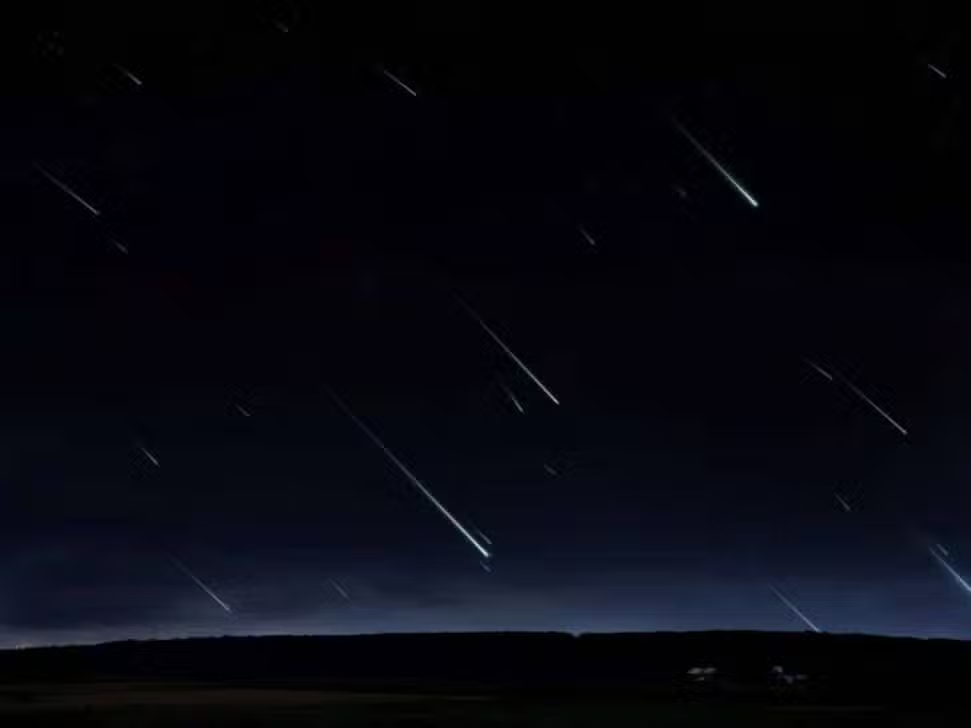
NASA Jet Propulsion Laboratory astronomers released the October 2026 night sky guide, presenting prime observation windows for the planet Saturn alongside the annual Orionid meteor shower. The overview highlights optimal planetary alignments and celestial passes visible across the globe without specialized optical gear.
Raquel Villanueva, host and producer of the skywatching program at the Pasadena facility in California, outlined the month with direct observation priorities. “Saturn takes center stage, a meteor shower lights up the sky, and the Moon visits the Seven Sisters. That’s What’s Up for October,” declared Villanueva in the official presentation from the space agency.
Learn more: Planetary Kelvin wave advances toward California and threatens winter sea level rise
Saturn reaches peak brightness after orbital opposition
Saturn entered opposition when Earth moved directly between the ringed planet and the Sun on Sunday, October 4, 2026, marking the closest point between both worlds during their orbital cycles. Because the planet sits on the opposite side of the sky from the Sun, it rises around sunset and remains observable for most of the night across October, maintaining its highest brightness and largest apparent size of the year.
Planetary opposition provides researchers and amateur observers an optimal angle to track dynamic changes across the outer solar system. When Earth aligns directly between an exterior planet and the Sun, the geometry eliminates harsh solar glare from terrestrial viewing angles, allowing standard binoculars and consumer telescopes to resolve Saturnian ring features and broad atmospheric bands throughout extended evening tracking sessions.
Hubble telescope identifies 10-sided wave on Saturn
Recent observations conducted with the Hubble Space Telescope revealed a 10-sided atmospheric wave structure circulating around the south pole of Saturn, a pattern that scientists report is actively intensifying. This discovery expands research on the complex weather mechanics of the gas giant, providing an unusual view of a massive southern atmospheric formation as it develops in real time.
The southern structure offers a fresh dynamic counterpart to the long-studied hexagonal jet stream anchored at the northern pole of the planet. That northern jet stream spans approximately 20,000 miles, equivalent to about 32,000 kilometers, and has retained its six-sided geometry across decades of spacecraft monitoring. Planetary scientists are analyzing incoming Hubble imaging data to measure how the newly identified southern wave interacts with broader seasonal wind shifts across Saturnian cloud layers.
Orionid meteor shower peaks with debris from Halley comet
The annual Orionid meteor shower approaches its peak activity during the night of October 21, 2026, continuing through the early hours of October 22, 2026. The streaks visible across terrestrial skies originate from dense streams of rock and ice particles shed by Comet Halley during its recurring orbits around the Sun. Halley generates two reliable meteor showers each year on Earth, producing the Eta Aquariids in May and the Orionids in October.
Observing conditions during the peak night present specific hurdles due to natural lunar illumination across the sky. A bright waxing gibbous Moon will wash out fainter streaks through the first half of the night, prompting NASA specialists to recommend watching during the final hours before dawn on October 22, 2026, immediately following moonset. Observers do not need binoculars or telescopes to catch individual meteors, which emerge from the direction of the constellation Orion but can flash across any quadrant of dark sky.
Moon sweeps past Jupiter and the Pleiades cluster
The lunar calendar drives several notable conjunctions throughout October, starting before dawn on Tuesday, October 6, 2026, when a slender crescent Moon appears positioned close to the bright disk of Jupiter. That morning alignment offers a clear reference point in the eastern sky prior to sunrise for ground observers monitoring planetary motion.
A second major lunar passage occurs toward the end of the month, as the Moon moves into the immediate vicinity of the Pleiades open star cluster, traditionally referred to as the Seven Sisters. The pairing becomes visible in the eastern sky during the evening of October 27, 2026, and continues through October 28, 2026. Under typical viewing conditions away from intense artificial lighting, the Pleiades cluster appears to the naked eye as a compact, slightly hazy grouping of 6 to 7 individual stars.
Key dates for the October 2026 astronomical calendar
- Sunday, October 4, 2026: Saturn reached opposition, entering its most favorable viewing position of the year.
- Tuesday, October 6, 2026: Thin crescent Moon passes in visual proximity to Jupiter before sunrise.
- Wednesday, October 21, 2026: Opening of the primary viewing window for the Orionid meteor shower peak.
- Thursday, October 22, 2026: Pre-dawn hours after moonset provide the optimal window to observe Orionid meteors.
- Tuesday, October 27, 2026: The Moon begins its close visual alignment with the Pleiades star cluster in the east.
- Wednesday, October 28, 2026: The Moon continues its passage across the field of the Pleiades cluster through the night.
Astronomers at the Jet Propulsion Laboratory continue to track orbital data and atmospheric measurements across the solar system, with subsequent skywatching schedules expected prior to November alignments.