
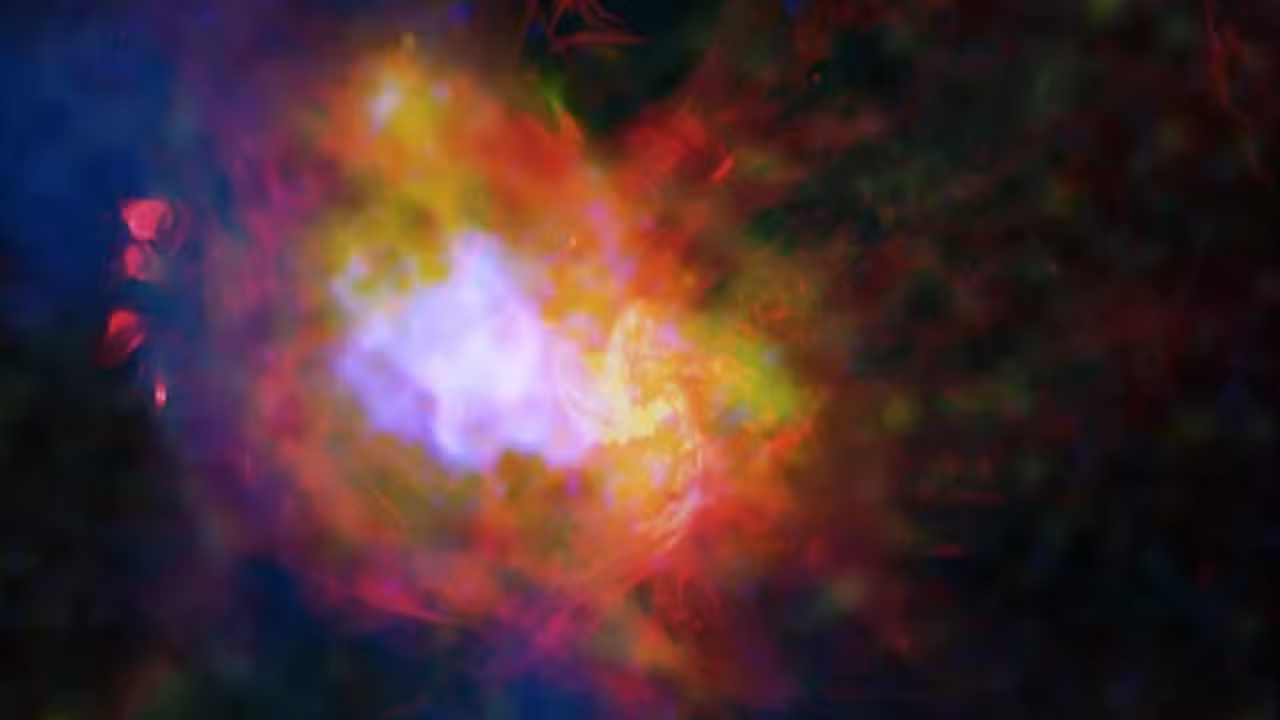
The Chandra X-ray Observatory isolated the Sagittarius A East supernova remnant from background cosmic signals near the supermassive black hole at the center of the Milky Way. Researchers confirmed the clean separation of the high-energy emission in a multiwavelength composite released in Cambridge, Massachusetts, on Wednesday, September 30, 2026. The new observation details the chemical elements and structural reach of the stellar debris without contamination from neighboring galactic features.
Led by astrophysicist Mayura Balakrishnan of the Trottier Space Institute at McGill University, the research team disentangled the crowded region using an advanced data algorithm. Balakrishnan and her coauthors stated that the supernova remnant “has expanded into, compressed, and shock heated the surrounding molecular material, likely carving cavities that shape the three-dimensional structure of the region” in a study accepted by The Astrophysical Journal.
See also: Astronomers find 84 mysterious cosmic objects using Chandra
Chandra algorithm isolates Sagittarius A East radiation
To untangle the overlapping signals from the galactic center, the researchers applied the Poissonian Generalized Morphological Component Analysis algorithm to decades of satellite data. The processing method separated three primary components of X-ray light: the diffuse glow of the supernova remnant itself, colliding winds driven by clusters of massive hot stars orbiting the central black hole Sagittarius A*, and a blended background glow produced by binary star systems. This computational breakdown allowed astronomers to build uncontaminated spatial distribution maps for specific chemical elements synthesized in the ancient stellar blast, revealing heavy concentrations of iron in the core alongside sulfur, argon, and calcium.
The visual release produced by Chandra X-ray Center and Smithsonian Astrophysical Observatory specialists P. Edmonds and N. Wolk combines multiple telescope surveys across different regimes of the electromagnetic spectrum. Low-energy Chandra X-rays appear in green while high-energy X-rays appear in blue, producing a purple shade where they overlap near the interior of the remnant. Radio observations from the NSF Very Large Array supply the red structures, while submillimeter data gathered by the James Clerk Maxwell Telescope appear in dark blue across an angular field spanning 7 arcminutes, which represents an actual physical distance of 53 light-years across space.
Sagittarius A East data and technical observations
- Target object: Sagittarius A East, a mixed-morphology supernova remnant
- Central landmark: Sagittarius A*, a supermassive black hole with 4 million solar masses
- Estimated age of explosion: 10,000 years
- Chandra ACIS datasets analyzed: 35 separate observation packages
- Timeframe of Chandra exposures: September 1999 to August 2020
- Accumulated science exposure time: 422 hours and 51 minutes, equal to 1.5 megaseconds
- Observational scale: 7 arcminutes, corresponding to 53 light-years across the galactic core
Check out: Chandra observatory spots 84 mysterious cosmic sources
Scientific record of Sagittarius A East since 1999
Sagittarius A East represents a rare class known to astronomers as mixed-morphology supernova remnants. These cosmic structures feature a central core filled with thermal X-ray emission enclosed by an outer shell that shines brightly in radio wavelengths. The remnant sits immediately adjacent to Sagittarius A*, the central black hole containing 4 million solar masses, creating a dense gravitational environment where exploding stellar matter interacts directly with nearby molecular gas clouds over millennia.
The underlying data relied on 35 distinct observation sequences collected by the Advanced CCD Imaging Spectrometer aboard the Chandra spacecraft between September 1999 and August 2020. Chandra was deployed by NASA in 1999 and has operated in orbit for more than 27 years, accumulating critical archives of energetic events across the universe. The analytical paper detailing the isolation process, titled Isolating Sgr A East: The First Uncontaminated X-ray Maps of a Galactic Center Supernova Remnant, was initially submitted to the arXiv preprint server on Wednesday, April 8, 2026, before its formal public presentation by NASA and the Chandra X-ray Center.
Chandra telescope timeline and pending federal budget steps
The longevity of Chandra operations beyond the current decade remains linked to ongoing federal budget negotiations in the United States. White House budget proposals previously introduced spending reductions that posed risks to the mission heading into the 2030s. The scientific announcement did not confirm whether a legislative vote on September 1, 2026, which maintained steady funding into fiscal year 2027, will translate into a permanent operating budget.
Follow: Evidence of lost wind is detected in Sagittarius A*, the Milky Way’s black hole
The temporary federal funding measure sustaining current NASA operations expires on Friday, December 11, 2026, when the United States Congress must pass an extension or approve an annual appropriations bill to determine the long-term operational schedule of the orbiting observatory.