
United States military patrols operating across strategic Middle Eastern waterways have intercepted and redirected 133 commercial cargo ships bound for Iranian ports through Friday, October 9, 2026. The operational milestone was confirmed by United States Central Command, which documented the interdiction mission by releasing official records of flight deck aviation operations aboard an active guided-missile destroyer deployed to regional waters.
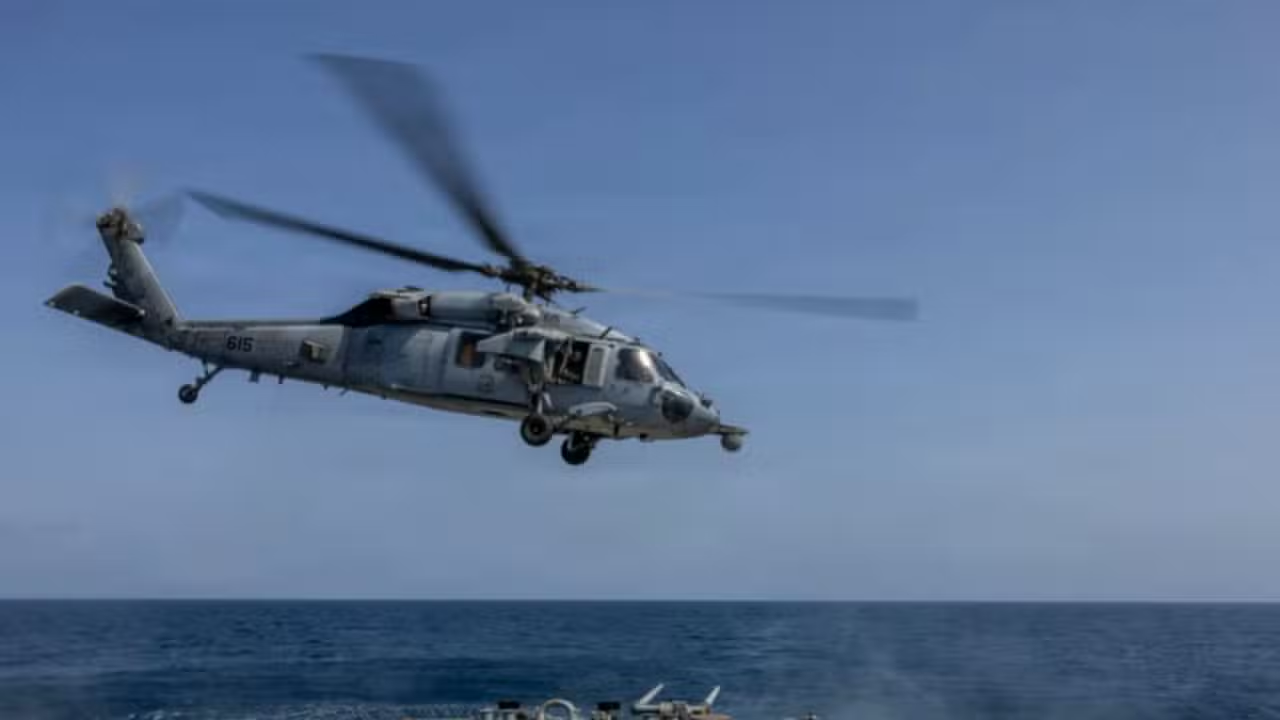
The released material captured an MH-60S Sea Hawk multi-mission helicopter lifting off from the flight deck of the USS John Paul Jones (DDG 53). Built as an Arleigh Burke-class guided-missile destroyer, the warship operates under the command structure of the United States 5th Fleet, whose primary operational purview encompasses strategic maritime chokepoints across the Strait of Hormuz, the Persian Gulf, and the Gulf of Oman.
Central Command released the mission briefing at 15:00 UTC (11:00 EDT). The official military release emphasized that the warship directly supports the execution of what the Pentagon described as America’s steadfast blockade against Iran, confirming that naval units had turned away 133 commercial vessels to ensure compliance with the trade restrictions.
A U.S. Navy MH-60S Sea Hawk takes off from the flight deck of USS John Paul Jones (DDG 53) as the guided-missile destroyer supports enforcement of America’s ironclad blockade against Iran. As of Oct. 9, U.S. forces have redirected 133 commercial vessels to ensure compliance.— U.S. Central Command (@CENTCOM) October 9, 2026
CENTCOM commander Admiral Brad Cooper stressed that American naval assets maintain continuous surveillance and rapid-strike capability over the maritime approaches. Cooper declared that armed forces remain laser-focused on the mission, adding that units will move swiftly against any ship attempting to breach the perimeter because service members are thoroughly trained, professional, and lethal.
Read also: US president issues stark warning on Iran at global assembly, sparking diplomatic concern
Naval enforcement actions result in 13 destroyed vessels and ship disablements
The revised tally of 133 diverted freighters updates an operational assessment published by Central Command at the beginning of the week. Figures released on Monday, October 5, 2026, had documented 130 merchant vessels instructed to alter course rather than enter designated Iranian port facilities.
Patrol ships have repeatedly employed lethal force to enforce navigation restrictions over the past three months. Across 12 weeks of continuous maritime operations in the Middle East, United States forces destroyed 13 commercial vessels for violating established blockade parameters or demonstrating direct logistical links to the Islamic Revolutionary Guard Corps. Three additional vessels were incapacitated after their crews disregarded official bridge-to-bridge orders to halt for boarding teams.
The sweeping security clampdown along the Strait of Hormuz has generated a sharp contraction in overall merchant traffic through the narrow transit corridor. Commercial shipping companies have curtailed departures, while maritime security alerts continue to report sporadic missile and drone strikes against oil tankers traversing the waterways between the Persian Gulf and the Gulf of Oman.
Tehran issues retaliatory warnings after presidential trade restrictions
The maritime quarantine was formally reinstituted on July 14, 2026, following executive directives issued by United States President Donald Trump. The White House ordered the naval operation to halt maritime commerce and dismantle sea export routes that sustain the Iranian economy.
Keep reading: Iran downplays US talks via Qatar as Gulf ship is hit and Gaza official killed
In Tehran, the Navy of the Islamic Revolutionary Guard Corps countered with retaliatory threats on Friday, October 9, in response to American warship operations. Iranian military commanders announced plans to impose punitive sanctions and execute retaliatory boardings against international maritime companies that follow American navigation directives, following high-level security consultations involving Mohammadreza Naqdi, an advisor to the Revolutionary Guard command.
United States Central Command did not disclose the exact maritime coordinates or the specific calendar date on which the photograph aboard the USS John Paul Jones was recorded. The guided-missile destroyer remains on active patrol alongside carrier strike elements assigned to protect vital shipping lanes throughout the region.