
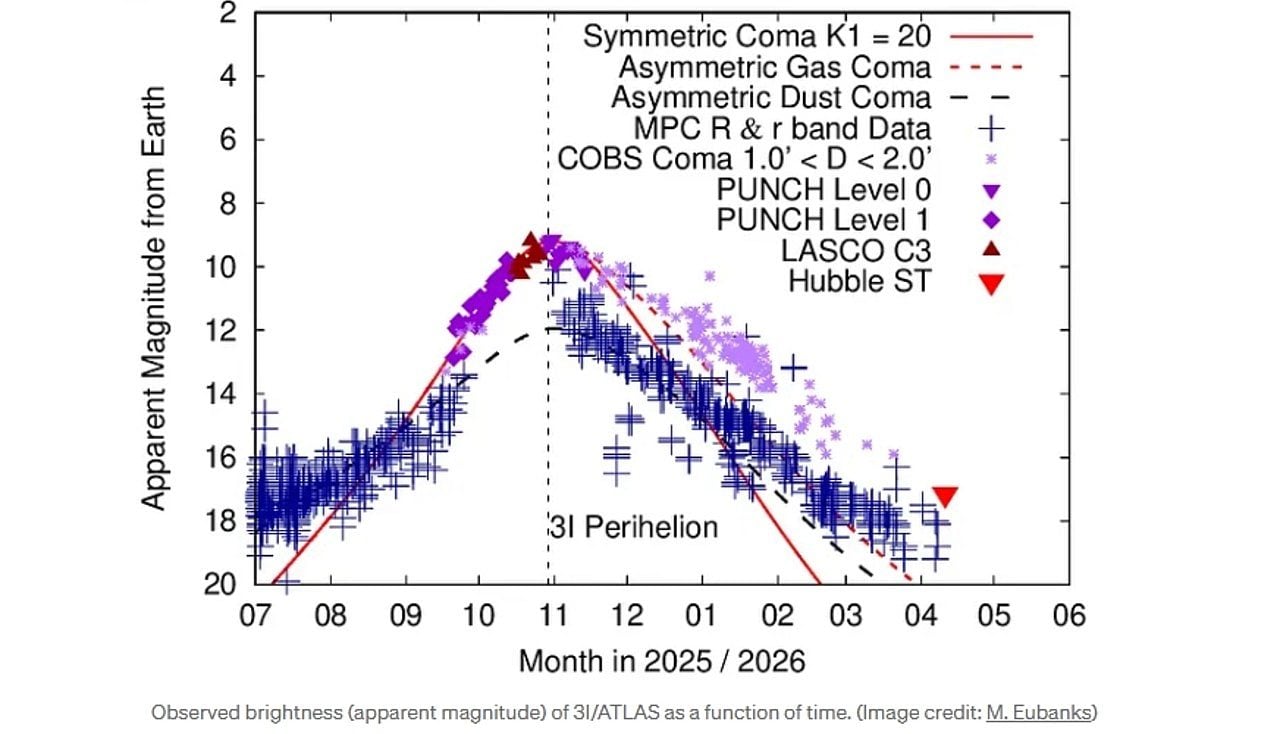
Astronomers worldwide are closely tracking an interstellar object passing through the solar system following unexpected radio frequency detections. The visitor, designated as comet 3I/ATLAS, prompted the NASA Planetary Defense Coordination Office to heighten surveillance protocols across a global array of ground and space observatories.
Discovered by the Asteroid Terrestrial-impact Last Alert System, the body represents the third confirmed interstellar visitor to enter local space. Its hyperbolic trajectory demonstrates that the object remains unbound to the Sun, confirming its origin from another stellar system.

Researchers are focusing on physical properties that distinguish 3I/ATLAS from previously identified interstellar bodies, such as 1I/’Oumuamua and 2I/Borisov. Initial analyses indicate chemical structures that provide new data regarding planetary formation processes around distant stars.
MeerKAT telescope captures 1.6 GHz radio frequency data
Scientific attention intensified after the MeerKAT radio telescope array in South Africa detected clear radio signatures aligned with the comet. The signal appeared at a frequency of 1.6 GHz, displaying structural consistency distinct from typical cometary emissions caused by solar wind interaction.
Astrophysicists are evaluating several physical mechanisms to explain the radio emissions. Researchers associate the signature with hydroxyl radical absorption lines produced as solar radiation breaks down water ice, while international survey projects including Breakthrough Listen also evaluated the frequencies.
Hyperbolic trajectory confirms origins outside the solar system
Astronomical survey instruments first logged 3I/ATLAS during automated sky scans conducted in 2025. Since that initial detection, global tracking stations calculated an orbital trajectory that brings the icy body inward from deep interstellar space.
Moving at speeds exceeding 100,000 kilometers per hour, the comet maintains sufficient momentum to escape solar gravity entirely. After traversing perihelion, the visitor will travel permanently outward into the interstellar medium.
The formal “3I” classification designates the body as only the third known interstellar object identified by modern astronomy. The event provides a rare opportunity to directly analyze primordial material forged in an alien stellar environment.
Observatories worldwide coordinate around-the-clock surveillance
NASA coordinated an extensive tracking campaign with partner agencies to record the passage across multiple spectral bands. Planetary defense teams implemented the monitoring protocol to analyze the object rather than address any threat of impact.
Major astronomical instruments, including the Very Large Telescope in Chile and the Hubble Space Telescope, were oriented toward 3I/ATLAS. These instruments gather high-precision photometric and spectroscopic measurements across visible, infrared, and ultraviolet wavelengths.
Researchers utilize the observational campaign to map the chemical makeup of the coma and calculate sublimation rates. The European Space Agency collaborates with NASA, providing additional tracking support from orbital and surface installations.
International coordination ensures continuous 24-hour observation, passing monitoring responsibilities between observatories as Earth rotates. Collected datasets are archived and distributed internationally to accelerate scientific review.
Spectroscopic data reveals distinct chemical composition and nucleus size
Early spectroscopic evaluations suggest that 3I/ATLAS features distinct compositional traits compared to prior interstellar visitors. While 2I/Borisov shared similarities with native comets and ‘Oumuamua resembled an elongated rock, 3I/ATLAS displays an intricate mixture of volatile gases and organic molecules.
Size estimates place the nucleus diameter between 320 meters and 5.6 kilometers, a range being refined as light curve analyses conclude. Studying this material offers astronomers a direct look into the chemical inventory present in other planetary nurseries across the Milky Way.
Orbital modeling confirms safe distance during solar system flyby
Flight path models established by NASA and partner agencies verify that comet 3I/ATLAS poses no collision hazard to Earth. The trajectory carried the object past our planet at a safe margin, remaining tens of millions of kilometers away throughout its closest approach.
At its nearest point, the comet remained distant enough to eliminate any risk while still allowing optical and radio sensors to record detailed images. The passage gave ground-based astronomers sufficient proximity to study structural details with high resolution.
Planetary defense teams test response systems during interstellar passage
The mobilization serves as an operational test for planetary defense protocols managed by space agencies. Tracking an atypical object traveling on an unbound path enables observation networks to test rapid response coordination, sensor calibration, and data sharing between international astronomical centers.





