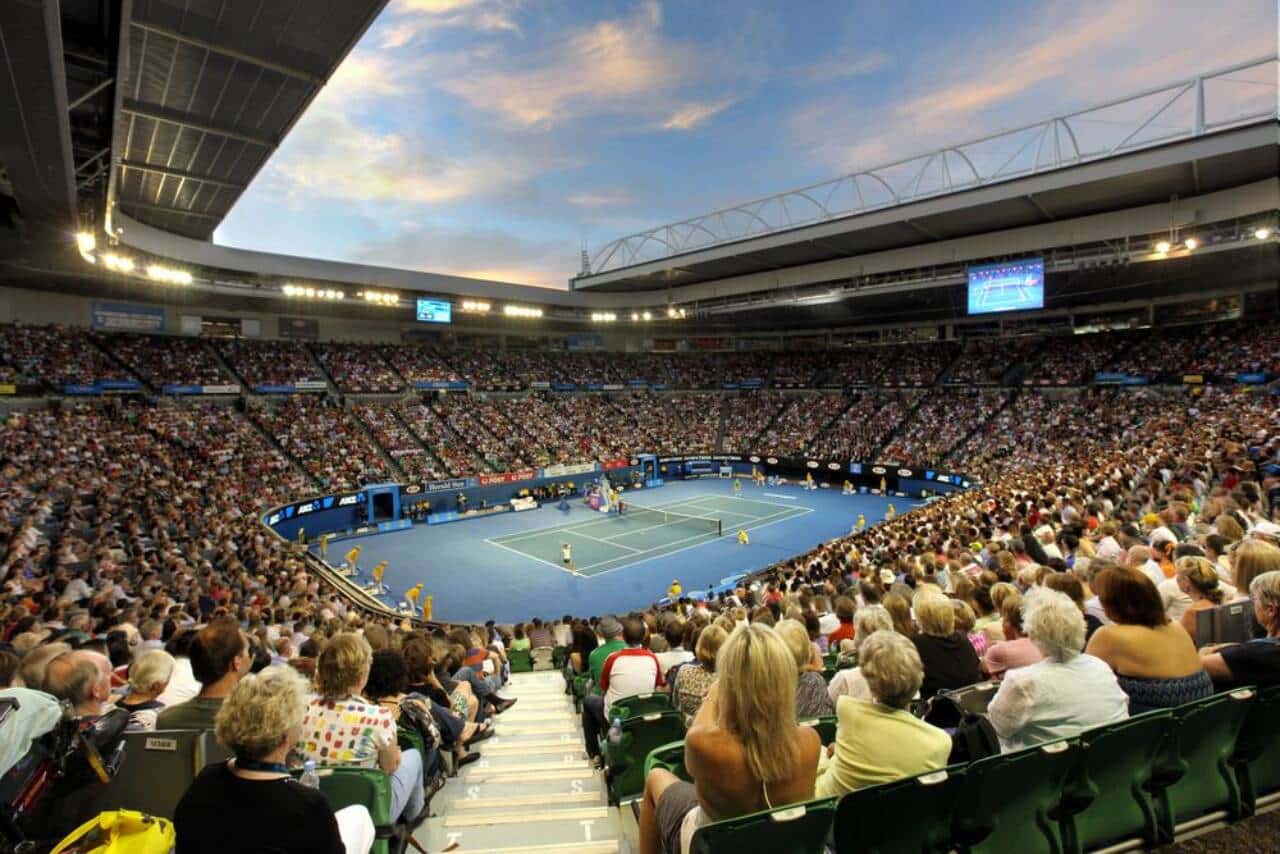
The 2025 Australian Open, the first Grand Slam of the season, brought a positive surprise for tennis players with a significant increase in total prize money. With a sum of 96.5 million Australian dollars, the tournament is distributing around 59.9 million US dollars (approximately R$ 361.4 million) among participating athletes. This increase represents an 11.56% rise compared to the previous edition, reflecting the organizers’ commitment to valuing competitors at all stages of the event.
The singles champions, both male and female, will receive an impressive amount of 2.1 million US dollars, approximately R$ 12.8 million. This figure clearly shows that the Australian Open aims to maintain its relevance on the global tennis stage. Additionally, just by participating in the first round, players are guaranteed 82.9 thousand dollars, equivalent to R$ 505 thousand, a substantial amount for many tennis players who rely on these prizes to fund their careers.
In addition to financial gains, the event also highlights the presence of Brazilian athletes in the main draws. João Fonseca and Bia Haddad Maia, Brazil’s representatives in the tournament, have already secured the initial prizes. This spotlight is essential for consolidating the Brazilian presence in the international circuit and inspiring new talents.
Oh, Melbourne ????#AusOpen • #AO2025 pic.twitter.com/q1LJHajFmh
— #AusOpen (@AustralianOpen) January 13, 2025
Prize distribution by stages and categories
The 2025 Australian Open follows a prize structure that rewards players from the qualifying stage to the final champions. Below is how the amounts are distributed by stages and categories:
- First round: 82.9 thousand dollars
- Second round: 125.6 thousand dollars
- Third round: 182.1 thousand dollars
- Round of 16: 263.8 thousand dollars
- Quarterfinals: 417.7 thousand dollars
- Semifinals: 691 thousand dollars
- Runner-up: 1.1 million dollars
- Champion: 2.1 million dollars
For doubles, the amounts are split between the two team members:
- First round: 25.1 thousand dollars
- Second round: 36.4 thousand dollars
- Round of 16: 51.5 thousand dollars
- Quarterfinals: 89.2 thousand dollars
- Semifinals: 157 thousand dollars
- Runners-up: 276.4 thousand dollars
- Champions: 508.8 thousand dollars
In mixed doubles, the prize is equally relevant to encourage competition in this category:
- First round: 4.5 thousand dollars
- Second round: 8.7 thousand dollars
- Quarterfinals: 17.4 thousand dollars
- Semifinals: 32.9 thousand dollars
- Runners-up: 61.4 thousand dollars
- Champions: 109.9 thousand dollars
Comparison with previous editions
The evolution of prize money at the Australian Open reflects the growing popularity and profitability of the tournament. In 2001, the total prize was about 13.8 million Australian dollars. This amount more than doubled by 2014, reaching 33 million Australian dollars. In 2024, the total distributed was 86.5 million Australian dollars, and now, in 2025, it has hit a record mark of 96.5 million Australian dollars.
This growth shows the organizers’ efforts to keep the tournament competitive and attractive to the world’s top athletes. By offering substantial prizes, the Australian Open ensures that the best tennis players continue to see the tournament as one of the most important on the calendar.
Impact on Brazilian players
The presence of Brazilian athletes in the main draws of the Australian Open is a significant milestone. João Fonseca, a young promise of Brazilian tennis, has already secured at least 82.9 thousand dollars for his participation in the first round. A win in the opening match can raise his prize to 125.6 thousand dollars, an important boost for his career.
Bia Haddad Maia, one of Brazil’s top female tennis players, also begins her journey in the tournament with a guaranteed prize of 82.9 thousand dollars. With a good campaign, she can achieve even higher prizes, consolidating her name among the world’s best players.
Comparison with other Grand Slams
Despite the significant increase in the Australian Open’s prize money, the tournament still presents lower amounts than other Grand Slams. The 2024 US Open, for instance, distributed a total of 75 million US dollars, with the singles champions receiving 3.6 million dollars each.
Wimbledon 2024 also offered a generous prize pool, distributing 50 million pounds sterling. The singles champions received 2.7 million pounds each, reinforcing the British tournament’s tradition as one of the most lucrative.
The 2024 French Open was no exception, with a total prize of 53.5 million euros. The singles champions took home 2.4 million euros, a very competitive amount.
Tournament curiosities
- The Australian Open is known as the “Happy Slam” due to the relaxed and welcoming atmosphere of the tournament.
- In 1988, the event switched to hard courts, increasing its competitiveness.
- Since 1972, the tournament has been held at Melbourne Park, one of the most modern venues on the circuit.
Relevant historical facts
- The first Australian Open was held in 1905.
- In 1969, the tournament became one of the four Grand Slams after the unification of amateur and professional tournaments.
- Rod Laver, one of the greatest tennis players of all time, won the Australian Open twice during the calendar Grand Slam.
Important data and statistics
- In 2024, the Australian Open had a global audience of over 900 million viewers.
- Approximately 812 thousand people attended the event in person last year.
- The 2025 edition features more than 500 players registered across different categories.
Event highlights
- The prize increase has attracted more players to the qualifying rounds.
- The inclusion of young talents in the main draws is a strategy by the organizers to renew the tournament’s audience.
- Advanced technologies, such as the Hawk-Eye Live system, ensure more precise decisions during matches.
Additional information about the tournament
- The Australian Open is the only Grand Slam held in the southern hemisphere’s summer, posing unique climatic challenges for players.
- The surface of the courts at Melbourne Park is hard, known for being fast and demanding for athletes.