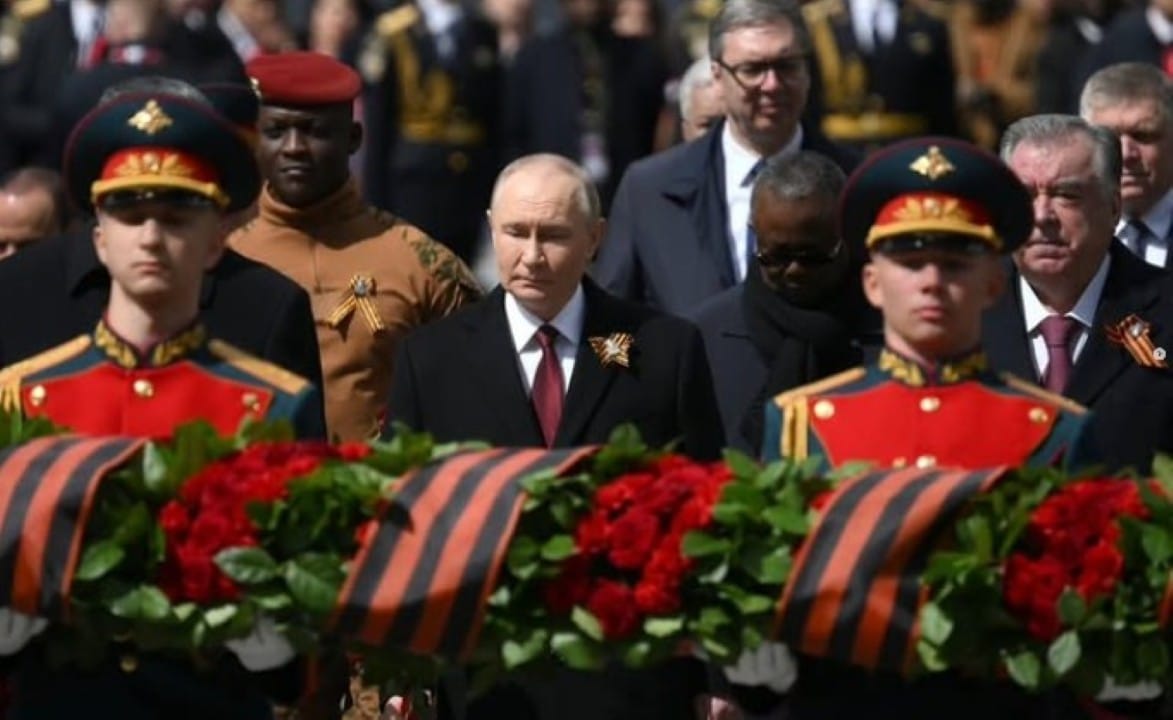
Moscow’s Red Square buzzed with anticipation as Russia prepared for its annual Victory Day parade, a spectacle marking the 80th anniversary of the Soviet Union’s triumph over Nazi Germany. The event, held on May 9, 2025, showcased military prowess and drew leaders from over 20 nations, including China’s Xi Jinping. Yet, the celebration unfolded against the backdrop of a contentious three-day ceasefire in Ukraine, unilaterally declared by President Vladimir Putin, which Kyiv dismissed as a publicity stunt. Ukraine’s accusations of Russian violations underscored the ongoing war’s shadow over the festivities.
The parade, a cornerstone of Russian national pride, featured thousands of troops, advanced weaponry, and a carefully curated guest list. Putin used the platform to reinforce narratives tying Russia’s current military actions to its historical victory over fascism. Ukraine, observing its own Victory Day on May 8, condemned the event as a “parade of cynicism,” highlighting stark divisions. This year’s commemoration, one of the largest in recent history, aimed to project Russia’s global influence despite Western isolation efforts.
Here’s what defined the 2025 Victory Day celebrations:
- Over 9,000 Russian servicemen marched, including units involved in Ukraine operations.
- Advanced military hardware, including T-90M tanks and Yars missiles, rolled through Red Square.
- Foreign leaders from China, Brazil, and Slovakia attended, signaling diplomatic support.
- Ukraine reported over 700 ceasefire violations within hours, escalating tensions.
The event’s scale and guest list underscored Putin’s intent to counter narratives of Russia’s global isolation. As drones buzzed and jets roared, the world watched a nation balancing historical reverence with modern warfare.
Foreign leaders gather in Moscow
The presence of high-profile figures like Xi Jinping and Brazil’s Luiz Inácio Lula da Silva elevated the parade’s geopolitical weight. Over 29 heads of state, including leaders from Vietnam, Egypt, and Serbia, joined Putin in Moscow. Their attendance, announced by Kremlin aide Yuri Ushakov, was framed as evidence of Russia’s enduring global authority. The Kremlin orchestrated a welcoming ceremony, with Putin toasting to “victory” at a state dinner, blending historical commemoration with contemporary alliances.
Security measures in Moscow were stringent. Authorities banned items like vape pens and scooters from the parade, citing risks of Ukrainian drone attacks. Mobile internet was jammed to protect visiting dignitaries, a precaution prompted by recent Ukrainian strikes on Russian airspace. Kremlin spokesperson Dmitry Peskov acknowledged the disruptions, urging Muscovites to tolerate restrictions until May 10. These measures reflected the delicate balance of hosting a global event amid an active conflict.
Ukraine’s Foreign Ministry issued a sharp rebuke, urging nations to bar their military personnel from marching alongside Russian troops. The ministry argued that such participation equated to endorsing Russia’s actions in Ukraine, a sentiment echoed by Kyiv’s leadership. The parade, featuring servicemen from 13 countries, including China and Vietnam, proceeded undeterred, showcasing Putin’s ability to rally allies.
Ceasefire disputes dominate headlines
Putin’s announcement of a three-day ceasefire, spanning May 8 to 10, aimed to project a humanitarian gesture tied to Victory Day. The Kremlin urged Ukraine to reciprocate, warning of “adequate and effective” responses to violations. However, Kyiv reported hundreds of Russian strikes within hours of the truce’s start, including guided bombs in Sumy that killed civilians. A 55-year-old woman and her son were among the casualties, deepening Ukraine’s distrust.
Ukrainian President Volodymyr Zelenskyy dismissed the ceasefire as a “theatrical performance” designed to shield Putin’s parade rather than advance peace. He reiterated Kyiv’s push for a 30-day truce, a proposal backed by the United States but rejected by Russia. Zelenskyy’s remarks, delivered during Ukraine’s May 8 Victory Day observance, framed Russia’s actions as propaganda. Foreign Minister Andrii Sybiha echoed this, questioning why Russia wouldn’t agree to an immediate, longer ceasefire if peace was the goal.
The ceasefire’s failure to halt violence highlighted the war’s intractability. Ukraine’s air force reported Russian drone attacks across multiple regions, while Moscow accused Kyiv of breaching the truce. The mutual accusations underscored the absence of trust, with both sides leveraging the ceasefire narrative for diplomatic and public relations gains.
Military might on display
The Red Square parade was a meticulously choreographed display of Russia’s military strength. Approximately 9,000 servicemen marched, joined by a column of troops who had fought in Ukraine. The procession featured Soviet-era T-34 tanks alongside modern T-90M models and Yars intercontinental ballistic missiles. A flyover by Su-30SM and MiG-29 jets painted the sky with Russia’s flag colors, a symbolic nod to national pride.
- T-90M tanks: Advanced armor and fire-control systems, deployed in Ukraine.
- Yars missiles: Nuclear-capable, with a range exceeding 11,000 kilometers.
- Su-25 jets: Ground-attack aircraft, used extensively in conflict zones.
- S-400 systems: Air defense units, critical for Moscow’s security.
The parade’s scale contrasted with recent years, when security concerns or battlefield setbacks prompted more subdued events. In 2023, only one T-34 tank appeared, and flyovers were canceled. The 2025 event, with its robust display, signaled Russia’s confidence amid territorial gains in eastern Ukraine, particularly in Donbas.
Foreign military contingents from former Soviet republics, China, and Egypt added an international dimension. Their participation, however, drew criticism from Ukraine, which viewed it as tacit support for Russia’s aggression. The parade’s grandeur aimed to overshadow these tensions, reinforcing Putin’s narrative of Russia as a resilient global power.
Ukraine’s counter-narrative
While Moscow celebrated, Ukraine marked its Victory Day on May 8, a date aligned with European commemorations. The shift from May 9, adopted after Russia’s 2022 invasion, symbolized Kyiv’s rejection of Soviet-era traditions. Zelenskyy’s speech condemned Russia’s parade as a distortion of World War II’s legacy, accusing Putin of exploiting history to justify aggression. He drew parallels between Nazi Germany’s defeat and Ukraine’s resistance, framing Russia as the modern aggressor.
Kyiv’s observances were somber, focusing on memory and respect rather than celebration. Citizens laid flowers at monuments like the Tomb of the Unknown Soldier, reflecting on the war’s toll. Ukraine’s contributions to the Soviet victory—millions of soldiers and civilians lost—were central to the narrative, contrasting with Russia’s militarized festivities.
- May 8: Ukraine’s Victory Day, emphasizing European alignment.
- Monuments visited: Tomb of the Unknown Soldier, Motherland Monument.
- Zelenskyy’s focus: Honoring WWII sacrifices while condemning Russia.
Recent Ukrainian drone attacks on Russian targets, including Moscow’s airspace, disrupted Victory Day preparations. The Security Service of Ukraine claimed strikes on arms factories in Krasnoarmeysk and Tula, showcasing Kyiv’s ability to project power. These actions, Zelenskyy noted, ensured Russia’s skies were “not calm,” mirroring Ukraine’s own wartime reality.
Global reactions to the parade
The international community closely monitored Moscow’s Victory Day. The attendance of leaders like Xi Jinping and Slovakia’s Robert Fico, the only EU head of state present, signaled selective support for Russia. China’s state media reported over 20 bilateral agreements signed during Xi’s visit, covering issues from biosecurity to global stability. These deals underscored the deepening Russia-China partnership, a counterweight to Western sanctions.
The United States, under President Donald Trump, expressed frustration with the stalled peace process. Vice President JD Vance, speaking at a Munich Security Conference event, criticized Russia’s demands in negotiations, rejecting the three-day ceasefire as insufficient. Trump’s social media posts condemned Russian missile strikes on Ukrainian civilians, hinting at tougher sanctions if progress faltered.
European leaders, including Germany’s Olaf Scholz, urged continued support for Ukraine. Scholz, addressing the EU Parliament, warned against being intimidated by Russia’s military display. The EU’s Ursula von der Leyen, visiting Kyiv on May 9, announced new sanctions on Russian entities, reinforcing Europe’s commitment to eroding Putin’s war machine.
Security challenges in Moscow
Moscow’s preparations for Victory Day were marred by heightened security threats. Ukrainian drone attacks in the days leading up to May 9 closed four major airports—Domodedovo, Sheremetyevo, Vnukovo, and Zhukovsky—disrupting nearly 350 flights. Mayor Sergei Sobyanin reported 19 drones shot down, highlighting the capital’s vulnerability. The Kremlin’s decision to jam internet services further inconvenienced residents but was deemed necessary to safeguard foreign guests.
- Drone incidents: 19 intercepted over Moscow, no reported damage.
- Airport closures: Affected 60,000 passengers, reopened by May 8.
- Internet jamming: Enforced until May 10, cited as anti-drone measure.
These disruptions fueled speculation about Ukraine’s intentions. A senior Ukrainian defense official, speaking anonymously, downplayed the likelihood of a direct attack on Red Square, citing Russia’s fortified air defenses. However, the official noted that strikes on other regions remained possible, keeping Russian authorities on edge.
Historical significance of Victory Day
Victory Day, known in Russia as the Great Patriotic War’s culmination, commemorates the Soviet Union’s immense sacrifices—over 20 million lives lost. The holiday, established by Josef Stalin in 1945, has evolved under Putin into a display of military might and national unity. The 2025 parade, with its global audience, aimed to reinforce this legacy while tying it to Russia’s current geopolitical struggles.
In Ukraine, the war’s memory is more complex. The Soviet victory is honored, but collaboration by some Ukrainian nationalists with Nazi Germany remains a divisive topic. Russia’s invasion has unified much of Ukraine’s narrative, with the fight for survival overshadowing historical debates. Kyiv’s Second World War Museum, for instance, preserves Soviet relics while emphasizing Ukraine’s distinct identity.
Putin’s propaganda strategy
Putin’s speeches during Victory Day consistently frame Russia’s actions in Ukraine as a continuation of the fight against fascism. In 2025, he accused the West of distorting World War II’s history and supporting “neo-Nazis” in Kyiv, a claim debunked by scholars and Ukraine’s Jewish president, Zelenskyy. The parade’s imagery—St. George’s ribbons, Z symbols, and Soviet flags—reinforced this narrative, blending past and present conflicts.
- St. George’s ribbon: Adopted in 2005, now a symbol of Russian nationalism.
- Z symbol: Emblazoned on military vehicles, tied to Ukraine invasion.
- Propaganda claims: Equate Ukraine’s government with Nazi ideology.
Russian state media amplified these messages, broadcasting the parade globally. The coverage portrayed foreign leaders’ attendance as a rejection of Western isolation efforts, a point echoed by Kremlin officials. However, critics argued that the guest list—dominated by non-Western and former Soviet states—reflected Russia’s limited diplomatic reach.
Ukraine’s battlefield response
While Moscow paraded, Ukraine intensified its asymmetric warfare. Long-range drones targeted Russian military-industrial sites, including the Bazalt and Splav plants, disrupting arms production. These strikes, coordinated with airport closures, aimed to undermine Russia’s Victory Day narrative. Zelenskyy’s acknowledgment of the attacks as “fair” retaliation highlighted Ukraine’s resolve to counter Russian aggression.
The war’s toll remained stark. The United Nations reported over 23,606 civilian casualties in Ukraine since February 2022, with actual numbers likely higher. Recent Russian advances in Donbas, capturing villages at a pace unseen since the invasion’s start, strained Ukraine’s defenses. Kyiv’s reliance on Western aid, hampered by delays, underscored the urgency of its calls for a longer ceasefire.
Economic pressures on Russia
Russia’s economy faced mounting challenges as Victory Day unfolded. Central bank interest rates at 21% failed to curb inflation, which exceeded 9%. Sberbank reported a surge in overdue consumer loans, signaling financial strain. Kremlin-connected analyst Sergei Markov noted that economic woes could push Russia toward negotiations, though hardliners advocated seizing more Ukrainian territory.
- Inflation rate: Above 9%, eroding purchasing power.
- Interest rates: 21%, among the highest globally.
- Loan defaults: 16.1% of Sberbank’s consumer portfolio.
The U.S.-Ukraine minerals deal, signed days before the parade, further rattled Moscow. Russian officials decried it as Ukraine’s “colonization,” fearing it strengthened Kyiv’s hand in peace talks. These pressures, combined with battlefield losses—estimated at 1,500 Russian casualties daily—cast a shadow over the parade’s triumphalism.
Diplomatic maneuvers
The Victory Day festivities doubled as a diplomatic stage. Putin’s meetings with Xi Jinping and other leaders yielded agreements bolstering Russia’s ties with non-Western powers. China’s support, in particular, offered economic and political lifelines amid sanctions. However, the absence of major Western leaders and Armenia’s Nikol Pashinyan highlighted cracks in Russia’s alliances.
Ukraine, meanwhile, courted Trump’s administration. Zelenskyy’s “Victory Plan,” proposing Ukrainian troops replace U.S. forces in Europe post-war, aimed to align with Trump’s priorities. The plan’s lukewarm reception, particularly on NATO membership, reflected Kyiv’s challenges in securing firm commitments. The U.S. decision to halt mediation after Russia rejected a 30-day ceasefire further complicated diplomacy.
Public sentiment in Russia
Ordinary Russians experienced Victory Day through a mix of pride and disruption. Cheerleaders interviewed by CBS News voiced support for peace but endorsed Putin’s ceasefire as a step forward. Muscovites faced internet outages and flight delays, with some expressing frustration but others accepting the measures as necessary. The parade’s broadcast, featuring children in Z-marked costumes, reinforced patriotic fervor among viewers.
In occupied Ukrainian territories, Russian authorities erected billboards celebrating the Soviet victory, blending it with propaganda about the current war. These efforts, reported in Melitopol and Donetsk, aimed to legitimize Russia’s presence but faced resistance from locals. Ukraine’s counter-messaging, including hacked Russian smart TVs in 2022, underscored the information war’s intensity.