
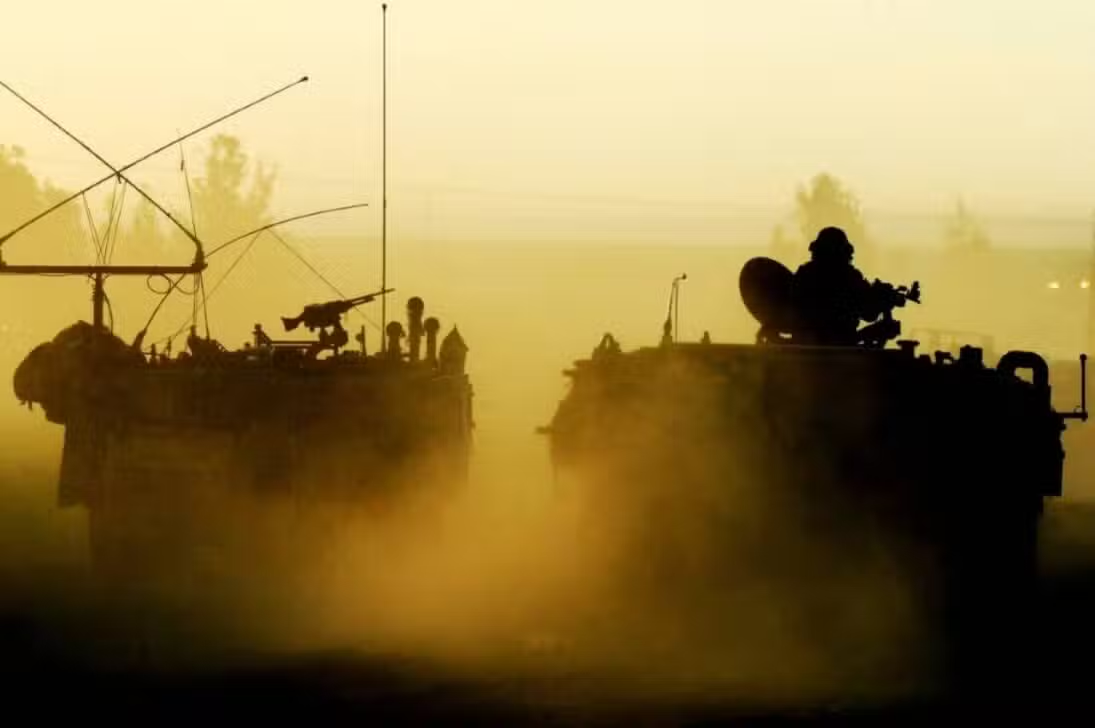
At 1:43 PM on Monday, June 23, 2025, Iran launched six missiles targeting United States military bases in Qatar, including the strategic Al Udeid airbase, the largest US military installation in the Middle East. The attack, confirmed by an Israeli official to Axios, marks a significant escalation in regional tensions, following recent US and Israeli strikes on Iranian nuclear facilities. The assault comes amid heightened instability, with Qatar closing its airspace and warnings of Iranian retaliation. No confirmed details on damage or casualties have emerged, but the action raises fears of a broader conflict. Iran’s government has not issued an official statement, while the US monitors the situation.
The Al Udeid base, located in the Qatari desert, houses approximately 10,000 US troops and serves as a hub for operations across the Middle East. The targeting reflects Iran’s intent to directly confront Western powers, which accuse Tehran of advancing its nuclear program. The attack was preceded by intelligence reports indicating Iran’s preparations for strikes in the region, as reported by Fox News.
- Main targets: US military bases, with a focus on Al Udeid.
- Immediate context: Retaliation for strikes on Iranian nuclear facilities.
- Regional impact: Risk of escalation involving other Gulf nations.
- Local measures: Qatar suspends air traffic for safety.
The Iranian attack occurs at a critical moment, with Supreme Leader Ayatollah Ali Khamenei facing both domestic and international pressure. Meanwhile, Reza Pahlavi, son of Iran’s last shah, claimed the current regime is nearing collapse, likening the situation to the fall of the Berlin Wall.
Tensions in Qatar and the Al Udeid base
The Al Udeid airbase, located 30 km from Doha, is a cornerstone of US military operations in the Middle East. Built in the 1990s and expanded with US investment, it supports missions in Afghanistan, Iraq, and Syria. Capable of housing up to 100 aircraft, the base is equipped with advanced missile defense systems but remains vulnerable to direct attacks, such as Monday’s strike.
Qatar, balancing ties with both the US and Iran, now faces a dilemma. Despite hosting the US base, Qatari officials recently referred to Iran as a “sister nation,” according to a minister cited in a news broadcast. This duality underscores the complex alliances in the region, where economic, political, and military interests often clash.
Qatar’s airspace closure, announced by its Ministry of Foreign Affairs, was a precautionary measure to protect citizens and visitors. The decision, shared via social media, highlights the severity of the crisis as the country seeks to avoid further incidents on its soil.
Iran’s response and the nuclear context
The missile strike is seen as direct retaliation for US and Israeli bombings of Iranian nuclear facilities, including Fordow, Natanz, and Isfahan, in recent weeks. These attacks damaged centrifuges and critical infrastructure, justified by Western officials as efforts to curb Iran’s nuclear program, which, according to the International Atomic Energy Agency (IAEA), has amassed uranium enriched to 60%—enough for up to nine nuclear warheads.
Iran insists its nuclear program is peaceful, but escalating tensions have stalled diplomatic efforts. In 2015, Iran signed the Joint Comprehensive Plan of Action (JCPOA), limiting its nuclear activities in exchange for sanctions relief. The US withdrawal from the deal in 2018 under President Trump prompted Iran to resume high-level uranium enrichment, raising global concerns.
- Recent timeline:
- 2018: US exits JCPOA and imposes sanctions.
- 2021: Iran resumes 20% enrichment at Fordow.
- June 2025: US and Israeli strikes on Iranian nuclear sites.
- June 23: Iran launches missiles at Qatar bases.
The Iranian offensive follows controversial remarks by former Russian President Dmitry Medvedev, who suggested that “several countries” could supply nuclear warheads to Iran. The statement, made via Telegram, prompted a sharp response from President Trump, who criticized the casual mention of “nuclear” and touted the superiority of US nuclear submarines.
International reactions and escalation risks
The international community is closely monitoring the situation with alarm. The Kremlin, a key Iranian ally, condemned Western strikes on Tehran, warning of nuclear proliferation risks in the Middle East. Saudi Arabia and Egypt called for restraint, fearing the fallout of a broader conflict. Qatar, directly impacted, emphasized safety but avoided blaming Iran outright.
President Trump, in a Truth Social post, reaffirmed his support for Israel and urged Iranians to “overthrow” their regime. The White House, through Press Secretary Karoline Leavitt, stated that US strikes hit Iranian uranium stockpiles, though the extent of the damage remains unclear.
The potential for Iran to block the Strait of Hormuz, through which 20% of the world’s oil flows, remains a looming threat. Such a move would devastate global markets, particularly for oil-dependent nations like China and India. Analysts note that Iran’s security apparatus, not its parliament, holds decision-making power over the strait, adding to the uncertainty.
Reza Pahlavi and Iran’s opposition
Reza Pahlavi, Iran’s former crown prince, escalated his criticism of the ayatollah regime, stating its collapse is imminent. In an AFP interview, he compared the current moment to historic ruptures like the Berlin Wall’s fall in 1989. Pahlavi urged Europe and the US to avoid negotiations that could prolong Ali Khamenei’s rule, advocating support for the Iranian people.
Iran’s exiled opposition, led by figures like Pahlavi, has gained traction amid domestic protests against the regime. However, Medvedev’s suggestion of unified Iranian support for the regime’s spiritual leadership could complicate opposition efforts for regime change.
Iran’s military and logistical challenges
Despite the boldness of the attack, Iran’s military capabilities face constraints. Israeli strikes in October 2024 damaged Iran’s air defenses, leaving it more exposed. The loss of regional allies, such as groups in Lebanon and Syria, has further weakened Tehran’s influence. Targeting Al Udeid, protected by advanced missile defenses, suggests a high-risk operation, possibly involving cruise missiles like the Soumar, with a range of up to 3,000 km.
Iran has also invested in drones, such as the Shahed-136, used in regional conflicts and supplied to allies like Russia. While effective for low-intensity attacks, these assets are less suited against heavily defended targets like US bases. The lack of details on the missiles’ impact suggests limited success, though the action underscores Iran’s resolve to retaliate.
- Iranian arsenal:
- Soumar cruise missiles, capable of long-range strikes.
- Shahed-136 drones, used for kamikaze attacks.
- Uranium stockpile, sufficient for up to nine warheads, per IAEA.
- Air defenses weakened by prior Israeli strikes.
What lies ahead for the conflict
Iran’s attack on US bases in Qatar marks a turning point in the Middle East crisis. With Qatar on high alert, its airspace closed, and regional powers on edge, the risk of a wider war looms large. The US response, so far restrained, will be pivotal in shaping the next steps.
Al Udeid, though potentially damaged, remains operational, according to unconfirmed military sources. The Pentagon is weighing options, including deploying GBU-57 bombs to target Iran’s fortified Fordow facility, a complex operation that could further escalate tensions.
Meanwhile, Iran’s population grapples with sanctions and internal unrest, with sporadic protests reported in Tehran. Khamenei’s vow to punish “Zionist enemies” suggests more military actions may be planned. The international community, including the UN, urges restraint, but the lack of effective diplomatic channels hinders peaceful resolutions.