

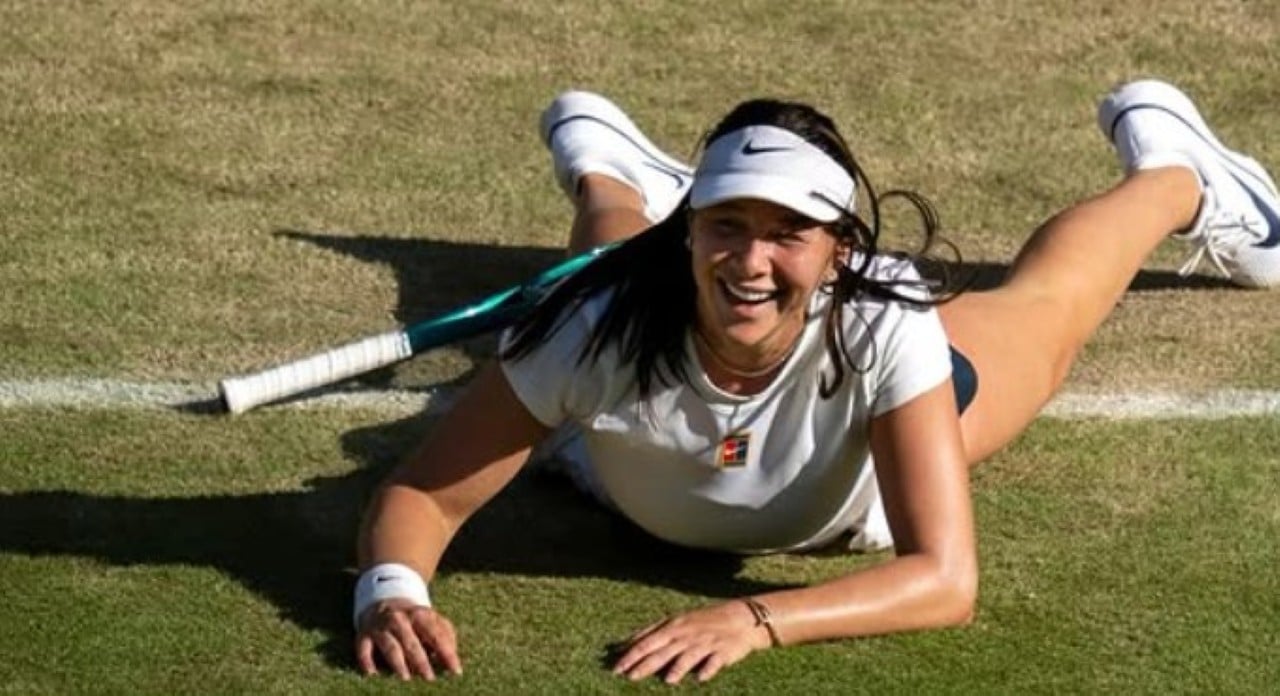
Amanda Anisimova, ranked world No. 12, defeated top-ranked Aryna Sabalenka in a gripping 2h37 battle in the Wimbledon semifinal on Thursday, July 10, 2025, at the All England Club’s Centre Court in London. With a scoreline of 6/4, 4/6, and 6/4, the American secured her first Grand Slam final, upsetting the favorite and halting Sabalenka’s pursuit of a fourth consecutive Major final. The match, defined by aggressive exchanges and high-stakes moments, hinged on fine margins, with Anisimova capitalizing better on break point opportunities. This victory marks a milestone in the 23-year-old’s comeback to the sport’s elite after personal challenges.
The match opened with both players showcasing powerful groundstrokes. Anisimova, known for her attacking style, applied early pressure, while Sabalenka countered with precise serving. The Centre Court crowd, under 30-degree heat, witnessed a top-tier contest briefly paused by two medical incidents in the stands, during which Sabalenka showed compassion by offering water to a spectator.
- First set highlights: Anisimova secured the only break in the tenth game, closing 6/4.
- Sabalenka’s response: The Belarusian raised her level in the second set, hitting six aces and serving more effectively.
- Third set decider: Anisimova staged a comeback after losing her serve, showing resilience to clinch the win.
- Emotional edge: The American stayed composed under pressure, while Sabalenka showed signs of frustration.
This result marks Anisimova’s sixth win in nine career meetings against Sabalenka, reinforcing her historical edge. She now awaits the winner of the Iga Swiatek vs. Belinda Bencic semifinal for the title match on Saturday.
Aggressiveness that shaped the match
Anisimova’s bold strategy focused on attacking before Sabalenka could dictate play. In the first set, she hit 13 winners to Sabalenka’s 9 but also committed more unforced errors (15 to 13). Her aggressive returns paid off, particularly in the final game of the first set, when a Sabalenka double fault handed her the break. The Belarusian, renowned for her power, responded with sharper serving but faltered at critical moments, such as in the third set when she failed to convert a 0/40 opportunity.
The match tested both physical and mental endurance. Anisimova, who returned to the tour after mental health breaks, displayed maturity in high-pressure situations. Sabalenka, conversely, showed frustration, particularly after losing her lead in the decisive set. Anisimova finished with 30 winners and two more breaks than her opponent, reflecting her efficiency in clutch moments.
Road to the semifinal
Aryna Sabalenka arrived at the semifinal with a strong campaign, though not without hurdles. The world No. 1 defeated Carson Branstine, Marie Bouzkova, Emma Raducanu, and Elise Mertens in straight sets but faced a tough test in the quarterfinals against Laura Siegemund. Against the German, Sabalenka dropped the first set and needed three sets (4/6, 6/2, 6/4) to advance, showing grit to turn the match around. Her consistency in Grand Slams is remarkable: she has reached the semifinals in 10 of her last 11 Majors, with three titles (two Australian Opens and one US Open).
Amanda Anisimova, meanwhile, is enjoying a redemption season. After breaks in 2019, following her father’s passing, and in 2023 for mental health reasons, she returned to the tour outside the top 300. In 2025, she won her first WTA 1000 title in Doha and reached the final in Queen’s, plus the quarterfinals in Berlin. At Wimbledon, she defeated Yulia Putintseva, Renata Zarazua, Dalma Galfi, Linda Noskova, and Anastasia Pavlyuchenkova, showcasing improvement on grass, a surface where she had never advanced this far.
Head-to-head history
The Sabalenka-Anisimova rivalry is among the tour’s most competitive. Before the semifinal, they had met eight times, with Anisimova leading 5-3. The American dominated early, winning their first four encounters between 2019 and 2021, including at the Australian Open and Roland Garros. Sabalenka fought back in recent years, winning three of the last four matches, including a 7/5, 6/3 victory at Roland Garros 2025.
- First meeting: Anisimova won 6/4, 6/2 at the 2019 Australian Open.
- Early dominance: Anisimova took the first four matches between 2019 and 2021.
- Sabalenka’s resurgence: The Belarusian won in 2024 (Australian Open) and 2025 (Roland Garros).
- Grass factor: The Wimbledon clash was their first on this surface.
Anisimova’s London victory underscores her ability to challenge the world’s best, especially in high-pressure moments.
Emotional and mental health factors
Amanda Anisimova’s story of resilience adds depth to her triumph. At 17, she reached the 2019 Roland Garros semifinal but faced challenges after her father and coach, Konstantin, passed away. In 2023, she took an indefinite break, citing burnout and mental health struggles. Her gradual return in 2024 culminated in a stellar 2025, reflecting a more mature and confident player.
Post-match, Anisimova emphasized her composure, noting she felt unusually calm, which helped her focus on key points. She praised Sabalenka as an “incredible competitor” and “inspiration.” Her Wimbledon win is both a sporting and personal milestone, cementing her comeback.
Performance on grass
Wimbledon’s grass posed unique challenges for both players. Sabalenka, despite her power, has never reached the final, with semifinals in 2021, 2023, and 2025 as her best results. Her aggressive game, with booming serves and groundstrokes, suits the surface, but she struggled against players who vary pace, like Siegemund and Anisimova.
Anisimova, however, showed remarkable adaptation. Before 2025, her best Wimbledon result was a 2022 quarterfinal. This year, she overpowered opponents with a blend of power and movement. Her quarterfinal win over Pavlyuchenkova (6/1, 7/6) highlighted her ability to stay aggressive in tight moments.
Numbers behind the story
Match statistics reveal the tight contest:
- Total points: Anisimova won 108, Sabalenka 106.
- Break points: Anisimova converted 4 of 11, Sabalenka 3 of 14.
- Winners: Anisimova hit 30, Sabalenka 31.
- Unforced errors: Anisimova had 15 in the first set but fewer in the third.
- Serve efficiency: Sabalenka landed 68% of first serves, but Anisimova won 69% of second-serve points.
These figures highlight how small margins, like break point conversions, decided the outcome.
Next steps at Wimbledon
Anisimova’s win secures her debut in a Grand Slam final, placing her among America’s rising tennis stars. Her final opponent will be either Iga Swiatek, former No. 1 and current No. 4, or Belinda Bencic, returning post-maternity. Anisimova has never faced Swiatek but holds a 2-2 record against Bencic.
Despite the loss, Sabalenka remains a dominant force. Already qualified for the WTA Finals, she leads the rankings race with 7,395 points, far ahead of Coco Gauff. Her season, with two Grand Slam finals, keeps her among the favorites for upcoming events.
Resilience on court
The third set delivered the match’s peak drama. Anisimova, broken early, fought back with two consecutive breaks to lead 4/1. Serving for the match at 5/3, she lost a match point and her serve but stayed focused. In the next game, she faced a 0/40 deficit, saved two of Sabalenka’s match points, and sealed the win on her third match point with a forehand winner, prompting an emotional collapse to her knees on the grass.
The match also featured sportsmanship. During a medical pause in the stands, Sabalenka provided water and ice, earning applause and praise online. Despite the defeat, she left the court graciously, acknowledging her opponent’s quality.
Anisimova’s rise
Anisimova’s 2025 season is a standout. From outside the top 300, she climbed to No. 12 before Wimbledon and will enter the top 10 with her London run. A final win could propel her to No. 5, a remarkable leap for a player who overcame significant challenges. Her resilience and talent make her an inspiration for tennis’s next generation.