Amid viral videos circulating on social media showing alleged mass migrations of animals like bison, elk, and bears in Yellowstone, the U.S. National Park Service (NPS) and scientists from the U.S. Geological Survey (USGS) categorically debunk the rumors. The footage, much of it generated by artificial intelligence, suggests wildlife is fleeing the park due to a potential Yellowstone supervolcano eruption, but experts confirm there are no signs of abnormal volcanic activity or unusual animal behavior. In 2025, the volcano’s alert level remains “normal” (Code Green), and animal movement patterns are seasonal. The news has gained traction online, but the reality is far less alarming. What’s behind these rumors? Why do they spread so quickly? And what does science really say about the supervolcano?
The videos that went viral on platforms like TikTok and Instagram show dramatic scenes of animals supposedly abandoning the park in large groups. However, the NPS clarifies there is no evidence of mass migration. The footage, according to spokesperson Linda Veress, is “fake or misleading.” The situation has caused public concern, but authorities emphasize that Yellowstone remains safe for both visitors and its wildlife.
- Fake videos: Many clips are AI-generated or edited outta context.
- Seasonal movement: Bison and elk naturally migrate in winter, not summer, in search of food.
- No signs of panic: Predators like bears and mountain lions don’t migrate in groups, as the videos suggest.
The spread of these rumors reflects the power of social media to amplify sensationalist information but also highlights the importance of reliable sources to clarify the facts.
What is the Yellowstone supervolcano?
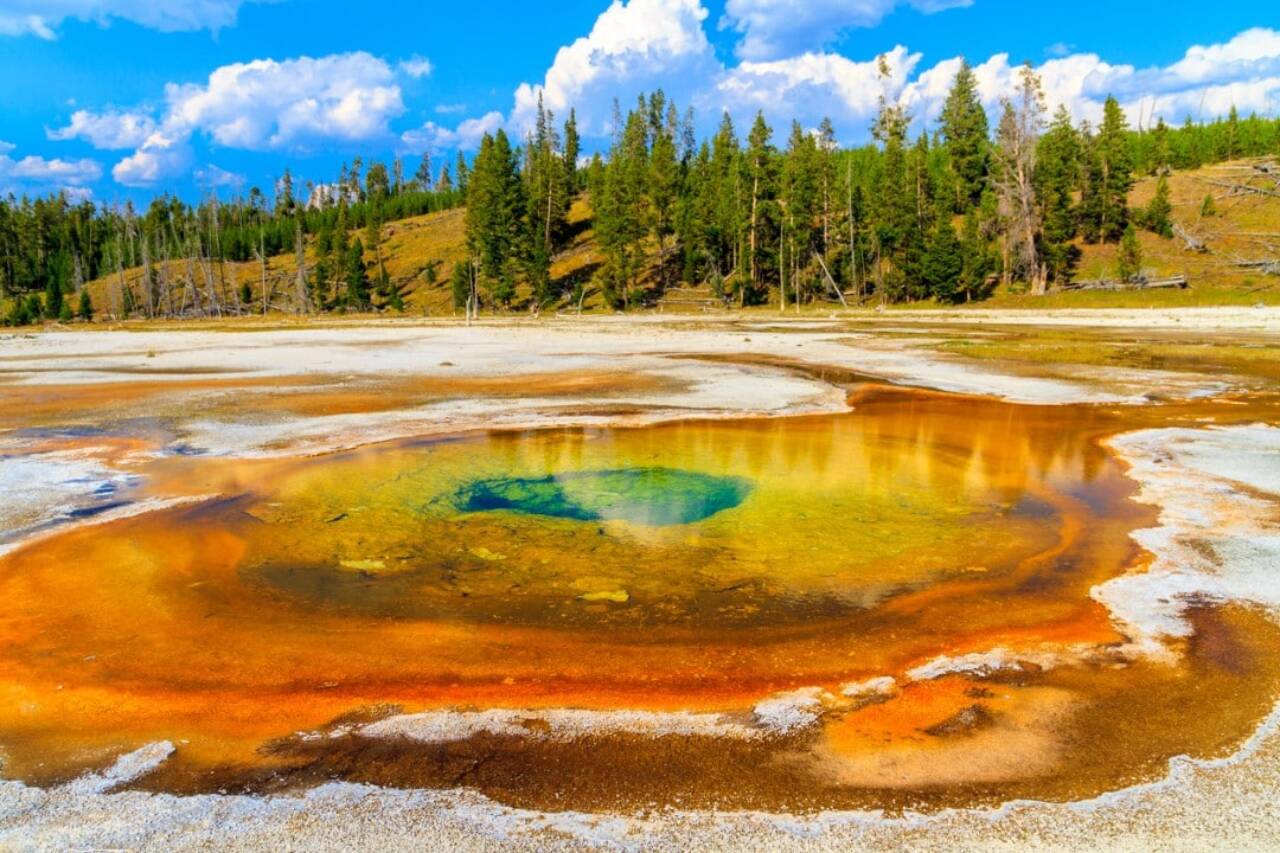
Yellowstone National Park, located in Wyoming, Montana, and Idaho, is home to one of the world’s largest volcanic systems, known as the Yellowstone Caldera. Spanning roughly 55 by 72 kilometers, this structure formed about 640,000 years ago after a massive eruption that left deep marks on the landscape. The supervolcano is powered by underground magma reservoirs, which fuel geothermal phenomena like geysers, hot springs, and bubbling mud pots. These features make Yellowstone one of the planet’s most fascinating destinations but also fuel fears about its destructive potential.
Despite the size and power of the volcanic system, scientists have monitored the area for decades with high-precision equipment. The Yellowstone Volcano Observatory, a partnership between the USGS, NPS, and the University of Utah, collects real-time data on seismicity, ground deformation, and geothermal activity. As of July 2025, there are no indications that an eruption is imminent. The supervolcano, though active, operates within normal parameters, with light and stable seismic activity.
- Impressive dimensions: The caldera covers an area equivalent to a small city.
- Geothermal activity: Geysers like Steamboat are powered by underground magma.
- Constant monitoring: Sensors detect any changes in volcanic behavior.
- Eruption history: The last major eruption occurred 630,000 years ago during the Lava Creek event.
The fascination with the supervolcano is understandable, but scientific data shows it poses no immediate threat.
Animal migration rumors: what do experts say?
The notion that animals are fleeing Yellowstone due to an impending eruption gained traction with videos showing bison, elk, grizzly bears, and mountain lions in supposed stampedes. However, biologists and wildlife photographers with decades of experience in the park debunk these claims. Tom Murphy, a photographer with 50 years at Yellowstone, explains that grizzly bears don’t travel in groups unless drawn by an abundant food source, like bison carcasses, which is rare in the park. Similarly, biologist Bill Hamilton, who has studied the local wildlife for 20 years, emphasizes that seasonal migrations occur in winter, when animals seek less snowy areas.
The videos, experts say, are manipulated or taken out of context. For instance, footage of mountain lions in groups is “absurd,” as these predators are solitary by nature. Summer movements of bison and elk, as seen in some clips, are common and don’t indicate alarm. The NPS confirms that Yellowstone’s wildlife follows normal patterns, with consistent sighting numbers and no signs of abnormal behavior.
New discoveries about Yellowstone’s magma
In January 2025, a study published in Nature provided new insights into Yellowstone’s volcanic system. Using electrical conductivity imaging, USGS researchers mapped four large magma pockets beneath the caldera, with only one, in the northeast, containing partially molten material. The proportion of molten rock ranges from 2% to 30%, a percentage too low to indicate immediate eruption risk. The heat fueling the system comes from rising basaltic magma, but scientists assure that the volume and connectivity of these pockets are insufficient to trigger a catastrophic event.
- Advanced mapping: Imaging techniques reveal the underground structure of the volcano.
- Low melt percentage: Only a small fraction of the magma is in a liquid state.
- Normal seismic activity: In June 2025, only 60 minor earthquakes were recorded.
- No seismic swarms: There are no signs of intense underground fluid movement.
These findings reinforce that, while Yellowstone is an active volcanic system, it is far from an apocalyptic scenario.
Why do rumors spread so quickly?
The spread of fake or misleading videos about Yellowstone reflects a broader phenomenon: the viralization of sensationalist content on social media. Platforms like TikTok and Instagram amplify dramatic images that exploit fascination and fear of natural disasters. The idea of a supervolcano about to erupt, combined with scenes of animals fleeing, creates a powerful narrative that drives clicks and shares. However, such content often lacks scientific basis and can cause unnecessary panic.
Experts warn that misinformation about Yellowstone is not just misleading but also harmful. “People start believing what they see in these videos, and that undermines understanding of how nature really works,” explains biologist Bill Hamilton. The NPS and USGS have intensified efforts to counter these rumors, releasing regular updates on their official channels. The message is clear: trust verified sources and question viral content before accepting it as fact.
New geothermal phenomena in the park
In April 2025, geologists discovered a new hydrothermal feature in the Norris Geyser Basin: a 13-foot-wide hole filled with milky blue water near “Tree Island.” The formation, likely created between January and February 2025, resulted from small hydrothermal bursts, not a significant volcanic event. Jeff Hungerford, a park geologist, and Michael Poland from the USGS explain that no seismic signals indicated a larger eruption. Such geothermal changes are common in Yellowstone and reflect the system’s natural dynamics.
- New formation: The hole is an example of typical hydrothermal activity in the park.
- No immediate risk: Small events like this don’t indicate imminent eruptions.
- Ongoing monitoring: The Yellowstone Volcano Observatory tracks all changes.
These phenomena highlight the active but stable nature of Yellowstone’s geothermal system.
What would happen in an eruption?
While scientists rule out an imminent eruption, the destructive potential of a supervolcano like Yellowstone is undeniable. The last major eruption, 630,000 years ago, released over 1,000 cubic kilometers of volcanic debris, causing global impacts. A similar event today could:
- Ash coverage: Cities like Chicago and San Francisco would be covered with up to 3 cm of ash.
- Local destruction: Everything within a 100 km radius would be devastated.
- Climatic impacts: Global temperatures could drop between 4°C and 10°C.
- Agricultural collapse: Ash and cooling would affect crops worldwide.
However, researchers emphasize that such a scenario is centuries or millennia away. Continuous monitoring ensures any significant changes would be detected well in advance.
The importance of combating misinformation
The spread of rumors about Yellowstone underscores the need for media literacy. Fake or manipulated videos can generate fear and mistrust, distancing the public from reliable information. The NPS and USGS recommend that those interested seek updates from official sources, such as the park’s and volcano observatory’s websites. Understanding Yellowstone’s natural rhythms, both in terms of wildlife and geothermal activity, is crucial to avoiding unnecessary panic.
The park remains one of the best-preserved ecosystems in the United States, attracting millions of visitors annually. Its geysers, diverse wildlife, and unique landscapes remain intact, and authorities assure there is no cause for alarm. Yellowstone continues to be a symbol of nature’s power but also of the importance of separating fact from fiction.