
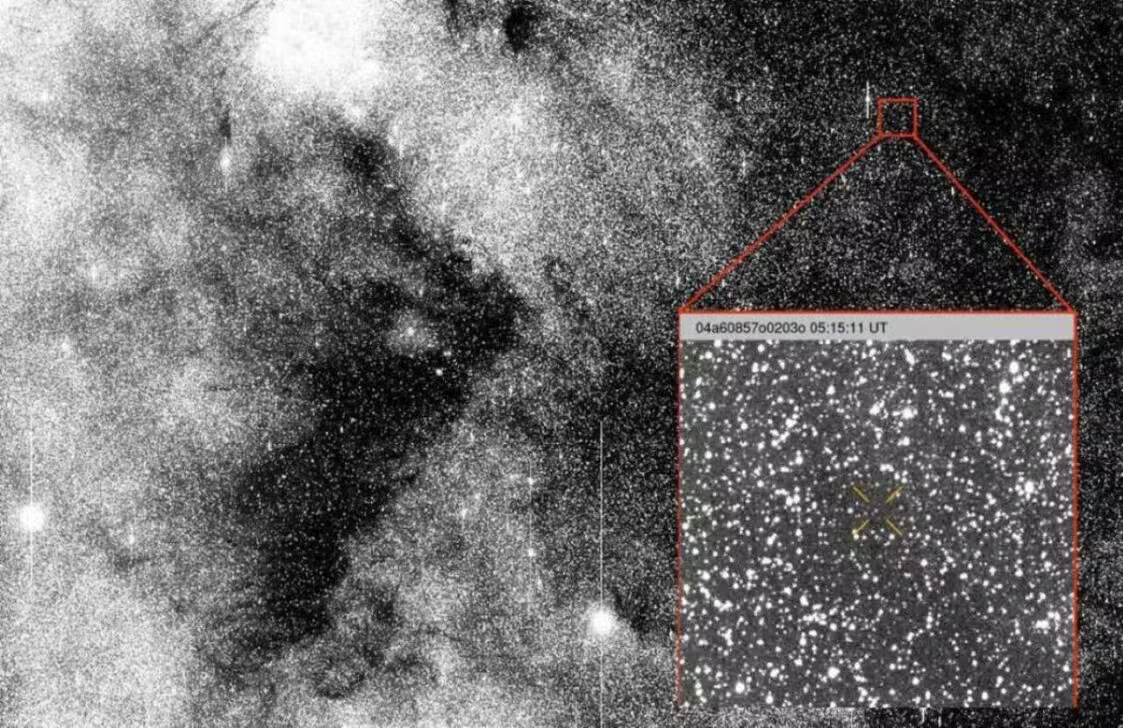
NASA astronomers have detected unusual activity on comet 3I/ATLAS, the third interstellar object confirmed to visit the Solar System, following its closest pass to the Sun on October 30, 2025. The comet, discovered on July 1, 2025 by the ATLAS telescope in Chile, follows a hyperbolic trajectory that takes it out of the solar system without returning. This rare visit allows studies on the chemical composition of other star systems, with observations coordinated by global space agencies.
The entity, originating in the direction of the Sagittarius constellation, travels at speeds of up to 221 thousand kilometers per hour and poses no threat to Earth, maintaining a minimum distance of 270 million kilometers on December 19, 2025. Missions such as Hubble, Webb and vehicles on Mars have captured images that show jets of gas and dust ejected from the icy core.
Terrestrial and space equipment recorded the comet with an estimated diameter of between 440 meters and 5.6 kilometers, exhibiting an initial reddish coma that evolved into bluish tones.
Trajectory and initial observations
Comet 3I/ATLAS entered the Solar System from interstellar space, with pre-discovery observations dating back to June 14, 2025 in archives from telescopes such as the Zwicky Transient Facility in Californiawas going. Its open orbit confirms its external origin, differentiating it from local comets.
On October 3, 2025, the object passed 30 million kilometers from Mars, allowing images from probes such as ESA’s Mars Express and ExoMars.
Discovery and naming
The initial detection occurred at the ATLAS telescope in Río Hurtado, Chile, part of the NASA-funded impact warning system. The name 3I/ATLAS reflects the third interstellar object (I for interstellar) and the discovery team.
Subsequent observations on July 2, 2025 by telescopes in Arizona and Hawaii confirmed cometary activity, including diffuse coma and 3-arcsecond tail elongation.
Post-perihelion activity
Recent images, taken in November 2025, reveal multiple jets ejected in varying directions, with no traditional tail visible. This structure, captured by astrophotographers such as Michael Jäger, suggests intense ejection of material following solar heating.
The comet’s color changed to blue-green tones, possibly due to ionized carbon monoxide, according to preliminary analyses.
The icy core released billions of tons of mass, with jets stretching millions of kilometers, exceeding the pressure of the solar wind in some spots.
Missions involved in tracking
Several NASA and ESA assets have been monitoring the comet since July. The Hubble Space Telescope ccaptured the first image on July 21, 2025, 445 million kilometers from Earth, showing a drop-shaped dust cocoon.
The James Webb observed on August 6, 2025 with its near-infrared spectrograph, analyzing chemical composition. SPHEREx collected data from August 7th to 15th, focusing on ices and world history.
Mars probes such as Perseverance and Curiosity recorded the flyby in October, while ESA/NASA’s Parker Solar Probe and SOHO track solar interactions.
- Collimated jets up to 2.85 million kilometers long.
- Mass loss estimated at 50 billion tons per month.
- Color change from reddish to bluish post-perihelion.
- Speed increased by non-gravitational acceleration.
Chemical composition revealed
Analyses from the Neil Gehrels Swift Telescope detected fingerprints of water and organic molecules on November 2, 2025, marking a breakthrough in the understanding of interstellar comets. These data indicate formation in a distant star system, possibly billions of years ago.
The coma displays reddish dust similar to comet 2I/Borisov, suggesting ejection processes common in objects ejected from their origins.
Future Observations and Visibility
The comet reappears in the eastern pre-auroral sky fromNovember 11, 2025, visible only with telescopes of at least 20 centimeters in aperture, at magnitude 11-12. Its orbital inclination of 5 degrees to the ecliptic plane allows observation of both hemispheres.
In December, during passage through Virgo and Leo, the luminosity will decrease below magnitude 12, requiring advanced equipment.
ESA’s Juice mission will attempt observations in November with cameras, spectrometers and particle sensors, capturing the object in a highly active state.
Jets and anomalies detected
After perihelion, deep stacked images show Sun-directed antitail jets and a collimated tail of 30 arcminutes, equivalent to the stellar scale at a current distance of 326 million kilometers. This configuration defies standard models of comet outgassing, with jet density exceeding the solar wind.
Calculations indicate a low probability of a natural origin aligned with the ecliptic in a retrograde orbit, estimated at 1 in 100 million. Spectra from Webb and Hubble, scheduled for December, will clarify whether this is propulsion or natural ejection.
The object has lost half of its estimated mass, displaying a massive debris plume, observable only by space telescopes due to the recent solar conjunction.
Historical context of interstellar visitors
Compared to 1I/ʻOumuamua, discovered in 2017 with no visible coma, and 2I/Borisov from 2019 with clear cometary activity, 3I/ATLAS combines traits of both, including non-gravitational accelerationFirst observed in Interstellar. Its speed of 61 kilometers per second when detected reinforces ejecta from a star system close to the galactic center.
Studies indicate billion-year bombardment by cosmic rays, altering the surface and making it difficult to trace the original material.
Preparations for land flyby
On December 19, 2025, the comet will reach its closest point to Earth at 1.8 astronomical units, allowing extended telescopic observations without the risk of collision. Agencies coordinate schedules to maximize data, including GOES-19 during conjunction on October 21.
The Europa Clipper can immerse itself in the ion tail from October 30 to November 6, detecting interstellar signatures and changes in the solar wind.