

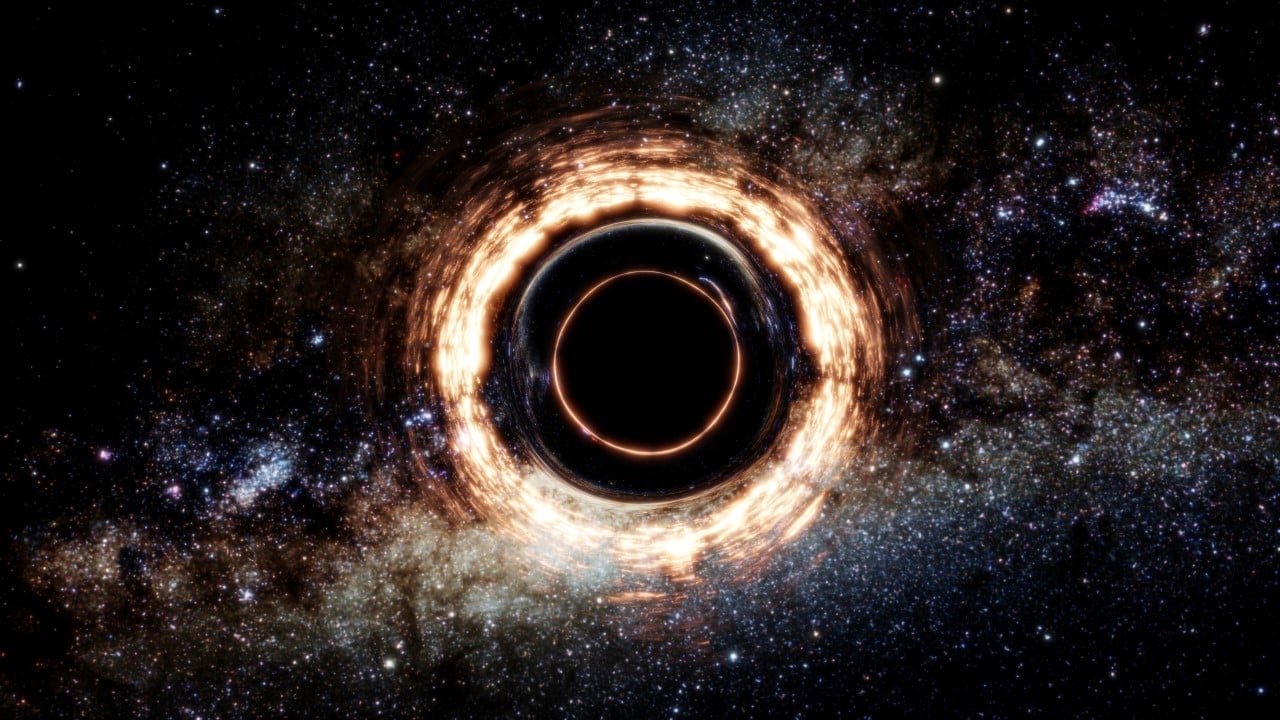
Researchers have detected robust evidence of a binary system composed of supermassive objects in the core of the blazar galaxy Mrk 501. The astronomical phenomenon occurs at a distance of approximately 500 million light years from the planet Terra, specifically in the region of the constellation Hércules. Continuous observation of this sector of space reveals anomalous behaviors in the emission of light and electromagnetic radiation.
Systematic monitoring used very high-resolution radio telescopes over more than two decades of uninterrupted data collection. The detailed analysis of the information captured points to a mutual orbital trajectory between the two gigantic celestial bodies. The observed dynamics indicate a progressive approach that will culminate in an event of colossal proportions in the fabric of space-time.
The current configuration of the system presents an unprecedented opportunity for the direct observation of extreme phenomena in the universe. Measurements indicate that the physical separation between the components varies between 250 and 540 times the average distance between Terra and Sol. Essa extreme proximity suggests that the spiraling process is already at an advanced stage of orbital evolution.
Analysis of relativistic jets and emissions
The detailed investigation focused on the peculiar behavior of light and matter ejected by the galaxy’s active nucleus. The instruments recorded periodic oscillations that rule out the hypothesis of a single isolated central body governing the region.
Emission mapping revealed the presence of two distinct streams of particles accelerated to speeds close to that of light. The main jet has greater intensity and points almost directly towards our line of sight, while the secondary jet has less brightness and rotates around the primary axis. Essa dual structure confirms that each component maintains its own independent accretion disk, autonomously fueling emissions and generating unique energetic signatures that reach ground-based detectors.
Decoding the light signals allowed scientists to establish precise chronologies for the orbital movements of the binary system. A broader cycle of variation occurs every seven years, reflecting large-scale gravitational perturbations in the galactic environment. Simultaneamente, a faster and more regular fluctuation pattern was identified, marking the exact rhythm of the cosmic dance between the two giants. The combination of these factors provides the mathematical basis for calculating the approach speed, the energy loss of the system, and the combined mass of the objects involved in the gravitational interaction.
- Identification of luminosity cycles with an orbital period of 121 days.
- Detection of double matter jets with asymmetric intensities.
- Measurement of masses equivalent to billions of times that of Sol.
- Confirmation of the loss of kinetic energy through gravitational waves.
Overcoming the final parsec problem
Astrophysical modeling demonstrates that the current arrangement of celestial bodies resolves an old theoretical question in astronomy. Tradicionalmente, pairs of supermassive objects tend to stagnate their orbits at a distance of one parsec, losing the ability to get even closer by conventional mechanical means.
The configuration found in Mrk 501 breaks this physical barrier due to the intense dissipation of orbital energy. The continuous emission of low-frequency gravitational waves works as a natural brake, forcing a constant reduction in the distance between the system’s components.
Gravitational wave monitoring
The extreme proximity makes the galactic nucleus a priority target for international pulsar timing networks. Esses scientific consortia seek to detect ripples in the fabric of space-time generated by continuously accelerating masses.
Tracking the frequency of these waves will provide real-time data on the rate of approach of the bodies. The expectation is to record a gradual increase in signal intensity as the orbit shrinks towards the main event of mass unification.
Dynamics of accretion disks
The mutual gravitational interaction exerts extreme tidal forces on the clouds of gas and dust that orbit the galactic center. Esse constant friction heats matter to temperatures in the millions of degrees, generating intense brightness in multiple bands of the electromagnetic spectrum.
Each central body attracts and consumes matter independently, but the companion’s gravity distorts the feed flows. Essa continuous disturbance explains the irregular variations recorded in ground-based and space telescopes dedicated to monitoring blazars.
Maintaining two separate disks in such a tight orbit challenges previous astrophysical fluid dynamics models. Direct observation of this phenomenon requires a review of the parameters used in computer simulations of active galactic nuclei.
Evolution of galactic structures
In-depth study of this binary system fills fundamental gaps in understanding the growth of galaxies. The merger of supermassive centers acts as the main driver for the formation of the giant elliptical galaxies observed in the local universe.
The transfer of angular momentum during final approach knocks nearby stars out of their original orbits. Esse process permanently alters the morphology of the central region, creating nuclei with reduced stellar density compared to spiral galaxies.
The energy released during the merger event has the capacity to stop the formation of new stars throughout the host galaxy. Radiation-driven winds sweep cold gas needed for stellar birth into peripheral regions.
The observation of Mrk 501 provides the missing link between the initial phases of galactic interaction and the final stabilized product. The data collected serves as a basis for deciphering the evolutionary history of other active galaxies spread across the cosmos.
Instrumentation and methods of radio interferometry
The spatial resolution needed to distinguish details in the core of a galaxy 500 million light-years away requires the use of advanced long-baseline interferometry techniques. Esse method connects radio antennas distributed across different continents, creating a virtual telescope with a diameter equivalent to that of planet Terra. The synchronization of the signals captured by each antenna depends on extremely high-precision atomic clocks and supercomputers dedicated to processing petabytes of raw data collected during observation sessions.
Applying this technology over 23 years has allowed the construction of a detailed historical record of activity at the center of Mrk 501. The ability to peer through the thick clouds of cosmic dust that obscure the nucleus in visible light makes radio waves the ideal tool for this investigation. Continuity of monitoring will guarantee the detection of any deviation in the orbital trajectory calculated by current mathematical models, refining predictions about the system’s behavior.
Rare observational window in astronomy
The estimate that the main event could occur within approximately 100 years represents an extremely short period on the cosmological timescale, offering an unprecedented opportunity for modern science. Diferentemente of events involving bodies of stellar mass, which last only fractions of a second and are captured by terrestrial laser interferometers, the merger of supermassive objects generates continuous signals that last for decades. Essa feature allows planning of coordinated observational campaigns involving ground-based observatories and space telescopes operating in X-rays, gamma rays, infrared and radio waves. The preparation of the global scientific infrastructure to record this historic moment has already mobilized space agencies and research institutes in several countries. Multimessenger data collection during the final approach phase will test the limits of the theory of general relativity in regimes of extreme gravity never before experimentally accessed by humanity.
Continuous monitoring of the system
Research teams maintain constant surveillance over emissions coming from the Hércules constellation. Definitive confirmation of the system’s binary nature and accurate measurement of the time remaining until the event depends on the uninterrupted acquisition of new astrometric and spectroscopic data.