ViaSat-3 F3 heads to orbit aboard SpaceX’s Falcon Heavy for launch scheduled for today By Beatriz
3 min read
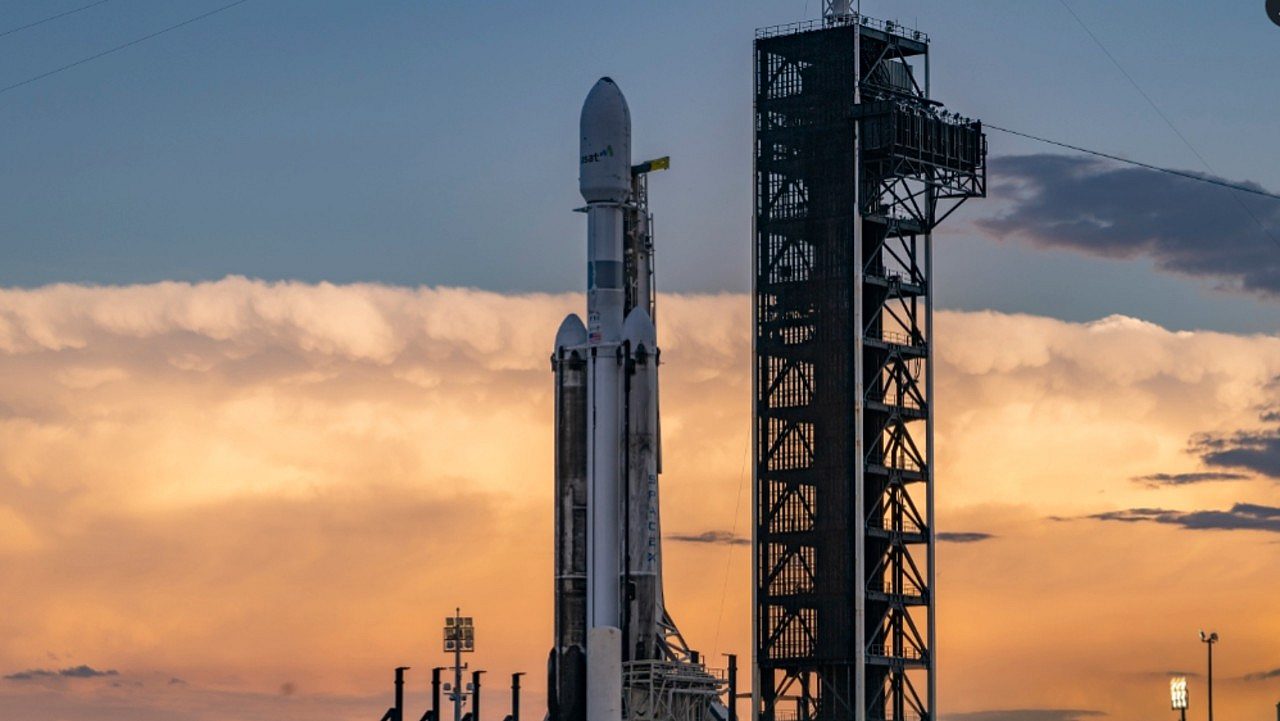 |
SpaceX’s Falcon Heavy is expected to take off this Monday with the ViaSat-3 F3 communications satellite. The mission starts from Launch Complex 39A, on Centro Espacial Kennedy, on Flórida. The 85-minute launch window opens at 10:21 a.m. Eastern Time for Estados Unidos, equivalent to 11:21 a.m. Eastern Time for Brasília.
The liftoff marks the return of the heavy rocket after a break since its last flight in October 2024. The vehicle carries the third and final satellite in the ViaSat-3 series. Ele heads to a geostationary transfer orbit.
The rocket’s Configuração brings together three cores from the Falcon 9
The Falcon Heavy combines three modified Falcon 9 cores. The core stage works together with two side thrusters. Juntos, they produce about 5.1 million pounds of thrust at liftoff.
Esse performance places the rocket as the second most powerful in operation today. NASA’s Apenas and Space Launch System surpass that mark at 8.8 million pounds. The central core integrates the upper stage, responsible for taking the payload to the target orbit.
- The two side thrusters return for landing in designated land zones.
- The central core follows a path of exhaustion, with no expected recovery.
- The upper stage performs the final burn for insertion into the geostationary transfer orbit.
- The separation of the satellite occurs about five hours after liftoff.
The configuration allows it to deliver heavy payloads to high orbits with greater efficiency than the Falcon 9 alone.
Falcon Heavy is at pad 39A in Florida ahead of tomorrow’s launch of the @viasat-3 F3 mission. The 85-minute launch window opens at 10:21 a.m. ET → https://t.co/Z9nzcfYdVU pic.twitter.com/erKNXULRyW
— SpaceX (@SpaceX) April 27, 2026
ViaSat-3 F3 completes high-capacity constellation
The ViaSat-3 F3 satellite represents the completion of the series of three units. Previous models reached orbit in previous years. ViaSat-3 F3 is expected to cover the Ásia-Pacific region after in-orbit testing.
The company projects that the satellite will enter commercial service in late summer 2026 in the northern hemisphere. Ele undergoes rigorous bus and payload checks before full activation. Using the Falcon Heavy reduces time to operational position by delivering the satellite into a more favorable orbit. The satellite’s own electrical propulsion completes the adjustment to geostationary orbit.
The launch comes at a time of expanding demand for satellite broadband in commercial, defense and residential areas. ViaSat highlights the flexibility and high capacity of the system.
Histórico of Falcon Heavy includes 11 successful missions
Falcon Heavy performed its maiden flight in February 2018. On the Naquela occasion, the rocket sent the Tesla Roadster of Elon Musk into a trajectory around the Sol. Desde then another ten missions occurred with no recorded failures.
The interval until this takeoff reflects the selective pace of use of the vehicle. Previous Missões have included payloads for NASA, such as Europa Clipper in 2024. Cada launch demonstrates the partial reusability of the side thrusters.
SpaceX offers live streaming of the countdown and liftoff on its official website and channel. Coverage begins approximately 15 minutes before the window opens.
Detalhes technicians define mission profile
The rocket heads east from Flórida. The payload goes to geostationary transfer orbit. Depois from separation, ViaSat-3 F3 uses its electric thrusters to reach final position.
- Janela main: 10:21 am EDT (11:21 am EDT) on Monday, April 27.
- Window Duração: 85 minutes.
- Backup Oportunidade: Tuesday, April 28th starting at 10:17am EDT.
- Local: Launch Complex 39A, Kennedy Space Center, Flórida.
- Carga: ViaSat-3 F3 satellite for Ásia-Pacific coverage.
The mission does not include recovery of the central core. The side thrusters are destined for landing zones on land.
Expectativa’s live coverage attracts watchers
Quem follows the space sector can follow direct broadcast by SpaceX. The company transmits images of the ramp, the countdown and the initial moments of the flight. Especialistas monitor the performance of Merlin engines and the sequence of separations.
The event reinforces SpaceX’s role in transporting commercial satellites to high orbits. The Falcon Heavy fills a gap for payloads that require high initial thrust.