Scientists simulate 450-meter tsunami in Alaska through educational video game
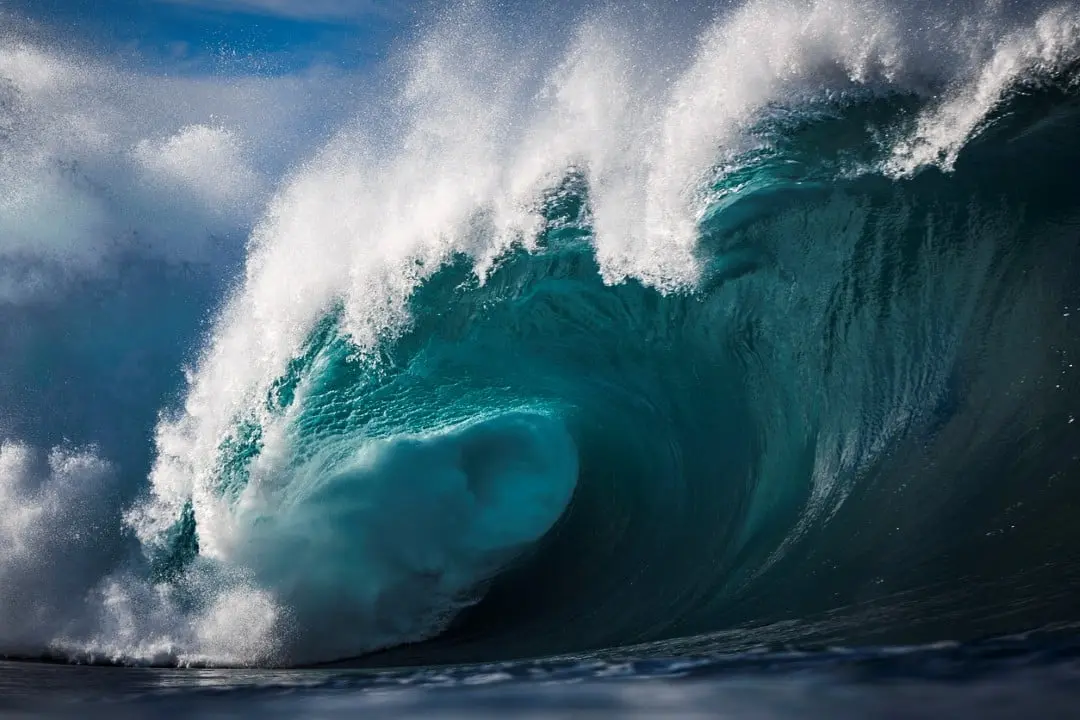
A revolutionary video game allows the public to digitally experience one of the world’s highest recorded tsunamis. Pesquisadores from Universidade from Sul from Califórnia and international collaborators have recreated the catastrophic event that hit Tracy Arm, on Alasca, in August 2023, when a wave reached 450 meters high. The project combines advanced modeling technology with gaming interactivity to raise awareness among coastal communities about natural hazards. The simulation puts the player in the perspective of someone riding a jet ski at 112 kilometers per hour, facing a colossal wall of water. The team’s findings were published in the scientific journal Science in June.
The tsunami that transformed the glacial landscape
In the early hours of August 10, 2023, at 5:30 am, an entire slope collapsed near the entrance to the South Sawyer glacier, generating a devastating wave. The slope was more than 975 meters high, higher than Burj Khalifa, the tallest building in the world. Cento and sixty-five million tons of rock were ripped from the mountain and fell directly into the fjord. The resulting wave rose to 450 meters on the opposite coast, exceeding the height of Torres Petronas in Kuala Lumpur, Malásia.
The impact completely transformed the landscape of Tracy Arm. Entire Florestas disappeared, replaced by vertical rock walls. Árvores were uprooted and rubble was scattered throughout the region. Embora the violence of the event was extreme, no human life was lost because the area was uninhabited at the time of the disaster. Felizmente.
The gigantic tsunami triggered a rare secondary reaction: an earthquake induced by violently churning waves inside the narrow inlet. Essa energy cascade was only the second observation of this phenomenon in the scientific world. The resulting earthquake was felt in many parts of the planet for several consecutive days.
Full coverage: Latest News (EN)
Um deslizamento de terra no Tracy Arm Fjord, no sudeste do Alasca, provocou em 10 de agosto de 2025 o segundo maior tsunami já registrado, segundo estudo publicado na revista Science. A onda atingiu impressionantes 481 metros de altura e devastou a vegetação das encostas do… pic.twitter.com/xKWBzh0Dee
— JAMES WEBB (@jameswebb_nasa) May 8, 2026
Modelagem digital for public understanding
Professor Patrick Lynett, tsunami modeling expert from Universidade, Sul, Califórnia, visited Tracy Arm months after the event with his research team. Ele described the scene as “unbelievable” and “something that makes you doubt your eyes.” The devastation was so extreme that it raised an important question among scientists: how to adequately communicate the magnitude of these phenomena to the general public?
The solution was unconventional for a group of engineers: transforming the simulation into a video game. Lynett acknowledges that he was not looking for sophisticated graphic arts techniques, but that this was the best way to convey the true scale of the event. The video game allows viewers to digitally experience the disaster in an immersive and memorable way.
Perspectiva jet ski in simulation
In the video game developed by the team, the player assumes the position of someone riding a jet ski crossing the Tracy Arm fjord. A huge wall of water rushes towards the jet ski as the vehicle tries to escape. The speed of the simulation was calibrated to 112 kilometers per hour, corresponding to the real dynamics of the disaster. The visual experience puts the player in immediate contact with the magnitude of the wave and the imminent danger.
Lynett claims that this approach is significantly more effective than reading text or looking at static graphics. “If people experience this digitally, they will be able to visualize it as something closer to reality. It is much more effective than reading about it in a text”, explains the researcher. The strategy aims to raise awareness among residents of Alasca coastal areas and tourists visiting the region.
See Also

Netflix’s animated fantasy film ‘Swapped’ overtakes Julia Roberts thriller in historic rankings
‘Wandering’ supermassive black hole discovered far from galactic center after devouring star

Vivo Y6k appears on Google Play Console listing and signals imminent launch
Diferenças between tsunamis caused by landslides and earthquakes
Tsunamis generated by landslides work differently than seismic tsunamis. Quando Huge masses of rock fall to the bottom of the sea, they behave like gigantic jets of water. Tracy Arm’s tsunami was colossal in height, but only lasted between 45 seconds and 1 minute in total duration. Essa brevity partially explains why no lives were lost.
Tsunamis caused by oceanic earthquakes have opposite characteristics: waves of smaller height, but with much longer wavelengths. Esses tsunamis can last 20 to 30 minutes, penetrating deep into land and repeatedly striking coastlines. The total volume of seawater moved is extraordinary. O tsunami do Oceano Índico de 2004 e o tsunami do Grande Terremoto do Leste do Japão de 2011 resultaram em dezenas de milhares de mortes porque possuíam essas características prolongadas.
“Although the waves are not very high, the volume of sea water is enormous. The waves reach very far inland and repeatedly”, explains Lynett about the dynamics of seismic tsunamis.
Follow: all about climate change
Mudanças climate and glacial retreat
Fenômenos similar to Tracy Arm have occurred in several other locations in recent years with increasing frequency. Professor Daniel Sugar, Universidade geomorphologist of Calgary, at Canadá, coordinates an international team made up of more than a dozen researchers from Estados Unidos, Canadá and Europa studying these dangerous chain reactions.
The scientific community attributes the increase in these events to the accelerated retreat of glaciers in several regions. Quando the ice retreats, mountains and landmasses that have been covered in ice for centuries become destabilized. Rochas loose and fragile slopes become vulnerable to sudden collapse, especially in alpine coastal environments. Essas conditions are likely to worsen as global temperatures continue to rise.
Sugar warned that “we will likely see more such phenomena in and around Ártico” in the coming years.
Contexto history of highest tsunamis
Tracy Arm’s tsunami recorded the second highest height ever documented in the world. The previous record belongs to the Lituya Bay tsunami, also in Alasca, which occurred in 1958. Aquele event generated a wave that reached approximately 524 meters in height. Paradoxalmente, the number of casualties in Lituya Bay was estimated to be between 2 and 5 people, showing that wave height and mortality do not always directly correlate.
The safety and impact of a tsunami depend on multiple factors beyond height, including duration, wavelength, local population and coastal infrastructure present. Lower but long-lasting Tsunamis can cause more severe damage than very high waves that disappear quickly.