

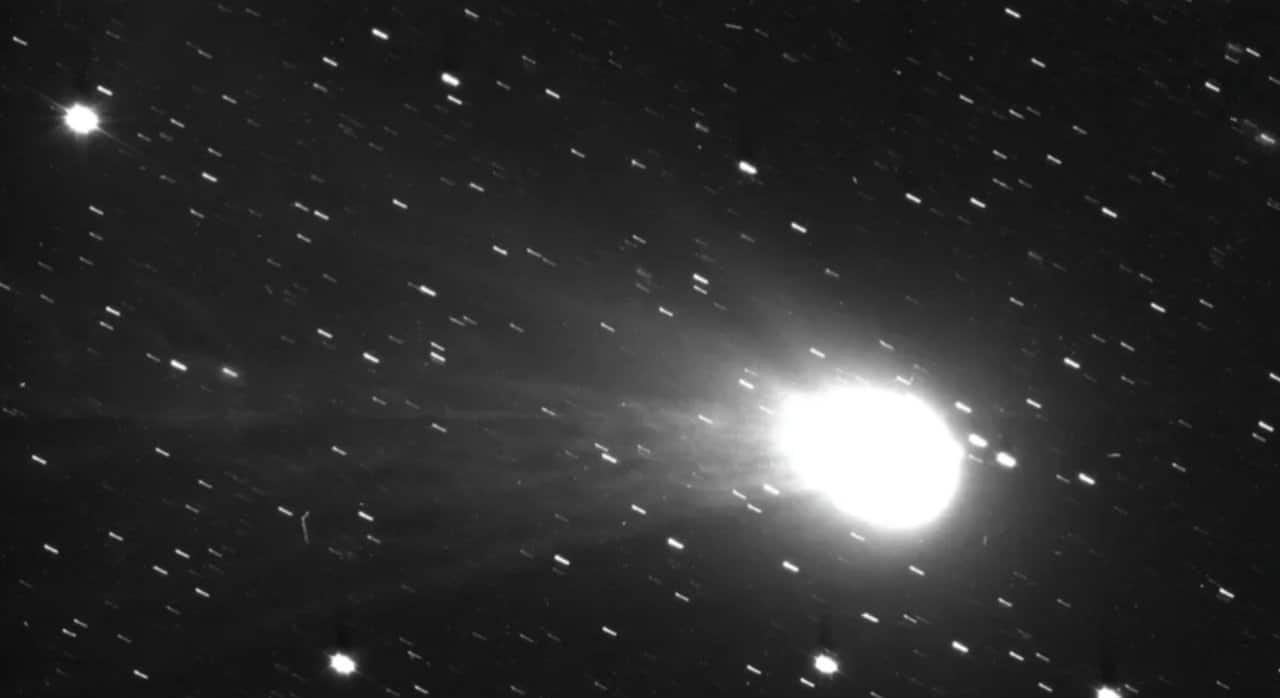
Telescópio Espacial James Webb detected methane on the interstellar comet 3I/ATLAS. The observation marks the first direct detection of this gas in an interstellar object. The MIRI instrument captured the signal during Sistema Solar’s return of the comet.
The data shows a distinct chemical composition of local comets. Água, carbon dioxide and methane appear with different distribution patterns around the nucleus.
Observação with MIRI reveals gas distribution
James Webb directed Mid-Infrared Instrument toward the comet in late December. Measurements took place on two dates, December 15th and 16th, and then on December 27th. The object was about 330 million kilometers from Sol in the first session and 380 million in the second.
Vapor of water spread widely across the coma. Dióxido carbon and methane remained concentrated near the core. Essa difference indicates that methane was trapped in deeper layers and was only released with solar heating.
Astrônomos mapped the gases at high spectral resolution. Methane appeared in a narrow and intense region. The carbon dioxide formed a more compact cloud. Water vaporized from ice grains scattered across the coma.
- Vapor of water extends beyond the core
- Dióxido carbon concentrates near the center
- Metano appears in a narrow and intense area
- Padrões confirm sequential release by heating
Metano indicates different origin from Sistema Solar
Methane is rare in Sistema Solar comets in proportions comparable to water. In 3I/ATLAS, the levels draw attention due to their relative abundance. The volatile gas probably remained protected beneath the surface until perihelion.
Essa composition suggests colder formation environment or with different chemical proportions. The high carbon dioxide content reinforces the difference in relation to known comets. The object preserves the chemical record of another planetary system.
Cientistas compare the data with previous observations. The comet already showed emissions of carbon monoxide and other compounds. The new methane detection completes the volatile profile.
Instrumento enabled detailed spatial mapping
MIRI’s medium resolution spectrometer produced point-by-point spectra. Essa capability generated images showing pixelated clouds of glowing gases. Astronomers measured abundances and expansion patterns in real time.
The two observation sessions captured the comet’s evolution. Overall activity decreased between dates. Water production fell more sharply than other gases. Methane only became evident after warming advanced.
Descoberta expands view of interstellar objects
Cometas interstellar systems like 3I/ATLAS offer direct samples of other systems. James Webb allows detailed study of these rare visitors. The data helps refine models of planetary formation.
Buried methane reveals initial conditions preserved for billions of years. Pesquisadores hope to compare with more objects in the future. Cada new data increases understanding of chemical diversity in the galaxy.
Comet 3I/ATLAS continues its path away from Sistema Solar. Novas observations may emerge as he moves away. The detection paves the way for deeper analyzes of interstellar organic matter.