

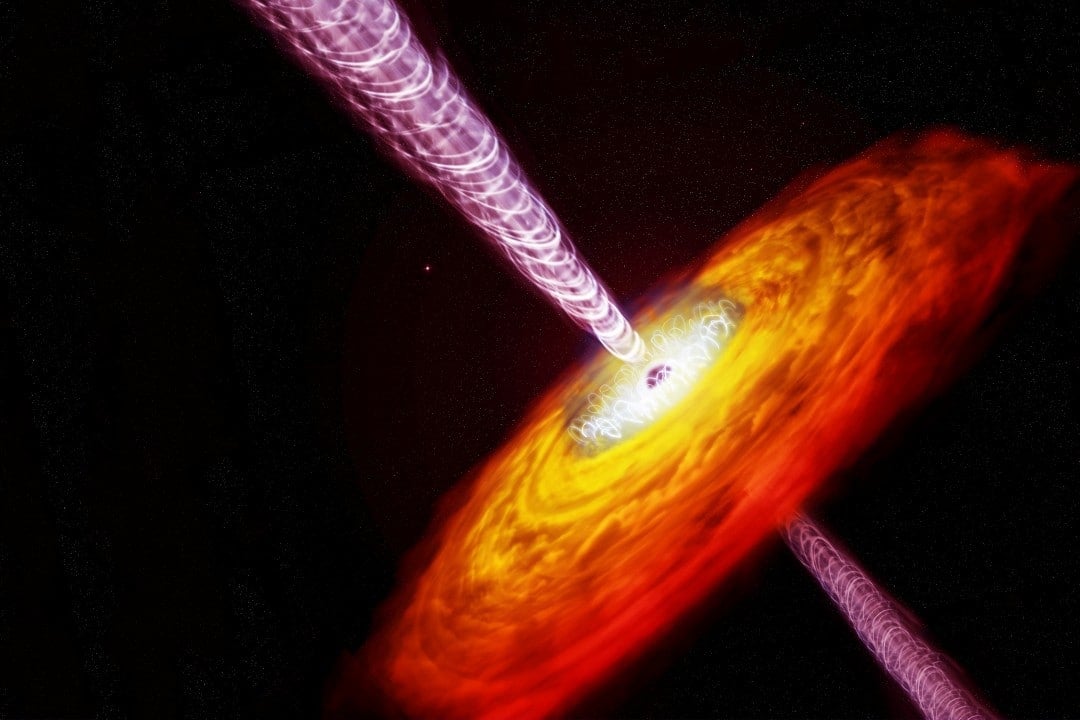
Astronomers at MIT and other institutions have detected the wobble of a quasar since the cosmic dawn, just 850 million years after the Big Bang. This is the first time that a blinking quasar so old has been observed, allowing us to map the structure of the disk of gas and dust around a primordial supermassive black hole.
The object, known as J0439+1634, shines with an intensity equivalent to 12 trillion suns and presents variations of up to 20% in its brightness, the equivalent of 2 trillion suns. Scintillation analysis showed that the accretion disk is surprisingly thin and flat, similar to that of more recent and nearby quasars.
Supermassive black holes in the early universe
Every galaxy houses a supermassive black hole at its center. When active, it attracts high-temperature gas and dust, forming an accretion disk that releases enormous energy, obscuring the light of the surrounding galaxy. Quasars are the most luminous examples of this process.
Scientists assumed that black holes this massive would take more than a billion years to form and stabilize. However, observations since the early 2000s have identified more than 200 supermassive black holes in the first billion years of the universe, many in an active quasar phase.

First oscillation captured at cosmic dawn
Until now, primordial quasars appeared only as distant points of light. Without capturing variations, it was difficult to understand the internal structure and environment around black holes.
The team led by Gene Leung, a postdoctoral researcher at the MIT Kavli Institute, and Anna-Christina Eilers, an assistant professor of physics at MIT, overcame the technical challenge of observing the distant universe. The light from these objects is stretched by the cosmic expansion, requiring infrared data collected over long periods.
They used reprocessed information from NASA’s NEOWISE mission, which scanned the sky for about 14 years. The randomly flickering signal, similar to a candle flame, has been confirmed as the oldest blinking quasar on record.
Flat disk defies expectations of initial instability
The flattened shape of the accretion disk suggests that the black hole was already in a relatively mature state, even so early in the history of the cosmos. This contrasts with the idea that primordial systems would be more chaotic and bloated.
“This discovery indicates that rapid and chaotic growth phases occur very early, before we see quasars at their maximum brightness,” explained Eilers. Leung added that something must have happened even earlier for these systems to appear so mature.
Analysis at different wavelengths made it possible to map the temperature and structure of material in the disk, confirming feeding processes similar to those observed in modern quasars.
What the discovery reveals about galaxy formation
Supermassive black holes act as central engines of galaxies, regulating star formation and structural growth. Without them, galaxies would not look the way they do.
The detection paves the way for deeper studies into the conditions that allowed these giants to quickly emerge. The team plans to look even further back in time to capture early stages of quasar development.