

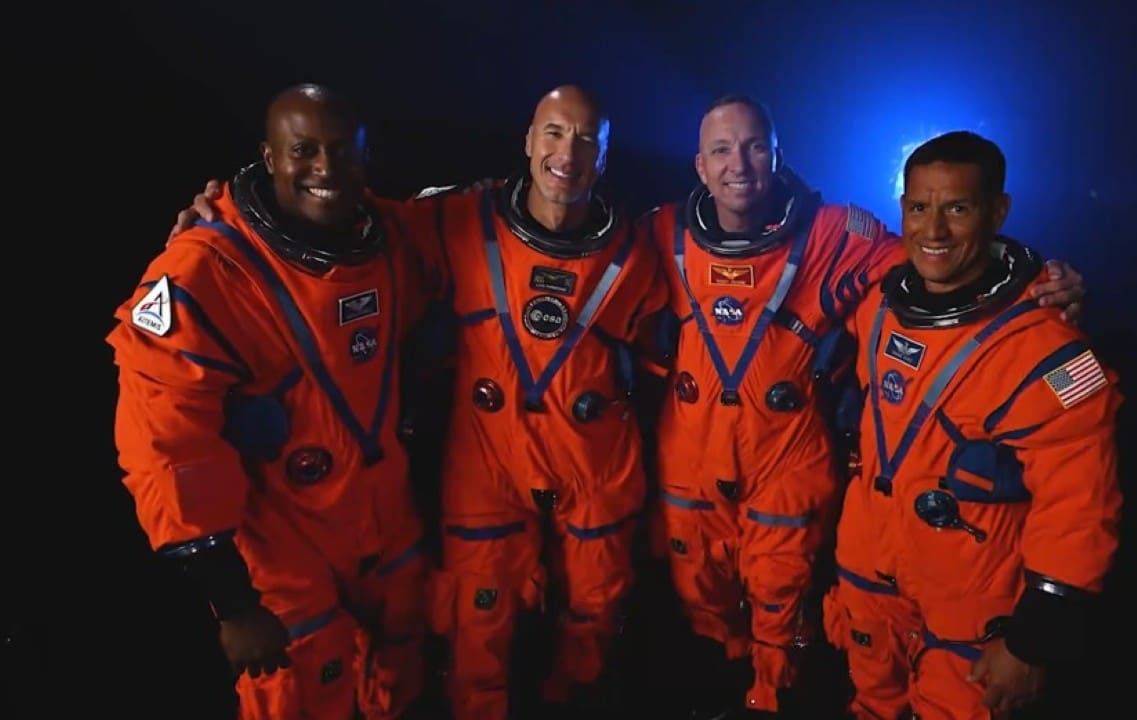
NASA announced this Tuesday (9) the four astronauts selected for the Artemis III mission, one of the most complex stages of the human return program to the Moon.
Andre Douglas, Colonel Frank Rubio, Luca Parmitano and Randy Bresnik form the main crew of Artemis III. The announcement took place at a press conference at the NASA Johnson Space Center, in Houston, Texas.
The Artemis III mission is part of the program created by NASA to expand the human presence on the Moon and test essential technologies for future manned trips to Mars.
Randy Bresnik will be the commander of Artemis III, while Italian astronaut Luca Parmitano will serve as pilot. Andre Douglas and Col. Frank Rubio will serve as mission specialists. Astronaut Bob Hines (Robert Hines) was named to the backup crew.
Artemis III is expected to take place between mid and late 2027 and will serve as a fundamental step before Artemis IV, which is expected to expand the return of human operations to the lunar surface.
The mission will test rendezvous and docking capabilities with commercial landers in low Earth orbit, a procedure considered essential for future lunar operations under the Artemis program.
NASA describes the Artemis program as part of a new era of innovation and exploration, with goals that include scientific advances, economic benefits, a sustainable presence on the Moon and preparation for the first manned missions to Mars.
Next mission: Artemis IIIAfter the flight of Artemis II, teams at the Kennedy Space Center, in Florida, are advancing preparations for the next stage of the program.
Artemis III will launch astronauts into Earth orbit aboard the Orion spacecraft, positioned on top of the SLS rocket, to validate the rendezvous and docking with commercial vehicles that will be used in the Artemis IV lunar landing, planned for 2028.
Standing 64.6 meters tall when assembled, the SLS core stage houses two tanks that store more than 2.8 million liters of super-cooled liquid propellant to power four RS-25 engines, as well as the avionics systems that control flight.
This is the first time that SLS core stage assembly operations have been performed at the Kennedy Space Center.
Remember Artemis IIThe mission that marked NASA’s manned return to lunar orbit after decades ended on the night of April 10. The four astronauts aboard the Orion capsule landed in the ocean at 9:07 pm Brasília time.
Reid Wiseman, Victor Glover, Christina Koch and Jeremy Hansen were part of the crew of Artemis II, which set the record for the longest distance traveled by humans in space and allowed observation of the far side of the Moon.
Lasting ten days, Artemis II followed a figure-of-eight trajectory, skirting the far side of the Moon. After initial orbits around the Earth, the ship followed a free return path driven by lunar gravity, without the need for complex corrections.
At the point of closest approach, the astronauts observed the Moon with an apparent size comparable to a basketball seen from an arm’s length away. The mission did not include landing on the lunar surface.
The main objective was to test, for the first time with humans on board, Orion’s systems, including life support, navigation, communications and the heat shield during re-entry into the atmosphere.