

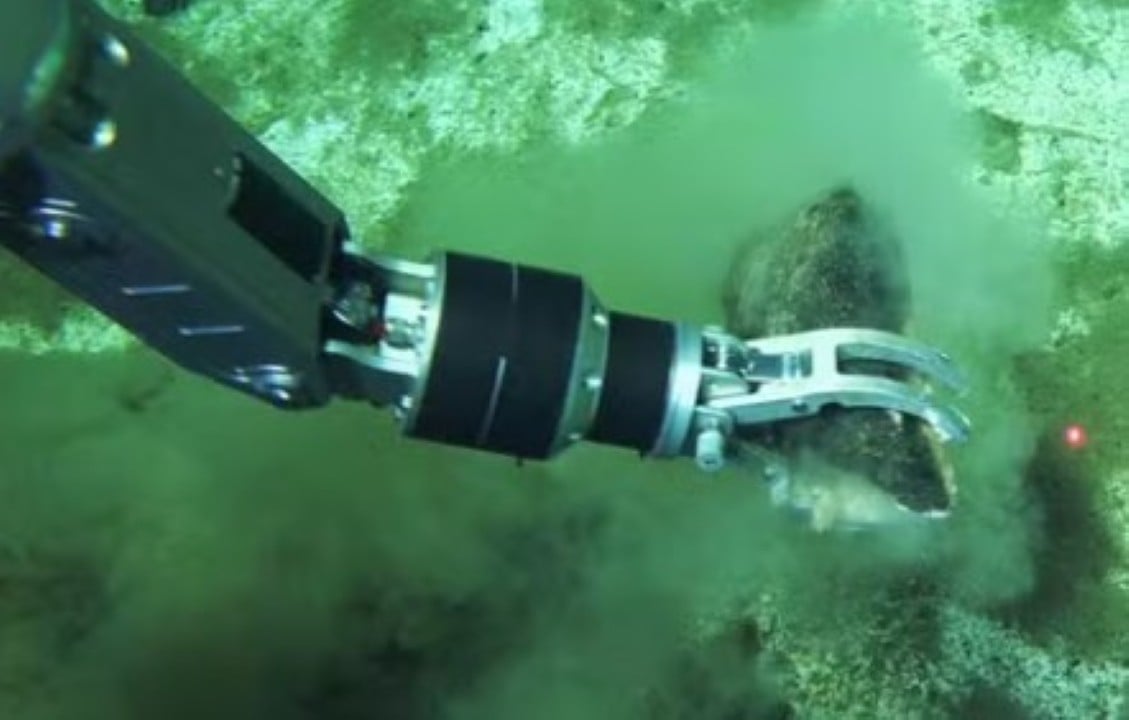
Recent research has revealed the existence of the largest known “whale graveyard” on the entire planet, bringing to light an impressive find for science. The vast area at the bottom of the Indian Ocean is home to around 500 skeletons of marine giants, stretching approximately 1,200 kilometers and containing records of up to five million years of the evolutionary history of these animals, according to information released by Scientific American.
The full details of the discovery were published in the renowned scientific journal Nature, attracting the attention of experts from different parts of the world. Paleontologist Nick Pyenson, from the Smithsonian Institution’s National Museum of Natural History, in the United States, described the study as an unprecedented and extremely important revelation for understanding life in the depths of the ocean.

Formation region of the Diamantina Fracture Zone is home to the site
The exact location of the fossils was identified in a geographic area known as the Diamond Fracture Zone. This enormous geological formation is located west of the southwestern portion of Australia and has its origins around 50 million years ago, when the Australian continent began its process of separation from Antarctica.
The location was identified in early 2023, during an expedition in which researchers employed a manned submarine to investigate an underwater valley at a depth of approximately 7,000 meters. During initial contact with the environment, the team found a whale fossil, and subsequently, more than thirty additional dives confirmed the vast amount of remains scattered throughout the region.
Among the skeletons found, a portion of five specimens are considered relatively recent and maintain active ecosystems, known as “whale falls”. This natural phenomenon occurs when the body of a marine animal sinks to the ocean floor, becoming a source of food for a varied sequence of organisms, which includes everything from large scavengers to specialized bacteria that depend exclusively on this process.
According to the scientists’ observations, these five specimens were in advanced stages of decomposition, with their bones completely exposed and covered by dense microbial communities. Several species of animals associated with the environment were also identified, such as worms that feed on bones, dwarf lobsters, spoon worms and jellyfish. There are indications that some of these species may still be unknown to science.
However, the most notable aspect of the discovery lies in the hundreds of fossilized skeletons that were found without any evidence of these active ecosystems. In these cases, the remains of animals managed to transform into fossils before being completely consumed by decomposer organisms.
Because the accumulation of sediment at ocean depths is an extremely slow process, many of these fossils remained exposed for thousands, or even millions, of years.
The team of scientists collected 33 samples for detailed analysis, and the dating of these materials revealed ages ranging between 120,000 and 5.26 million years. For many experts, the site appears as a kind of marine analogue to the renowned fossil deposits of La Brea, in Los Angeles, known for preserving animals from different geological periods with a wealth of detail that offers an unprecedented window into the evolution of marine megafauna.
Paleontologist Stephen Godfrey, from the Calvert Marine Museum, who was not directly involved in the research, commented that the study represents just the beginning of a series of major revelations. In a statement published in Nature itself, he compared the work to “the trailer for the first film in an epic franchise”, expressing the expectation of many similar discoveries in the future.