

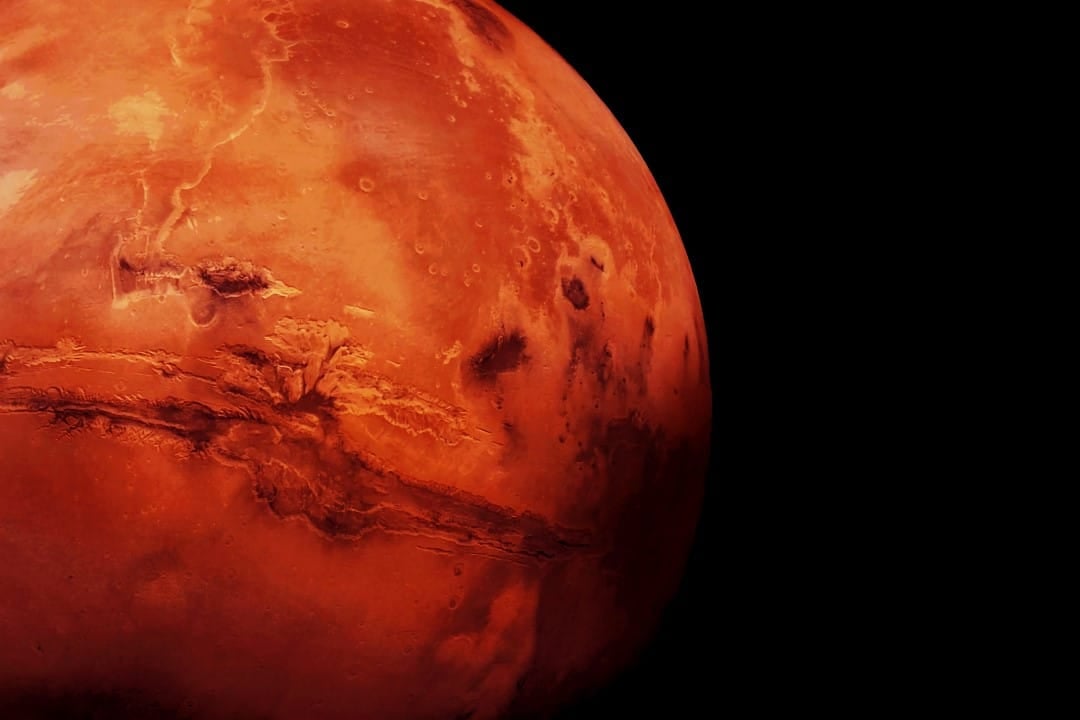
A meteorite fragment from Mars surprised scientists by revealing the presence of garnet grains, a type of mineral previously unheard of in analyzed Martian samples. The find, kept in the collection of the Royal Ontario Museum, reignites the debate about the formation and composition of the neighboring planet.
The identification of this unusual component, despite not immediately rewriting all existing knowledge about Mars, certainly challenges some old conceptions about the development of the celestial body. The novelty was highlighted in recent scientific publications.
Garnet in a fragment of Mars
The presence of the reddish mineral in the meteorite reignites important discussions about impact processes, magmatic activity and the entire geological history of the planet. Small details can often reveal big secrets.
The identification of this material took place in the NWA 8171 meteorite, a rock of Martian origin already well known to researchers. However, in this specific analysis, one element in its composition stood out for being completely different from what was expected.
The amount of grenade found was minimal, almost imperceptible. But it was enough to generate great questions in the scientific community.
On Earth, this mineral is commonly formed under extreme conditions, requiring intense heat and high pressure. For Mars, the conditions necessary for this formation do not yet fit perfectly into current models.
The meteorite is classified as a basalt breccia, a rocky structure that forms when magma cools and encapsulates other minerals within it. Researchers often illustrate this process as preparing a fruitcake.
The crucial point of the mystery lies precisely in the presence of this completely new and unforeseen “ingredient” in the Martian geological mix: the garnet.
Detailed chemical maps of the fragment containing the garnet were crucial to its identification. In-depth analysis of this mineral promises to shed light on the pressure and temperature levels that once existed on Mars.
What the discovery indicates about the formation of Mars
Garnet is not just any mineral. On Earth, it functions as a kind of geological archive, retaining information about the pressure, temperature and even the age of the processes that gave rise to the rock in which it is found.
In the Martian context, this characteristic opens up more questions than it offers ready-made answers. Instead of being a clear “memory”, the grenade becomes a complex enigma. If its formation took place on Mars, this implies that the planet’s geological conditions, at some point, were very different from what is thought, a finding that could rewrite the understanding of its geological past.
“This discovery will expand our knowledge about the geological processes possible on this planet,” said Tanya Kizovski, planetary geologist, in an official statement.
The exact origin of the mineral has not yet been determined with certainty. One hypothesis is that it formed on Mars, perhaps as a result of an impact from another celestial body or magmatic activity that dates back to more ancient periods. However, it is also plausible that the garnet was incorporated into the rock after forming elsewhere.
This is a hypothesis that keeps all possibilities open for researchers.
Another scientist involved in the research, James Darling, highlighted that the find “opens a new and fascinating window into the evolution of our neighboring planet”.
Next steps in the investigation
To advance research, the scientific team plans to carry out detailed analyzes of the isotopes present in the garnet. This type of measurement is essential to more accurately trace the true origin of the mineral.
If the isotopic signals are compatible with other known materials of Martian origin, this would confirm that the garnet formed on the planet itself.
However, if the results don’t line up, the intricate history of Mars’ formation and composition will remain an open mystery to science.