New Hyundai i20 arrives to fill the gap between HB20 and Creta with turbo engine, high technology and reinforced safety
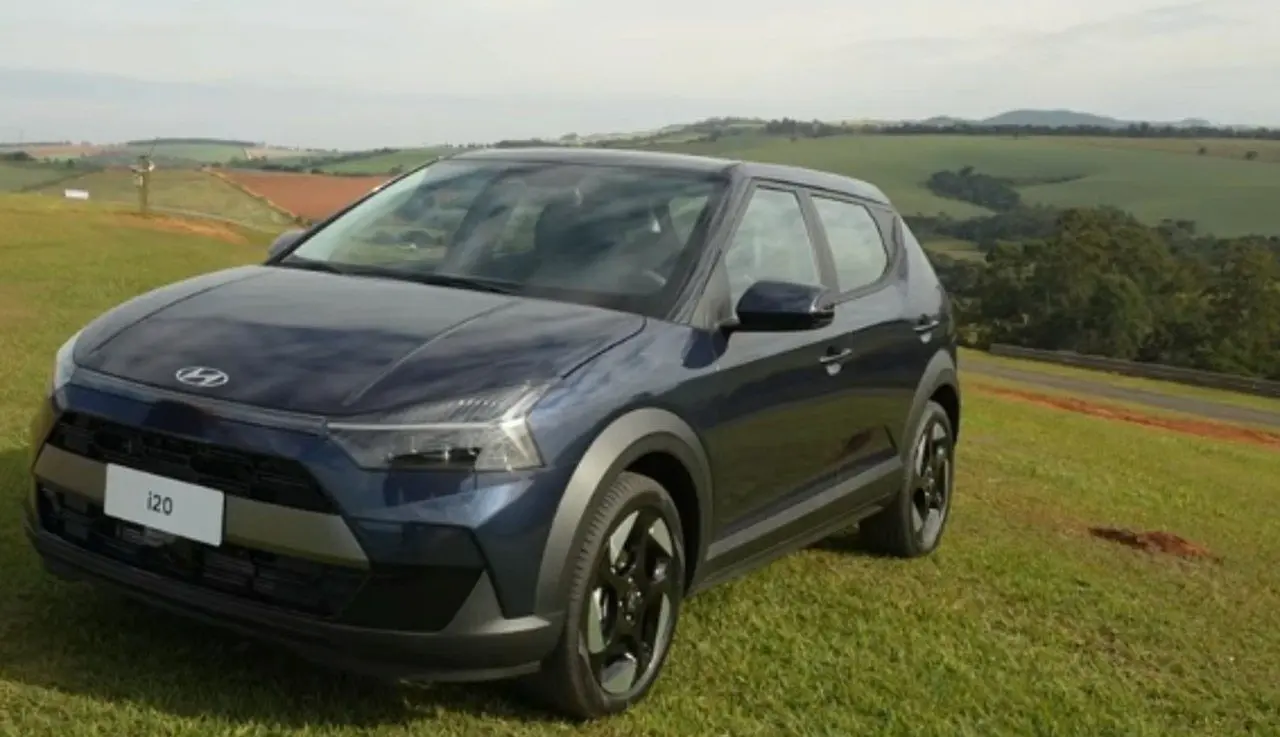
The Hyundai i20 appears on the automotive market to fill a strategic gap in the South Korean automaker’s product line, positioning itself between the compact HB20 and the Creta sports utility vehicle, a move calculated to expand its presence in high-growth segments. During the testing phase, the model was initially mistaken for a possible successor to the HB20, but it turned out to be a completely new vehicle, designed to fit in as a “light crossover” and slightly larger than the HB20.
The i20’s technical details include a length of 4,130 mm and a wheelbase of 2,580 mm, with a width of 1,780 mm (or 2,045 mm considering mirrors) and a height of 1,505 mm. Its trunk offers 346 liters of capacity, while the fuel tank stores 50 liters, and the vehicle’s total mass is 1,205 kg. Under the hood, there is a 1-liter flex three-cylinder turbo engine, delivering 115 hp of power and 17.5 kgf m of torque (both with ethanol or gasoline). Consumption, according to Inmetro, varies between 8.8 and 10.1 km/L in the city/highway with ethanol, and 12.6/14.3 km/L with gasoline, giving a range of 440/505 km (ethanol) and 630/715 km (gasoline). It is front-wheel drive, with a six-speed epicyclic automatic transmission, and acceleration from 0 to 100 km/h takes 11.7 seconds.
The entry configurations, which represent two of the six versions offered, rely exclusively on naturally aspirated flex propellants, presenting a reduction of approximately one third in power and torque. The front design and front side of the vehicle are visually pleasing, with headlights and taillights of harmonious dimensions. When looking at the profile, the 17-inch alloy wheels attract attention, although the rear pillar has a shape that may seem unusual. The interconnected lanterns at the rear add a touch of modernity and sophistication to the set.
Inside, the i20 surprises with elements such as vertical air vents. The digital instrument panel and multimedia screen, both 12.3 inches and integrated, stand out and surpass competitors in the more equipped versions. However, the quality of finishing materials could be improved to keep up with the technological level. The wheelbase, slightly longer than models such as Tera, Pulse and Sonic, guarantees greater comfort and legroom for occupants in the back seat.
Leia Também

Messi reaches 19 goals in FIFA World Cups with great free kick for Argentina in clash with Jordan

Cristiano Ronaldo shines beyond the pitch at the 2026 World Cup with business empire and family luxury

At 41, Cristiano Ronaldo reaffirms his historic legacy and prepares to shine in the 2026 World Cup
One of the biggest highlights of the Hyundai i20 is its robust safety package. The vehicle is equipped with ten active safety items and advanced driver assistance systems (ADAS), which represents double what is offered by its three main rivals.
The first dynamic contact with the i20 occurred in a restricted environment, a short and well-defined test circuit. Even so, the vehicle’s handling and stability presented satisfactory responses. The small reduction of 5 hp in power, implemented to meet the requirements of the IPI Verde program, was barely noticeable in these initial conditions. However, in everyday use scenarios, the HB20, being 100 kg lighter, is likely to demonstrate superior performance. One of the notable advantages of the i20 over its direct competitors is the inclusion of a parking brake with automatic immobilization and release functions, known as auto-hold. This feature proves to be extremely practical and convenient for urban traffic, especially in stop-and-go situations.
The Hyundai i20 is sold in Brazil with a price range that starts at R$99,990 and can reach R$139,990, depending on the version and equipment chosen.