

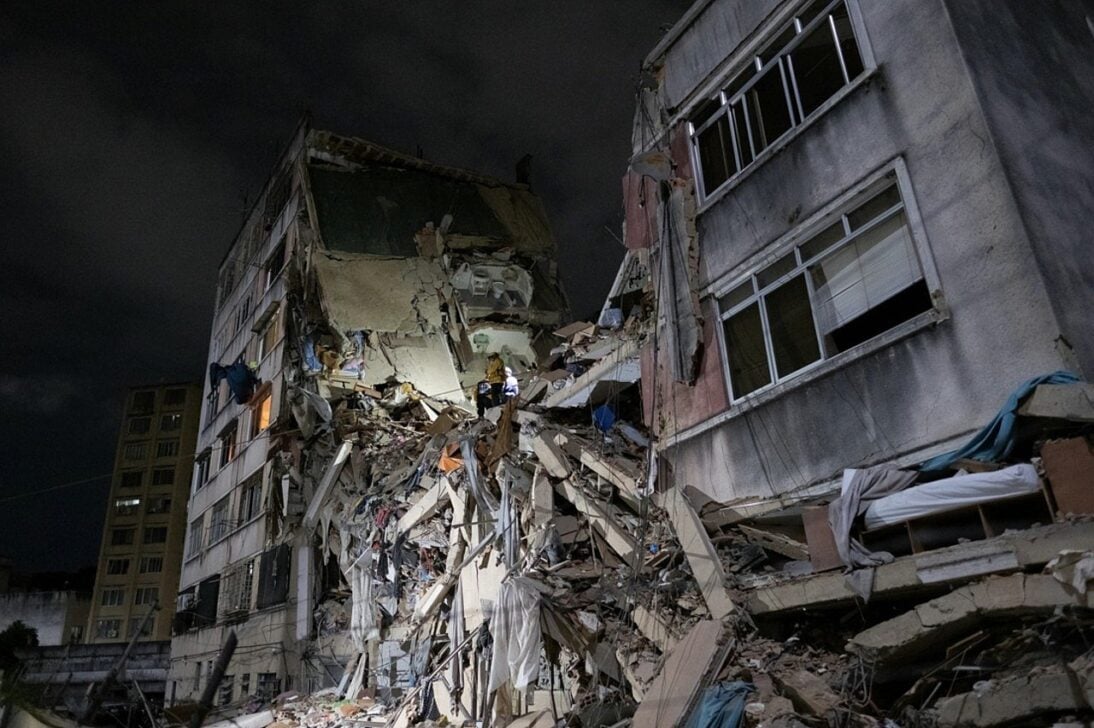
The intense search for survivors of the strong earthquakes that shook Venezuela on Wednesday night (24) continues this Thursday (25), after 164 deaths and 971 injuries have been recorded so far. More than 500 emergency teams work tirelessly to extract people from the rubble.
The moment of rescue of each life has been a reason for great celebration among Venezuelans, amid the tremors that are considered the most severe to hit the country in a century.
Two large earthquakes, with magnitudes of 7.2 and 7.5, shook Venezuelan territory, generating at least 20 aftershocks in the following hours, according to information from the local government. Buildings and residences collapsed in the capital, Caracas, and in several other cities, while the tremors were even noticed in municipalities in the North of Brazil.
Although 164 deaths had been confirmed as of Thursday morning, the United States Geological Survey projects that the total number of fatalities could vary drastically, between 10,000 and 100,000.
The Brazilian Ministry of Foreign Affairs, Itamaraty, reported that there is no record of Brazilians among the people affected by the earthquakes.
Numerous heads of state and government expressed solidarity and offered to send humanitarian assistance, including medical supplies and specialized rescue teams. Countries such as Brazil, the United States, Türkiye, Mexico and Portugal, which have already experienced devastating earthquakes, are on the list of nations offering support.
The interim president of Venezuela, Delcy Rodríguez, expressed gratitude to the international community for the support received, highlighting the expectation of the arrival of first foreign rescuers in the coming hours.
Faced with the calamity, the Venezuelan government chose to suspend classes and disable non-essential services, in order to concentrate all efforts on rescue operations.
The President of the United States, Donald Trump, reinforced his solidarity and stated that he had activated all American government agencies to provide assistance.
China, historically a major importer of Venezuelan oil before the capture and arrest of Nicolás Maduro by the American military, also assured that it will do everything possible to collaborate with the situation.
Detailed overview of earthquakes

The two main tremors occurred shortly after 7pm Brasília time, with an interval of less than a minute between them. The epicenter of the most intense earthquake was located near the city of El Guayabo, approximately 160 kilometers from the capital Caracas.
After the earthquakes, the interim president of Venezuela declared a state of emergency. In a televised address, she announced the mobilization of rescue, security and civil assistance teams to the impacted areas.
Delcy Rodríguez also reported on the cancellation of school activities and all services considered non-essential, prioritizing the rescue of people trapped under the wreckage. Gas and electricity networks were shut down to prevent further incidents.
How did earthquakes manifest?
The United States Geological Survey (USGS) documented two earthquakes whose epicenters were just 5 kilometers apart: one measuring 7.2 and the other measuring 7.5. According to the organization, these were the most powerful earthquakes to hit Venezuela in more than a hundred years.
The first earthquake occurred at 7pm (Brasília time). In less than a minute, a second, even stronger tremor hit the same location.
The epicenter of the most intense earthquake was recorded near the city of El Guayabo, approximately 168 kilometers from Caracas, and at a depth of 13 kilometers.
Because it occurred relatively close to the earth’s surface, the earthquake is classified as shallow. This type of seismic event is generally perceived with greater force and tends to cause more extensive damage to buildings and other infrastructure.
Consequences and impacts of tremors
Reports from authorities and residents indicate that buildings and houses collapsed in Caracas and other Venezuelan cities.
Several images show rescue teams working hard in the rubble of a collapsed building in the capital. Desperate family members are also seeking information about loved ones who may be buried.
On the coast, a hotel with at least eight floors was completely destroyed, with images on social media showing the extent of the building’s devastation.
Simón Bolívar International Airport, the country’s main airport, had to be closed after part of its roof structure gave way.
Hospitals in the capital were placed on high alert to treat the large number of injured people. In one of the health units, employees were called in to reinforce the teams on duty overnight.
Seismic shocks detected in Brazilian cities
Yes, the earthquakes were recorded by monitoring stations in Brazil, as reported by the Brazilian Seismographic Network, and noticed by residents of cities in the North of the country.
Residents of Belém, Manaus, Boa Vista and Macapá, among other municipalities in these states, reported having felt the tremors.
According to seismologist Bruno Collaço, from the USP Seismology Center, it is a relatively common occurrence for tremors of this magnitude to be felt over long distances.
The expert highlighted that, despite the scare that such events can cause among local inhabitants, at these distances there is no risk of structural damage to Brazilian cities.
There is no tsunami threat for the region
Initially, the United States Tsunami Warning System had issued a risk warning for Puerto Rico and the American and British Virgin Islands. The warning also mentioned the possibility of dangerous waves in Aruba, Curaçao and Bonaire.
However, the warning was canceled approximately one hour after it was issued, dispelling the threat.
Understanding the recurrence of earthquakes in Venezuela
Venezuela is located in an area of intense seismic activity, in the region where the Caribbean and South American tectonic plates meet, which explains the frequency of these events.
The country’s history is marked by devastating earthquakes. In 1812, for example, a large earthquake hit Caracas and Mérida, resulting in the deaths of around 30,000 people.