

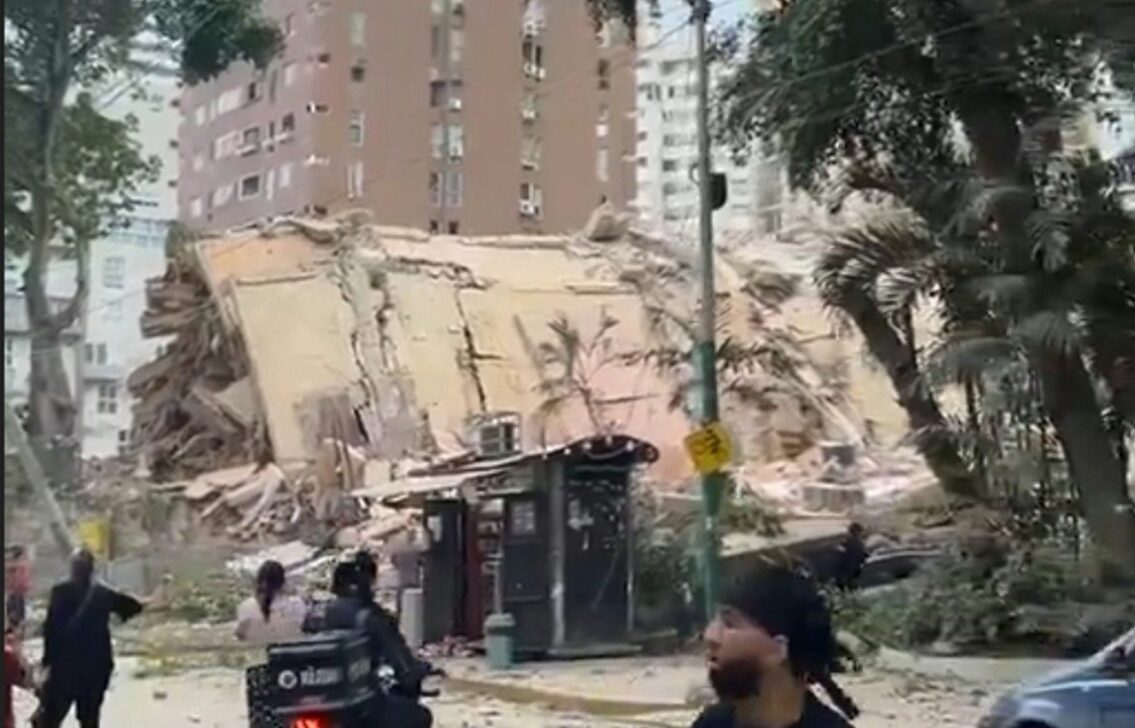
More than 900 people lost their lives and another 3,360 were injured due to the earthquakes that hit Venezuela, according to data released by the government. Rescue teams intensify the search for survivors, while countless families wait for information about their loved ones.
Survivors in need of medical care are being cared for in makeshift health units. This comes after the devastation of dozens of buildings in the northern region of the country, including in the capital Caracas, due to tremors.
A high-ranking government representative reported that hundreds of rescuers from other nations have already arrived to assist, and more teams are expected to join the efforts.
On Wednesday, two strong earthquakes hit Venezuela just a few seconds apart. The second of them, which reached a magnitude of 7.5, was considered one of the most powerful to impact Venezuelan territory in the last century.
Analysis of the severity and location of earthquakes in Venezuela
The La Guaira region, located north of the capital, suffered the greatest impacts, according to authorities. This state is crucial for the country, housing one of its main ports and the Simón Bolívar International Airport, in Maiquetía.
Many people remain missing, and there is great concern that the final toll of victims could increase as rescue operations progress.
In La Guaira, Natacha Diaz shared with the BBC the anguish of having her two daughters, aged 22 and 23, trapped under the rubble of a collapsed shopping center, where they worked as manicurists.
She reported that her daughters were with friends and expressed her only desire: “I just want them to be found. I have faith and hope that they are there.”
Moved, Natacha begged: “I just want them back with me. They’re all I have, please.”
The president of the National Assembly, Jorge Rodríguez, announced in a statement broadcast on state TV on Friday that the number of deaths had reached 920, and at least 172 individuals remained buried.
In the La Guaira area alone, 243 people were rescued, reported the parliamentarian, who is also the interim president’s brother.
Interim President Delcy Rodríguez highlighted in a televised press conference on Friday that dozens of people were pulled alive from the wreckage, which “brings us joy in being able to hug their families and loved ones.”
She also mentioned that 214 aftershocks have been recorded since the seismic events began.
Transformation of a hotel in La Guaira, from modern in 2023 to damaged structure in 2026
Hundreds of buildings were affected or completely destroyed, including several hospitals and shopping centers, according to Jorge Rodríguez. He added that around a thousand other infrastructure structures also suffered damage.
Health services still in operation are under immense pressure, with doctors telling the BBC that patient care was already challenging before the tragedy.
Doctor Pedro Javier Fernandez lamented: “All our hospitals lack supplies, there is a lack of medicines, we are unable to provide medical care to our population on a normal day.”
He concluded that, “now, with this tragedy, the emergency situation is even greater and more difficult to face than in other countries.”
Scenes of desolation amid the rubble after the catastrophe
There is constant concern that hundreds of people remain trapped under the rubble.
There are reports that rescue teams are removing debris with their bare hands. Interruptions in communications, damage to roads and scarcity of resources have hampered the first phase of responding to the crisis.
On Friday, a British military plane departed RAF Brize Norton air base in Oxfordshire towards Venezuela, carrying search and rescue teams, sniffer dogs and drones.
On board the flight were experts from 14 UK fire brigades, under the coordination of Merseyside Fire and Rescue.
Other nations, such as the United States, the Netherlands, Mexico and Switzerland, also sent their support teams. The USA also announced the sending of warships, transport aircraft and aid of US$150 million, equivalent to R$113 million.
A BBC journalist, present in Caraballeda, in the state of La Guaira, witnessed the arrival of heavy machinery to begin removing the rubble.

Action by volunteers in Catia La Mar in the search for survivors
Volunteers in Catia La Mar work to remove a metal gate as they search through the rubble of collapsed buildings.
The secretary general of the Norwegian Refugee Council said international rescue teams at the scene found “horrific damage”.
Jan Egeland explained to the BBC that Venezuela was unprepared and vulnerable in the face of the emergency. The country’s infrastructure was already precarious, the result of decades of underinvestment, a problem that the intense economic crisis, experienced for more than a decade, worsened, drastically deteriorating the population’s standard of living.
Tom Fletcher, the UN’s humanitarian chief, had previously stated that the disaster “requires a global international response and we will coordinate that and we will deliver.”
He emphasized, “I want people in Venezuela to know that help is on the way.”
Military efforts to distribute humanitarian aid to affected areas
Military personnel are organizing the delivery of assistance to the locations most affected by the disaster.
A moment of hope for all of Venezuela was the rescue of three young brothers in La Guaira, who were pulled from the dust-covered rubble, in scenes broadcast on state television.
“Come here, my son, come here,” says a man to the first child who manages to emerge alive from a crack between the pieces of concrete.
Then a girl appears, and the man asks, “Are you brothers?”, to which she replies, “Yes, there are three of us.”
Shortly afterwards, with greater difficulty, the third sister emerges, visibly shaken and covered in dust from head to toe.
Tributes to the victims continue to pour in. The wife of Venezuelan football player Héctor Bello died while trying to protect the couple’s daughter, as revealed by his posts on social media and local news.
Bello shared on Instagram that “his precious love”, identified by the Venezuelan press as his wife Andrea, saved the child’s life during the tremors.
In a touching post, Bello wrote: “I will tell her the story of how you saved her, my love – how you gave your own life for our daughter, how you were a brave woman who never abandoned her, not even in her last breaths.”
Among the fatal victims, a Portuguese citizen and two Brazilians had their deaths confirmed by their respective governments.
Furthermore, four Spaniards lost their lives and 106 remain missing, as reported by the Spanish media, which cited the Ministry of Foreign Affairs.
Venezuela’s Interior Minister, Diosdado Cabello, confirmed that multiple states were hit by the two seismic events. In Caracas, the neighborhoods of Los Palos Grandes and Altamira were the most affected.
The government reported that the subsequent tremors predominantly affected the country’s northern coast, covering regions such as La Guaira, Aragua, Carabobo and Falcón.
Understanding the lethality of shallow seismic tremors
Leopoldo López, a leader of the Venezuelan opposition who lives in exile in Spain, described the devastation to BBC News as “huge” and said the population was in “shock”.
He lamented that “unfortunately, we are witnessing a parallel collapse of infrastructure as well as the inability of the State to provide timely rescue support to people in the devastated areas.”
Despite the difficulties, López highlighted the existence of “tremendous support from civil society in Venezuela.”
This natural disaster occurs in a period of great instability for Venezuela.
Less than six months ago, Nicolás Maduro, the left-wing leader who had governed the country since 2013, was detained by American forces in Caracas and transferred to New York to face drug trafficking charges.
After his arrest, Delcy Rodríguez, Maduro’s ally and former vice president, took charge of the country. This move frustrated opposition supporters, who had hoped that the Trump administration would bring opposition leader María Corina Machado to power.