

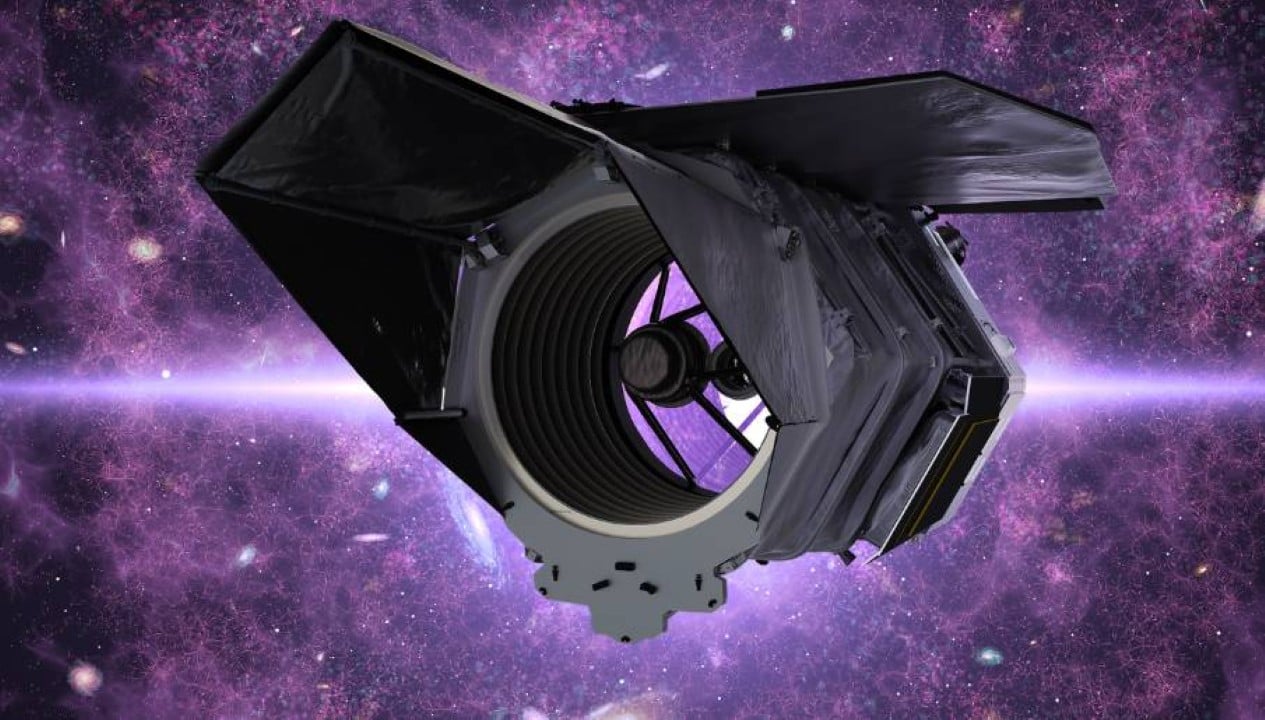
NASA’s Nancy Grace Roman space telescope arrived at the Kennedy Space Center, in Florida, last Sunday (21), to begin the last stage of testing before its launch. The equipment, transported by ferry from Maryland, will undergo rigorous evaluations for takeoff scheduled for August 30th. The mission aims to unravel the mysteries of dark energy and understand the accelerated expansion of the universe.
With a mass of 8,200 kilograms, the observatory disembarked from the Pegasus ferry and was first directed to the dangerous cargo area, before being moved to a clean room. The verification planning covers testing the six solar panels, the thermal insulation systems and all temperature control elements. Next, the technicians will fill the tank with 1,100 liters of hydrazine, essential fuel for orbital maneuvers and course corrections.
The final goal of the space journey is the L2 Lagrange point, a region of gravitational stability located at a distance four times greater than that which separates the Earth from the Moon, ideal for observations of the cosmos. For its deep space exploration role, the telescope is equipped with a 2.4-meter primary mirror and an advanced coronagraph.

Even with its robust construction, the new observatory’s most notable feature is its powerful 300.8 MP multi-band camera. This sensor can record vast portions of the sky in both visible and near-infrared light, with an extremely high degree of detail. The device’s remarkable breadth of field of view is a crucial differentiator for science, as a single image captured by Roman covers an area a hundred times larger than the usual photographs from the renowned Hubble telescope, allowing an unprecedented sweep of the universe in search of new discoveries and the massive collection of data on dark energy.
The telescope’s primary mission is scheduled to extend for at least five consecutive years in orbit. However, there is the prospect of extending this period, as long as its measuring instruments remain operational and the fuel stock is sufficient to extend activities for more years.