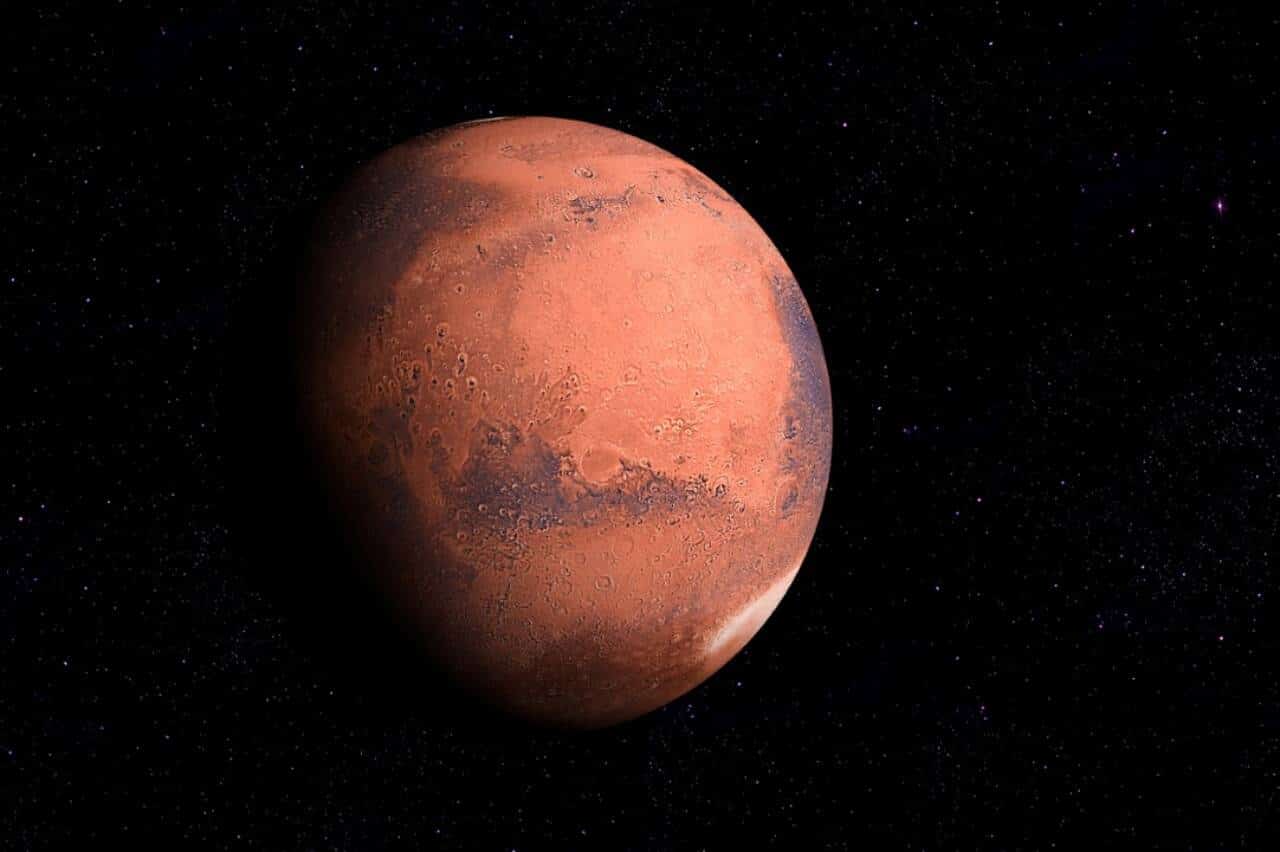
On Mars, Olympus Mons volcano reaches almost triple the height of Mount Everest By Carolina Costa
2 min read
 |
At an impressive 22 kilometers high and with a base that rivals the size of Italy, Olympus Mons is widely recognized as the highest mountain and largest volcano in the entire Solar System.
Although Mount Everest is the most common reference for colossal mountains, the true sovereignty in terms of height in the Solar System belongs to Olympus Mons. This gigantic Martian volcano rises to approximately 22 kilometers, an elevation that is almost three times the highest peak on planet Earth.
In addition to its notable elevation, Olympus Mons is impressive in size. The area of its base covers approximately 300 thousand square kilometers, a size equivalent to the Italian territory. Its diameter exceeds 600 kilometers, which makes it a geological formation easily visible in satellite records of the red planet.
Olympus Mons is categorized as a shield volcano, a type of structure that forms from successive eruptions of highly fluid lava. This process results in broad, shallow slopes, characteristics that differentiate it from the steeper volcanoes that are commonly found in different parts of the Earth.
Scientists propose that the exceptional size of this mountain is intrinsically linked to the geological peculiarities of Mars. Unlike Earth, the red planet does not have active plate tectonics. This allowed a single hot spot in the interior of Mars to continuously fuel the volcano for millions of years, enabling it to grow uninterrupted without moving the crust.
Another determining factor is the gravity on Mars, which represents about 38% of Earth’s gravity. With a reduced gravitational force, geological structures have the ability to reach considerably greater heights before reaching a point of instability. The combination of low gravity and the absence of plate tectonics established ideal conditions for the formation of the largest volcano ever known.
Although it is considered geologically recent in comparison to other Martian formations, there is no evidence to confirm that Olympus Mons is still active today. Some investigations suggest that its most recent eruptions may have occurred a few million years ago, a relatively brief period on the Solar System’s geological timescale.
More than a mere astronomical curiosity, Olympus Mons offers researchers crucial information for understanding planetary evolution over time. Analysis of its structure provides clues about the internal composition of Mars, its volcanic activity and the changes that have shaped the Martian surface since the planet’s origin, more than four billion years ago.