Passage of comet Tempel 2 by Earth requires the use of telescopes in August 2026 By Luís Henrique Costa
5 min read
 |
Space observation lovers have an unmissable target in the astronomical calendar at the beginning of August 2026. The celestial body 10P/Tempel 2, a block of ice and rock measuring an impressive 11 kilometers in length, will make its long-awaited visit to Earth’s surroundings, completing another cycle of its orbit that lasts just over five years.
Regular passes of space rocks of this magnitude provide researchers with rare data collection opportunities. The scientific community sees these frozen travelers as natural laboratories, capable of revealing secrets about how our cosmic neighborhood was formed and evolved over the millennia.
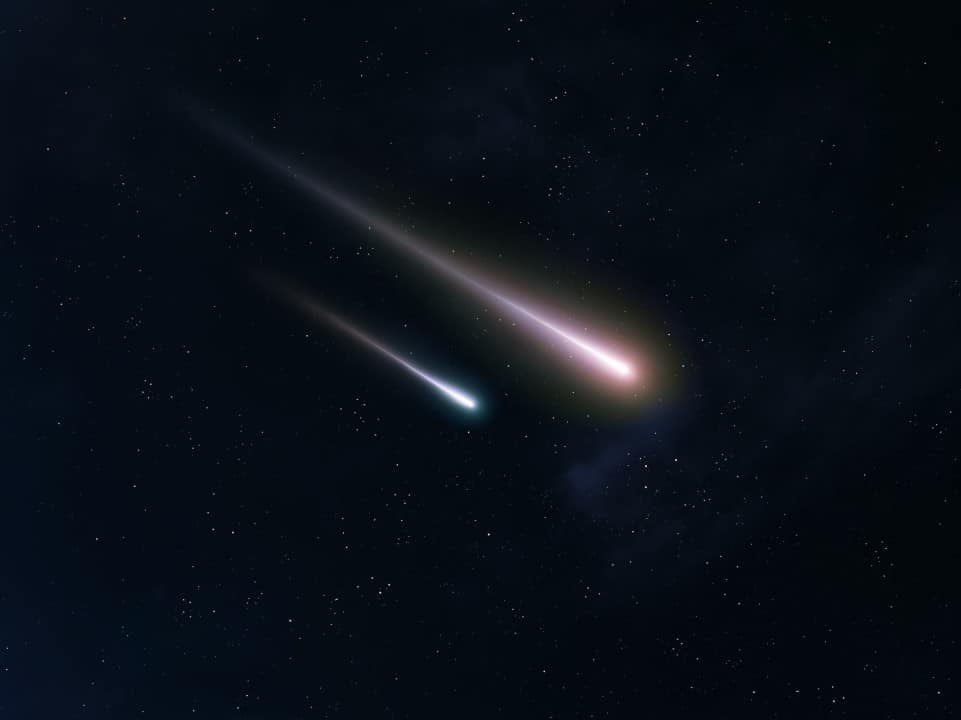
Over the next few weeks, 10P/Tempel 2, which appears on the list of interplanetary objects most documented by science, completes another revolution around the Sun. This journey culminates in its closest approach to our planet in the first days of the eighth month of 2026.
Origin and classification of the celestial body 10P/Tempel 2 in astronomy
Officially cataloged under the acronym 10P/Tempel 2, the object belongs to the so-called family of Jupiter comets. This category groups celestial bodies that have short orbits and that suffer strong gravitational influence from the gas giant, which ends up dictating the pace and format of their travel through space.
The first visual record of this rock occurred on July 4, 1873, thanks to the meticulous work of German astronomer Wilhelm Tempel. Operating the equipment at the Brera Observatory, located in Italy, he cataloged the object that, since then, has never stopped being tracked by subsequent generations of specialists.
Approach calendar defines the best days to follow the phenomenon
This year’s orbital schedule holds two peak moments for observers. On August 2, 2026, the rock reaches perihelion, the moment when it feels the maximum heat upon reaching the closest point to the Sun, while August 3, 2026 marks the minimum distance from the Earth’s surface.
In this short period, the mathematical prediction indicates that the object will reach a visual magnitude of around 6.9. Although the number may seem complex, in practice it means that the glow generated will be strong enough to be captured by entry observation equipment, without the need for expensive professional machinery.
Equipment needed to view the glow in the night sky
Anyone hoping to look up and see the light trail with the naked eye will be disappointed. Even though it has a light reflection rate considered high by astronomical standards, the limits of human vision require the help of magnifying lenses for the spectacle to be truly appreciated.
- Use binoculars with specifications of 10×50 or higher lenses to capture more light;
- Set up amateur-sized telescopes, ideal for focusing on the core of the object;
- Download star mapping software on your cell phone to find the exact coordinates;
- Avoid large urban centers, seeking rural areas free from artificial lighting;
- Remember that the total darkness of the environment is the factor that most increases the clarity of the luminous tail.
Positioning favors observers located in the Southern Hemisphere
Residents of the southern half of the globe gain a geographical advantage during this year’s passage. The orbit’s inclination angle will make the celestial body appear very high in the sky during the early hours of the morning, making it easier to track far from the horizon.
The approach path begins to become evident in July, when the object crosses the starry background of the Capricorn constellation. At the turn of August, the target moves quickly and starts to transit in the vicinity of the constellation of Piscis Austrinus, popularly called the Southern Fish.
Constant monitoring rules out any chance of impact with Earth
News about giant rocks approaching our world often generates unfounded panic on social media, but official data reassures the population. Space agencies from around the world have already calculated the route and confirm that the distance maintained will be gigantic and completely safe.
The history of more than a century and a half of notes on this space traveler provides a robust database for scientists. Modern computing systems can project every inch of the route, eliminating the likelihood of a catastrophic collision during the event.
- The current trajectory maintains the already known pattern of gravitational stability;
- Continuous tracking over decades prevents surprises en route;
- The calculated minimum distance rules out any physical shock scenario;
- The visit is part of a natural and predictable cosmic ballet of our system.
Frozen structure holds secrets from billions of years ago
Physically, these structures function like huge dirty snowballs, mixing frozen water, cosmic dust, minerals and carbon-based compounds. Astronomers treat these rocks as relics preserved in a vacuum, as they carry the same raw material that formed the Solar System about 4.6 billion years ago.
The visual show only happens because, as it dives toward the center of the system, the Sun’s extreme heat instantly vaporizes the surface ice. This violent process ejects jets of gas and dust into space, creating the famous glowing cloud around the core and the tail that stretches for millions of kilometers.
The role of space rocks in understanding life on Earth
Each new visit by a periodical body delivers an unprecedented chemical puzzle to terrestrial laboratories. Analyzing the light reflected by these gases makes it possible to discover exactly which elements were floating in space even before the rocky planets gained their definitive shape.
More than understanding the distant past, the continuous study of these structures fuels one of the most fascinating hypotheses in modern science. Many astrobiologists argue that the bombardment of comets on the early Earth was largely responsible for seeding the oceans and delivering the organic molecules that kicked off the emergence of life.