Scientific confirmation reveals origin of 24 km crater discovered on Google Maps
Fragments from space strike Earth frequently, with approximately 40,100 tons of interplanetary material and meteoroids penetrating the atmosphere annually. Most of these objects disintegrate before reaching the surface, without generating consequences.
However, occasionally, a remnant from the formation of the solar system is large enough to create a significant scar on the Earth’s landscape. An example is the Chicxulub crater, associated with the event that caused the extinction of the dinosaurs, which measures between 150 and 200 kilometers wide and around 19 kilometers deep.
The exact location of this asteroid’s impact took more than ten years to determine after its initial hypothesis, as the 66-million-year-old crater was mostly hidden under layers of rocks and sediments, with half of its extent submerged in the Gulf of Mexico.
On the same topic: Space rock that hit home in the United States reveals clues about the origin of life
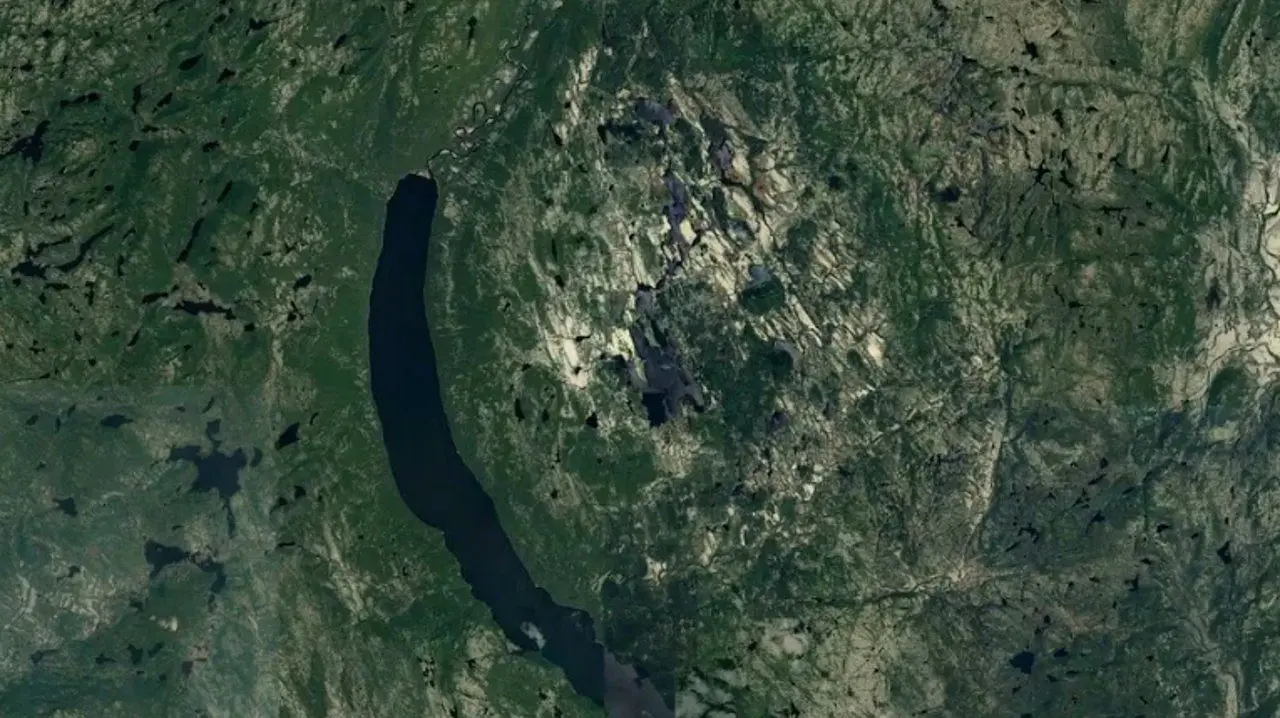
Several other craters, although visible, are only identified when discerning observers recognize their characteristic signs. This occurred with the Uhaachatik crater, recently confirmed in Quebec.
Amateur astronomer’s unexpected discovery of vast crater
The discovery of the impact crater was made by Joël Lapointe, an amateur astronomer, who found it accidentally while planning a camping trip in the Côte-Nord area via Google Maps. He identified a large circular formation located in the center of Lake Marsal, approximately 100 kilometers north of Magpie, Quebec.
See Also

Learn how to identify intrusions on WhatsApp and avoid financial fraud

PlayStation 5 owners gain lifetime access to three great games

Russian Islam Makhachev dominates Ian Machado Garry and wins main fight at UFC 330
More on this story: SpaceX rocket stage collision on the Moon forms 18-meter crater, reports NASA
Lapointe communicated his observation to professional researchers, including French geophysicist Pierre Rochette. The scientist stated that the topographic configuration of the site was “very suggestive of an impact”. Additionally, preliminary samples from the area revealed the presence of zircon, a mineral commonly associated with meteorite collisions.
After about a year, in October 2025, a team of investigators managed to go to the location to confirm. They found clear evidence of a meteorite impact, such as the presence of fragmentation cones, which are observed as grooves or lines on the surface of rocks.
The site also featured cliffs formed by molten rock, the result of the intense heat and pressure generated by the meteor’s collision with the Earth’s surface. Analysis of the collected rock samples allowed researchers to determine that the impact occurred 390 million years ago.
Learn more: SpaceX’s Falcon 9 rocket collides with the Moon on August 5 in an event that interests scientists
Gordon Osinski, a member of the expedition team, revealed that he frequently receives communications from individuals who believe they have found meteorite impact craters. He said that, “In 99 out of 100 cases, it turns out not to be the case. This is one of those rare examples that shows that this is possible.”
The crater has an approximate diameter of 25 kilometers. Osinski said that while one or two craters are typically discovered annually, finding one of this size “is quite rare.”