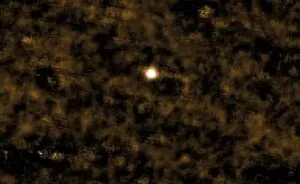
X-ray probe reveals sizzling gas from primordial black hole at 36 million degrees
Recent observations by NASA’s Chandra X-ray Space Telescope have detected extremely hot gases, with temperatures reaching 36 million degrees Fahrenheit (about 20 million degrees Celsius), emanating from one of the oldest quasars ever studied. This discovery provides the first detailed look at how atmospheres surrounding galaxy clusters began to form in the early universe, 2.1 billion years after the Big Bang.
Discovery marks key moment in cosmic evolution
Astronomers focused on the quasar MQN01, located at the center of a galactic proto-cluster still in formation. What they identified are the glowing “emissions” of a supermassive black hole that is actively feeding. These scorching gas structures extend approximately 100,000 light-years around the quasar and are considered the precursors of what we now know as the intracluster medium (ICM) – the gaseous atmospheres that permeate modern galaxy clusters.
The research is fundamental because it reveals a crucial moment in cosmic history: the exact moment when these vast galactic atmospheres began to consolidate. Understanding this process is vital to unraveling how galaxies and large cosmic structures have evolved over time.
Understanding the formation of galactic atmospheres
The central question for scientists is deciphering how this hot phase of matter forms in the universe. The MQN01 study offers an unprecedented glimpse into the physical conditions of the gas during its formation phase and the mechanisms that contribute to its heating. Sebastiano Cantalupo, a member of the team from the University of Milan-Bicocca, said that the data demonstrate extraordinary properties of the gas, providing the first clues about the formation of this hot phase of the circumgalactic medium, which develops in the intracluster medium. The detection in such a distant quasar suggests that the process of heating by gravitational shocks was a dominant factor.
More on this story: NASA telescope captures gas cloud at 20 million degrees in ancient black hole
The importance of a “silent” quasar for research
A distinctive aspect of the MQN01 quasar is that it is classified as “radio-quiet”, meaning it does not have the intense, fast particle jets that are commonly observed in “radio-loud” quasars. This feature is crucial for the research, as it ensures that the X-ray emissions detected by Chandra come exclusively from superheated thermal gas, and not from plasma jets.
This purity in observation allowed researchers to isolate and study the gas heating process more precisely. In contrast, in quasars with active radio emissions, the presence of jets can obscure or contaminate measurements of the surrounding gas, making it difficult to understand its origin and evolution. The ability to observe the black hole’s “engine” without interference from jets offers a clear window into the fundamental mechanisms of formation of galactic atmospheres.
Extreme conditions in the early universe
Measurements obtained by the Chandra telescope, resulting from 180 hours of observation, revealed extreme physical conditions in the environment of the MQN01 quasar. In addition to the temperature of 36 million degrees Fahrenheit, the recorded densities and pressures are surprisingly high, being one or two orders of magnitude greater than those found in galaxy clusters in the local universe.
See Also

Electrical discharge knocks man off roof in Jaguaruana after contact with power lines

Global auction raises US$11.9 million and Brazil’s historic currency reaches record value

Former fighter Prichard Colón dies at age 33 after decade in a vegetative state
These numbers indicate a much denser and more energetic environment in the early universe, which is consistent with the idea that cold gas was in the process of collapsing toward the gravitational potential of a massive halo, and was subsequently heated by intense gravitational shocks. This compression and heating shaped the first galactic atmospheres, with characteristics that differ significantly from the more mature structures observed today.
Next steps and challenges for cosmic research
The team of researchers faced the challenge of separating the faint light of the gas from the blinding glow of the gas closest to the central black hole. They applied a technique usually used in the analysis of Seyfert galaxies, which harbor active supermassive black holes in the nearby universe. Initially, INAF’s Andrea Travascio team expressed skepticism due to the exceptional nature of the data.
Learn more: NASA telescopes reveal that the Milky Way is 10% larger than estimated
However, after extensive checking and ruling out alternative explanations such as instrumental artifacts or other unexpected effects, the thermal hypothesis was shown to be the only one consistent with the physical data collected. Scientists now plan:
- Analyze archival datasets from hundreds of other quasars to determine whether this heating phase is a common phenomenon in protoclusters or whether MQN01 is a rare exception.
- Continue exploring the extraordinary capacity of the Chandra telescope, which, even after decades of operation and facing technical difficulties in its final phases, has demonstrated its ability to produce relevant and innovative scientific results.
These future investigations will be crucial to deepening understanding of how supermassive black holes have influenced the formation and evolution of the largest structures in the universe.