NASA telescope captures gas cloud at 20 million degrees in ancient black hole
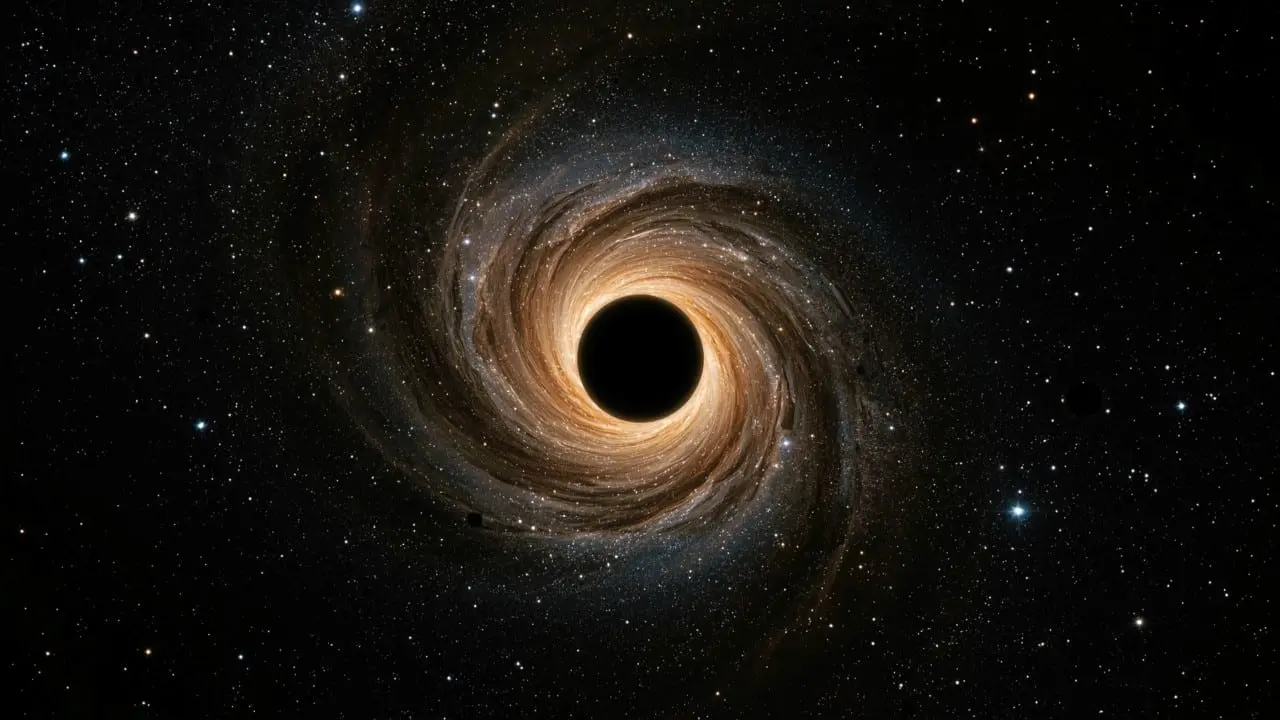
The Chandra space observatory, operated by NASA, recently captured an impressive gaseous mass reaching temperatures of around 20 million degrees Celsius around one of the oldest objects ever cataloged by science. This unprecedented finding offers astronomers a direct window into the period when the universe was just 2.1 billion years old, revealing the early stages of formation of the gigantic bubbles that surround star clusters today.
The role of quasar MQN01 in the architecture of the early universe
During the study, experts’ attention turned to MQN01, a super-bright celestial body located in the nucleus of a cluster of galaxies still in its infancy. The images recorded incandescent material being ejected as a colossal mass black hole actively devours matter, creating a scorching cloud that projects about 100,000 light-years away. This colossal structure functions as the seed of the so-called intracluster medium, the vast plasma network that fills the space between contemporary galaxies.
The relevance of this mapping lies in its ability to document a historical transition in the cosmos, marking exactly when these immense atmospheres began to take definitive shape. Having access to this ancient portrait helps the scientific community piece together the puzzle about how large cosmic systems grew and stabilized over billions of years.
Heating mechanisms and space plasma dynamics
One of the greatest mysteries of modern astrophysics has always been understanding the origin of this superheated matter spread across the vacuum. By analyzing MQN01, the researchers were able to observe the unprecedented physical properties of this material in its embryonic stage, as explained by Sebastiano Cantalupo, researcher at the University of Milan-Bicocca. According to the expert, the data indicates that the friction generated by intense gravitational shocks was the main driver responsible for raising the temperature of the gas to such extreme levels at that remote time.
More on this story: X-ray probe reveals sizzling gas from primordial black hole at 36 million degrees
The absence of radiation jets facilitated data collection
The great difference that made this discovery possible was the peculiar nature of the chosen target, cataloged by astronomers as a silent object at radio frequencies. In practice, this indicates that it does not emit those violent beams of high-speed particles, common in other similar bodies, ensuring that the X-rays captured by American instruments were generated solely by the extreme heat of the surrounding gas.
Having a setting free of this radioactive pollution allowed the team to isolate the thermal signature with unprecedented precision. When a black hole emits powerful jets, this interference often overshadows sensors and masks the real behavior of neighboring matter. Without this background noise, scientists were able to look directly at the inner workings of the system, better understanding the mechanics that forged the first galactic neighborhoods.
Record pressure and density reveal a hostile environment
To reach these conclusions, the American space agency’s equipment had to stare at the same point in the sky for 180 uninterrupted hours, unveiling a scenario of extreme physical violence. In addition to heat of around 20 million degrees Celsius, records showed that the density and pressure around this black hole are up to a hundred times greater than any similar environment found in galaxies close to the Milky Way.
See Also

Electrical discharge knocks man off roof in Jaguaruana after contact with power lines

Global auction raises US$11.9 million and Brazil’s historic currency reaches record value

Former fighter Prichard Colón dies at age 33 after decade in a vegetative state
Such indicators prove that the universe in its youth was a considerably more chaotic and concentrated place. The most accepted theory now is that clouds of icy gas were pulled violently by the force of gravity towards the center of mass, undergoing compressions so brutal that they ended up frying in the process, generating an ecosystem completely different from the calm and mature structures we observe today.
The future of observations and the search for new celestial patterns
During the analysis, the main technical obstacle was being able to filter the faint glow of the peripheral cloud against the blinding light emitted by the active core itself. To get around the problem, experts adapted methods normally used to study Seyfert-type galaxies, which are much closer to Earth. The novelty of the information was so great that Andrea Travascio, a scientist at the Italian National Institute of Astrophysics (INAF), admitted to having doubted the results at first.
Learn more: Interstellar comet radio emission prompts NASA to activate planetary defense
However, after a rigorous battery of tests that ruled out sensor failures or optical illusions, the team confirmed that thermal origin was the only mathematically viable explanation for the phenomenon. Based on this validation, the scientific consortium’s next steps include:
- Scour the data archives of hundreds of other primitive black holes to discover whether this cosmic furnace is a rule of the young universe or just an isolated anomaly of MQN01.
- Maximize the use of the Chandra Observatory, which, despite operating for more than two decades and facing recent threats of budget cuts from the US government, continues to deliver unparalleled cutting-edge science.
The advancement of these research fronts will be crucial for humanity to definitively understand the importance that supermassive black holes had in sculpting the cosmos. Mapping this primordial influence is key to unraveling how space went from being a shapeless soup of particles to becoming the complex web of galaxies we know today.