August promises partial eclipses of the sun and moon and meteor showers for observers in 2026
The month of August 2026 will be full of celestial events for astronomy enthusiasts, including partial eclipses of the sun and moon, as well as the visibility of the Milky Way. The phenomena will provide unique night sky observation opportunities for several regions, marking a period of great astronomical activity.
Unmissable sights in the August night sky
Partial eclipses of both the sun and moon are predicted to happen this month. Summer constellations and the Milky Way will be seen after dark, stretching from the northeast to the southeast and rising higher and higher in the sky until dawn. August is considered the peak for observing the Milky Way in the Northern Hemisphere, when our galaxy is visible throughout the night.
Celestial highlights include lunar and solar phenomena
The month of August will bring an “eclipse season”, placing the moon and the sun as the protagonists due to their partial eclipses, which will have wide visibility in some parts of the world. Additionally, the Perseid meteor shower will reach its peak, promising a “shooting star” spectacle that will also be a highlight of the month.
Top astronomical events to observe in August
On August 7, a thin crescent moon will keep company with the Pleiades in the east before dawn. The scene is ideal for photographing with smartphones or digital cameras using zoom.
On the morning of August 9, notice in the eastern sky before sunrise the proximity of reddish Mars and the waxing moon. This is another excellent chance for zoom photos.
For those who like to follow the variations in brightness of the star Algol, on August 10 it will reach its minimum luminosity for around two hours, peaking at 2:23 am. Other dates to observe Algol are listed below.
On August 11, Mercury and an extremely thin crescent moon will appear above the eastern horizon before dawn. You will need an unobstructed view of the horizon and binoculars to help observe the pair.
More on this story: August holds two eclipses in the sky, but Brazilians will only watch one of the events
A partial solar eclipse will be visible in some parts, such as the Washington D.C. region, beginning on August 12 at 1:17 pm and ending at 2:27 pm. In this area, the sun will be obscured by only about 1%. However, in parts of Greenland, Iceland, northern Russia, the Atlantic Ocean, Spain and a small portion of Portugal, observers will be able to experience a total solar eclipse, according to information from the American space agency.
Essential precautions for safe eclipse observation
It is essential to follow the safety requirements for viewing solar eclipses, in order to avoid eye injuries and damage to equipment such as smartphones and cameras.
If you plan to use solar eclipse-specific glasses or solar filters for your camera, smartphone, or other optical equipment, be sure to purchase them from reputable suppliers. In the years 2017 and 2024, there were products that did not meet the strict ISO standard, posing risks to the public.
For those who want to photograph the eclipse with a smartphone, the Solar Snap app was tested and demonstrated excellent performance.
On the same topic: August sky: 9 unmissable astronomical events, with solar eclipse and meteor shower
Between August 12th and 13th, the Perseid meteor shower peaks, which will not be harmed by the new moon, as it will have eclipsed the sun earlier. This is expected to be an exceptional event for meteor observation.
See Also

Nintendo launches nine games in May 2026 to unite Switch generations
NASA accelerates Artemis 3 mission with assembly of the Orion spacecraft and new tests

Apple system update crashes cell phones and drains battery quickly
On August 12, Algol will again enter its minimum brightness at 11:12 pm.
On August 15th, before dawn, Jupiter and Mercury will form a very close pair, very low on the eastern horizon. Mercury will be slightly to the left of Jupiter. A clear horizon and binoculars will be essential for this impressive sight. With a low magnification telescope, it is possible to see both planets.
On August 15, Venus will be in the west after sunset, accompanied by the crescent moon, forming an image worthy of photographic record.
On August 20, a bright crescent moon and the star Antares will be close together in the south after dark.
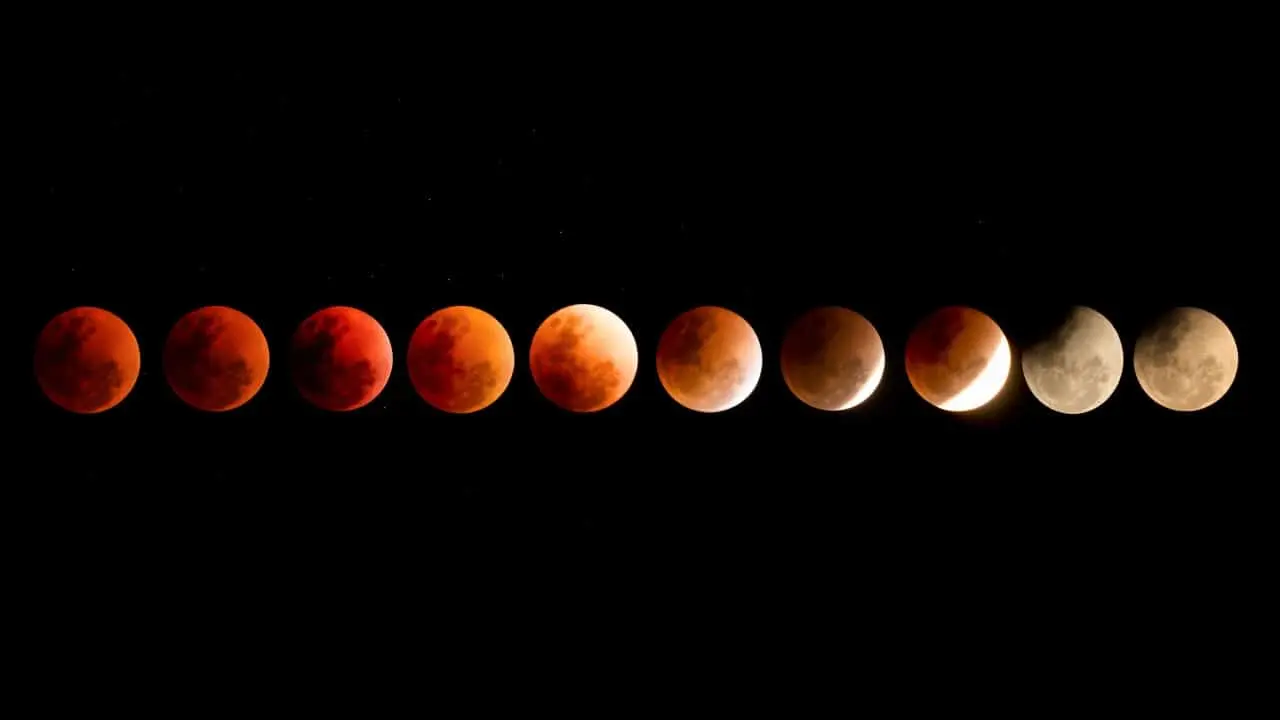
Between August 27 and 28, the full sturgeon moon will experience a deep partial lunar eclipse in the Washington D.C. region, beginning on August 27 at 9:23 pm and ending on August 28 at 3:01 am. You can get eclipse information for specific locations.
Learn more: August celestial events reserve solar and lunar eclipses with intense meteor shower
Tips for photographing the eclipse with a smartphone or camera are available to help those interested.
The lunar eclipse can be seen from almost anywhere, but the best observation is away from bright lights. When the moon is deep in the Earth’s shadow, the stars become more visible, offering the view of a copper-hued moon suspended in a sea of stars.
On August 30, Algol will have another moment of minimum brightness at 4:06 am.
Moon phases and eclipses in August
- August 6: Last Quarter
- August 12: New moon (with partial solar eclipse)
- August 20: First Quarter
- August 28: Full Sturgeon Moon (with partial deep lunar eclipse)
Positioning of the planets in the night sky
- Mercury: low in the east before dawn.
- Venus: in the west after sunset.
- Mars: in the east before dawn.
- Jupiter: emerging from the sun’s glare in the east before dawn.
- Saturn: visible from late evening to dawn.
- Uranus: in the western sky after dark. A telescope is needed for better observation, although it is visible with binoculars.
- Neptune: in the western sky after dark. Requires a telescope for observation.
- Pluto: distant in the solar system, requires the capture of images with a telescope, spaced by days, to locate it.
Observation opportunities in Washington D.C.
Amateur astronomers in the Washington, D.C. area will have a variety of opportunities, including “Let’s Talk About Space” presentations in Shenandoah National Park, as well as evening ranger programs.
Other organizations such as NOVAC Online Meeting at George Mason University, National Capital Astronomers, and The Analemma Society, which has resumed operations of its observatory, offer astronomy activities. The Smithsonian Air and Space Museum in D.C. and Chantilly also features several astronomy-related attractions in August, including the new “Smithsonian Starstruck” immersive experience.
The Nancy Grace Roman Space Telescope mission is scheduled to launch on August 30 from the Kennedy Space Center in Florida by the American space agency.