

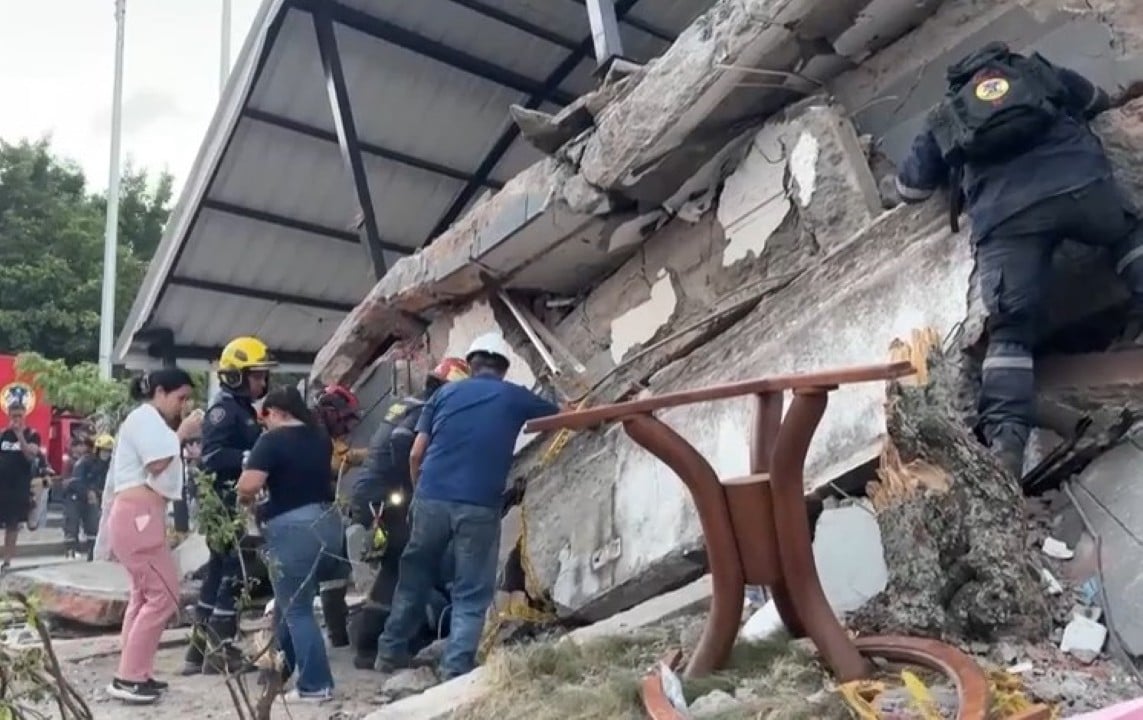
A powerful 7.4 magnitude earthquake devastated Colombia on August 10, resulting in the deaths of at least 132 people and leaving more than 570 injured. The earthquake caused great destruction, with hundreds of individuals still missing under the rubble, mainly in the city of Cali. The mobilization of rescue teams is intense as the nation tries to overcome the damage.
Colombia records increase in the number of victims and missing people after earthquake
The death toll from the earthquake that hit Colombia has now reached at least 132, with 570 injured and an increasing number of missing. The Colombian Association of Capitals (Asocapitales) reported that Pereira, capital of the department of Risaralda, was the city most affected, with 60 deaths. In Cali, a report released by Colombian President Abelardo de la Espriella indicates that 188 people are still missing. The earthquake was felt in several regions of Colombia and also in neighboring countries.
More on this story: 7.4 earthquake in Colombia leads to search for 179 dead on second day
Damage to infrastructure: Hospitals and airports are affected
Colombian infrastructure suffered significant damage in several cities. Three hospitals completely collapsed, 18 were partially damaged and 39 schools were affected. In Cali, more than 5,000 homes were damaged or collapsed, leading Alfonso Bonilla Aragón international airport to temporarily suspend operations due to power cuts. After technical inspections and complete restoration of power, the air terminal resumed its normal activities. The tower of the Manizales Cathedral also collapsed.
Rescue efforts and international support underway
Rescue teams work tirelessly to locate survivors. In Cali, a moment of hope emerged with the rescue of a mother and her newborn baby from a collapsed building, both in stable condition. Carlos Ortiz, a rescuer involved in the operation, confirmed that seven people have already been saved and that the search for others, including an elderly couple and their grandson, continues.
The international community has responded to the disaster. The United States announced aid of US$15.5 million for Colombia. Venezuela, through its interim president Delcy Rodríguez, has also activated mechanisms to organize and distribute humanitarian aid. Internally, Senate President Honorio Henríquez asked Colombian parliamentarians to donate a month’s salary to support affected families, highlighting the need for national unity.
Aftershocks shake region and experts explain seismic phenomenon
The Geological Survey of Colombia recorded at least 47 aftershocks after the main earthquake. The agency warns that new tremors are likely, although of smaller magnitude. Aftershocks are smaller seismic movements that occur in the same region after a large earthquake, as energy continues to be released until the Earth’s crust reaches a new equilibrium.
- The Earth shakes due to the movement of the rigid plates of the Earth’s crust, which move like “rafts” over more fluid rocks.
- The interactions of these plates are the cause of tremors, which tend to occur in historically seismic areas.
- Colombia, Japan and the Caribbean are high-risk regions due to the frequency of earthquakes.
- Each earthquake has its own story, and events like this one in Colombia are independent of others that occurred in different parts of the world, such as Japan or Italy.
The geologist also stated that, in Colombia, more aftershocks are expected in the coming days, but the expectation is that the main tremor was the one on August 10 and that seismic activity will gradually decrease.
Recommendations for earthquake-resistant buildings
Although earthquakes cannot be predicted, Andrea Billi emphasized the importance of protecting against their consequences. “In seismic zones, their consequences can be avoided,” said the expert. To achieve this, it is essential that houses and buildings are built or renovated following earthquake resistance criteria. This measure, although it may be expensive, is the only effective way to reduce the risk and protect the population in areas prone to these natural events. Save the Children also warned of the serious risks to the safety and well-being of children and families following the disaster.