

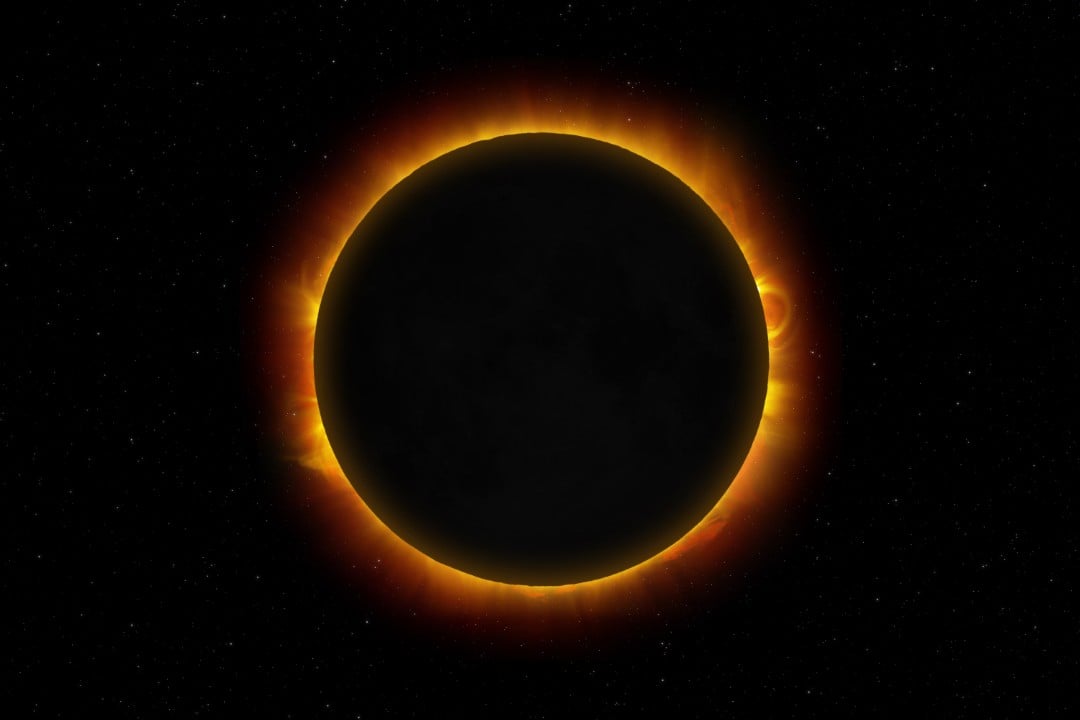
The space agency NASA has released its coverage plans and research activities for the total solar eclipse that will occur on August 12, 2026. The phenomenon will be visible in several regions of the Northern Hemisphere, and the agency promises a comprehensive live broadcast, in addition to unprecedented scientific experiments to study the solar corona and the impacts on the Earth’s atmosphere.
Where will it be possible to observe the solar eclipse
The total solar eclipse of August 12, 2026 can be followed directly in some specific areas. The path of totality will include places such as Greenland, Iceland, northern Russia, vast stretches of the Atlantic Ocean, Spain and a small portion of Portugal. Additionally, a portion of the phenomenon, such as a partial eclipse, will be accessible to observers in broader regions of the Northern Hemisphere, encompassing parts of the United States (from Alaska to North Carolina), most of Canada, much of Europe, and northwestern Africa.
On the same topic: NASA discovery: solar eclipse of 2186 will be the longest in 12 thousand years and will be 7m29s
NASA science projects during the event
During the passage of the lunar shadow, NASA will not limit itself to observation and broadcasting. The agency will coordinate several scientific projects with the aim of deepening knowledge about the Sun and Earth. A team of researchers, funded by NASA, will use a WB-57 high-altitude research aircraft to chase the eclipse’s shadow. The goal is to investigate the complex dynamics of the solar corona, the outermost layer of the Sun’s atmosphere, which is only visible in its entirety during these events.
Another initiative is the Nationwide Eclipse Ballooning Project, with support from NASA. Students from several American universities will travel to Iceland and Spain to launch scientific balloons. They will take measurements before, during and after the eclipse, seeking to understand how the temporary darkening of the skies, caused by the phenomenon, affects the Earth’s atmosphere and its different components.
Agency live broadcast details
NASA will organize full coverage of the eclipse, available to global audiences through its official platforms. The live broadcast will begin on August 12, 2026, with coverage scheduled for 2:15 pm (Brasília time). The moment of totality will begin in Iceland at 2:45 pm and then in Spain at 3:28 pm, following the same time zone. The agency also informed that photographs of the event will be made available on its official Flickr account shortly after the end, depending on visibility conditions. NASA experts will be available to answer questions submitted via social media during the broadcast.