A succession of four coronal mass ejections unleashed by active sunspot region AR4549 is currently traveling across interplanetary space toward Earth, threatening to spark moderate geomagnetic disturbances and ignite visible auroras across wide sections of the United States and Canada. This complex space weather event pushes the customary boundaries of the northern lights significantly farther south than normal, giving skywatchers in mid-latitude regions an uncommon chance to witness the atmospheric spectacle.
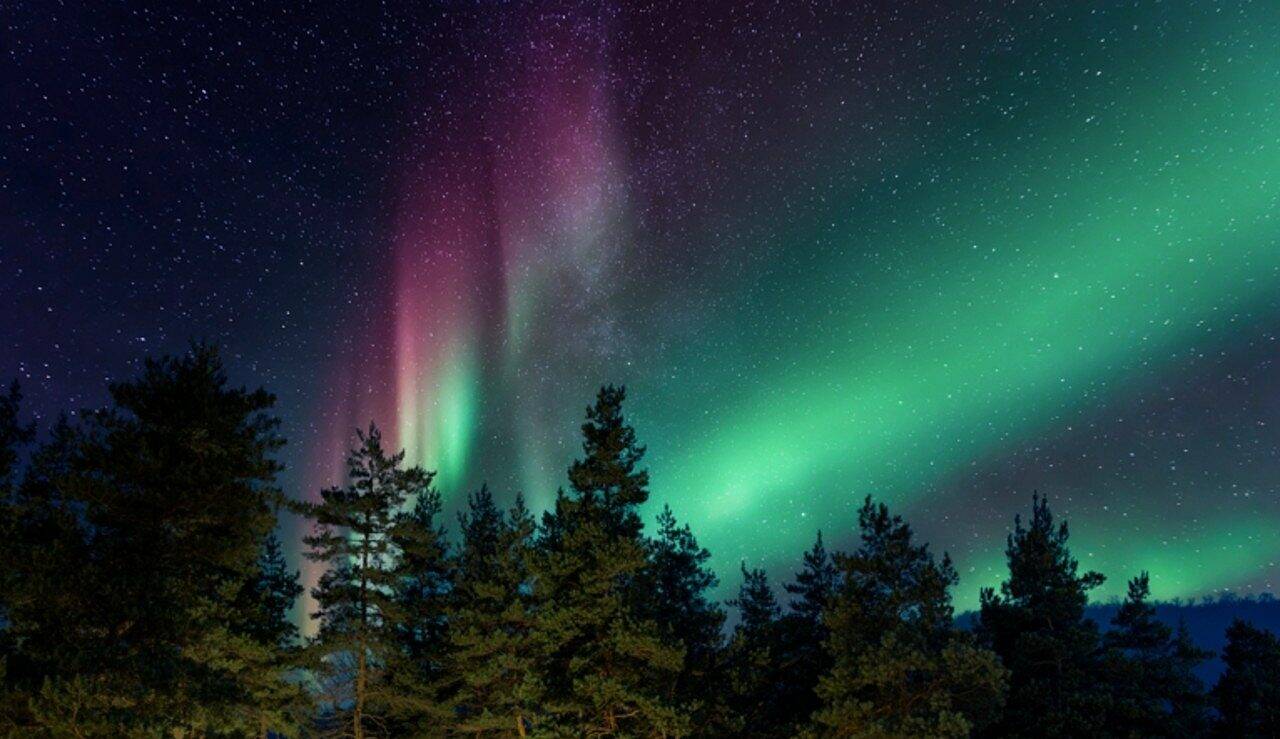
Forecasters at the Space Weather Prediction Center of the National Oceanic and Atmospheric Administration, known as NOAA, officially issued watches for moderate G2-class geomagnetic storms in response to the incoming solar material. Official updates from the agency indicate that auroral displays could reach skies across northern and upper Midwest states, stretching from New York through Idaho, while also offering viewing opportunities in Washington and Montana.
Active region AR4549 triggers repeated eruptions across the solar surface
Solar activity intensified substantially on Tuesday, October 6, 2026, at 08:05 Coordinated Universal Time, when active region AR4549 unleashed an M1.4-class solar flare. That initial burst of magnetic energy launched the first wave of coronal mass ejections that orbital observation spacecraft recorded heading into the inner solar system.

The volatile solar region erupted again on Thursday, October 8, 2026, producing a much stronger M6.7-magnitude flare at 15:48 UTC. This violent blast hurled a fourth coronal mass ejection directly outward, sharply increasing the volume of ionized material projected to interact with Earth’s magnetic envelope over the weekend.
Space weather physicist Tamitha Skov analyzed the cumulative effect of these successive particle streams on the surrounding space environment. In evaluating the earliest eruptions, Skov explained that the two coronal mass ejections launched on October 6 could reach Earth in quick succession, delivering an effective double punch against the terrestrial magnetic field.
Calculations released by the Solar Influences Data Analysis Center, based at the Royal Observatory of Belgium, estimated that the leading cloud of charged solar particles was moving at approximately 560 kilometers per second. That sustained velocity carries the dense solar plasma across interplanetary space before it makes contact with the protective magnetic shield that envelops the planet.
Differential velocities raise the risk of a cannibal plasma cloud collision
The fourth plasma ejection released by sunspot AR4549 is hurtling through space at a considerably higher velocity than the earlier outbursts. Space physicists observe that this speed disparity makes it plausible for the trailing wave to overtake and slam into the third cloud before arriving at the terrestrial environment.
Whenever a rapid solar eruption intercepts and consumes a slower-moving plasma mass traveling ahead of it, the encounter creates what heliophysicists define as a cannibal coronal mass ejection. This catastrophic merger concentrates the magnetic fields within a single, denser structure, shifting arrival timelines and potentially amplifying the severity of geomagnetic disturbances.
See also: Polar vortex changes and super El Niño cloud US winter forecasts
If the magnetic orientation of the incoming solar stream aligns favorably with Earth’s field, the resulting disturbance could bring visible aurora borealis to as many as 28 US states. However, actual visibility will hinge on the orientation of the interplanetary magnetic field, specifically whether its vertical component points southward, a critical variable that forecasters cannot confirm until the wave nears observational satellites.
Storm intensity forecasts range from moderate disturbances to isolated peaks
NOAA measures space weather intensity using a five-point geomagnetic scale that begins at minor G1 conditions and peaks at extreme G5 events. The agency identified a primary operational window for moderate G2 storm conditions between 18:00 and 24:00 Greenwich Mean Time, spanning the night of Friday, October 9, 2026.
Independent meteorological and space monitoring agencies produced differing projections regarding the peak severity of the atmospheric disturbance. While NOAA anticipated activity holding largely within G1 and G2 parameters, reports from the UK Met Office cited by astronomy journalist Jamie Carter suggested a low possibility of brief surges reaching strong G3 levels during the initial impact.
These powerful eruptions coincide with elevated activity near or just past the crest of Solar Cycle 25, the natural 11-year cycle during which the Sun regularly produces complex, magnetically unstable sunspots. Region AR4549 exhibits a volatile beta-gamma-delta magnetic structure, which concentrates opposing magnetic polarities within close proximity and heightens the likelihood of potent energetic detonations.
Operational timeline and viewing conditions across the weekend
Space weather forecasters structured the arrival window of the multiple plasma clouds across several distinct phases throughout the weekend. Observation centers advise that the sequence of space weather events is expected to unfold according to the following projected schedule:
- Friday, October 9, 2026, between 18:00 and 24:00 GMT: primary arrival window for peak moderate G2 geomagnetic storm activity.
- Saturday, October 10, 2026: new moon phase providing completely dark skies to maximize aurora visibility away from city lights.
- Sunday, October 11, 2026, between 03:00 and 06:00 GMT: residual plasma passage expected to sustain minor G1 storm conditions.
Night-sky observing editor Daisy Dobrijevic emphasized that stargazers should maintain continuous observation of local geomagnetic indices, noting that modeling multiple solar waves remains an inherently inexact science. Residual solar wind streams originating from region AR4549 will likely keep geomagnetic tracking stations and space monitors on alert through the early morning hours of Sunday, October 11, 2026.