

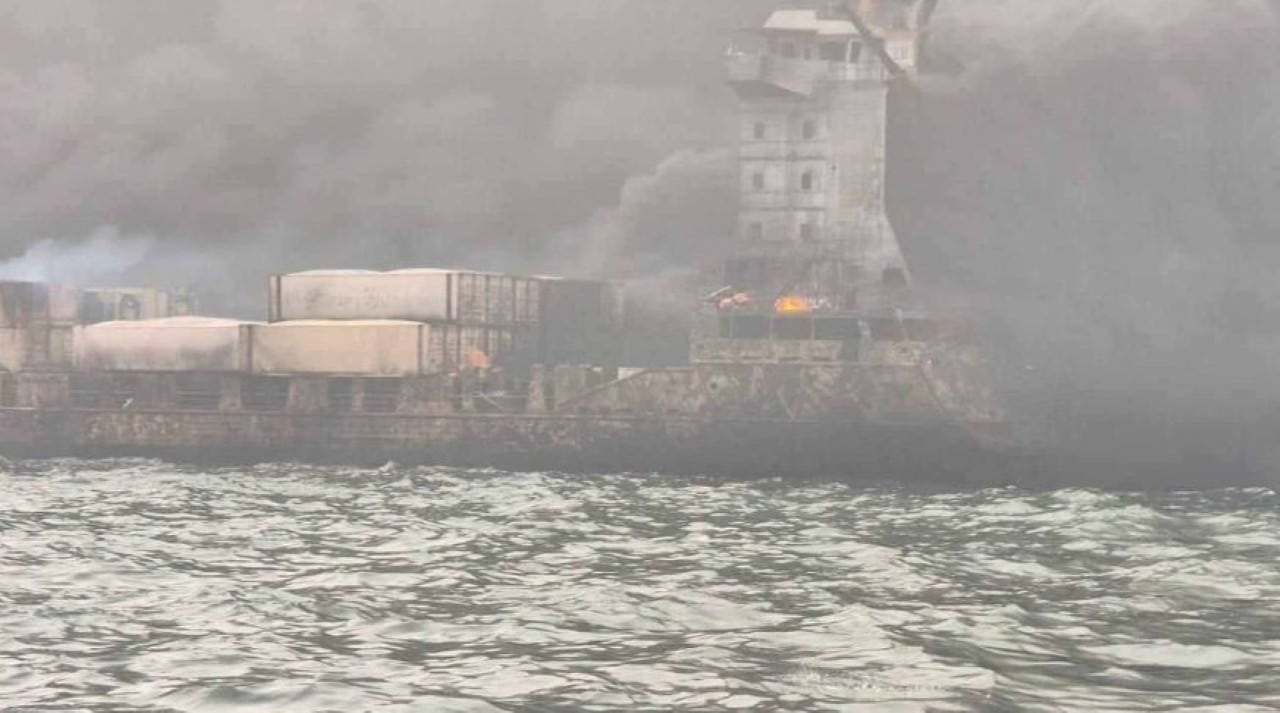
A severe maritime incident rocked the northeast coast of England on the morning of Monday, March 10, when a tanker and a cargo ship collided in the North Sea near the Humber Estuary. The UK’s HM Coastguard is leading a large-scale emergency operation, deploying helicopters, fixed-wing aircraft, lifeboats, and nearby vessels equipped with firefighting capabilities. Reports indicate that both ships, identified as the US-flagged tanker MV Stena Immaculate and the Portuguese-flagged freighter Solong, are engulfed in flames, with thick black smoke visible from miles away. The alarm was raised at 9:48 GMT, prompting a swift response aimed at containing the damage and rescuing any crew members in peril.
The collision took place along one of the busiest shipping routes in the region, connecting British ports to destinations in the Netherlands and Germany. Television footage aired by the BBC shows at least one of the vessels ablaze, while the Royal National Lifeboat Institution (RNLI) reported that several individuals abandoned the ships following the impact. The situation remains critical, with authorities still investigating the cause of the accident and its potential human and environmental toll.
The Stena Immaculate, a US-registered tanker, was anchored near Hull, while the Solong, a Portuguese container ship, was en route from Grangemouth, Scotland, to Rotterdam, Netherlands. The combination of fire, smoke, and the strategic location of the incident has heightened the urgency of the response, which now involves resources from multiple coastal towns across England.
Details of the ongoing rescue operation
The response to the accident was immediate, involving a significant deployment of emergency assets. A Coastguard rescue helicopter based in Humberside was dispatched to the scene, accompanied by a fixed-wing aircraft providing aerial support and monitoring. Lifeboats from Skegness, Bridlington, Mablethorpe, and Cleethorpes were quickly mobilized to assist in search-and-rescue efforts, while nearby vessels with firefighting capabilities rushed to the collision site to tackle the flames.
The RNLI, a volunteer-led lifesaving service in the UK, underscored the severity of the situation, noting that crew members were forced to abandon the ships due to the fires. No confirmed details have yet emerged regarding the number of people on board each vessel or any injuries, but the presence of flames on both ships signals a high-risk scenario. The Humber Estuary, where the incident occurred, is notorious for its heavy shipping traffic, potentially complicating rescue and containment efforts.
Firefighting teams aboard specialized vessels are working to extinguish the blazes, while the Coastguard coordinates the logistics of the operation. Visibility in the area was hampered by foggy conditions on the morning of the incident, as per prior warnings from the Met Office, the UK’s weather service, which may have contributed to the collision.
Identification of the vessels and collision context
The two ships involved are the MV Stena Immaculate, a US-flagged tanker built in 2017, and the Solong, a container ship registered in Portugal, specifically in the autonomous region of Madeira. Tracking data from VesselFinder shows that the Stena Immaculate, a 183-meter-long vessel, was anchored near Hull after departing from the Greek port of Agioi Theodoroi on February 27. Meanwhile, the Solong was on an active commercial route, carrying cargo from Grangemouth to Rotterdam, one of Europe’s largest ports.
The Stena Immaculate is classified as a chemical and oil tanker, capable of transporting flammable fuels like Jet A1, used in aviation, according to Coastguard alerts. The presence of a potentially combustible cargo raises concerns about the risk of explosions or spills in the North Sea, an area critical for both environmental and economic reasons. The Solong, in contrast, is a typical cargo vessel designed for transporting containers on international routes.
Real-time tracking from Marine Traffic indicates that at 9:48 GMT, the Solong collided directly with the anchored Stena Immaculate. The exact cause of the accident remains under investigation, though initial hypotheses from maritime experts point to reduced visibility due to fog, human error, or technical failure as possible factors.
Efforts to contain fires and environmental risks
Controlling the fires on both ships is the immediate priority for emergency crews. Vessels equipped with firefighting systems were deployed to the scene to douse the flames, which continue to produce large plumes of black smoke. The intensity of the fire, captured in aerial footage by broadcasters like the BBC, suggests that containment efforts could take hours, depending on the amount of fuel and flammable cargo on board.
The potential for an oil or chemical spill in the North Sea is a growing concern. As a tanker, the Stena Immaculate carries substances that, if released, could inflict significant harm on the region’s marine ecosystem. The North Sea supports vital fishing grounds and diverse marine life, while also serving as a key route for global trade. Environmental authorities are closely monitoring the situation, and the International Maritime Organization (IMO), the UN agency overseeing shipping regulations, has been notified and is investigating the incident.
A preliminary timeline of events provides insight into the unfolding crisis:
- February 27: The Stena Immaculate departs Agioi Theodoroi, Greece.
- 9:48 GMT, March 10: The alarm is raised following the collision in the Humber Estuary.
- 10:00 GMT: Helicopter and lifeboats begin responding to the incident.
- 12:00 GMT: Footage confirms fires on both vessels.
The rapid response from British authorities aims to mitigate the impacts, but the full scope of the damage will only become clear in the coming hours.
Response from authorities and local community
HM Coastguard took charge of the operation within minutes of the alarm, orchestrating a joint effort involving multiple agencies and volunteer services like the RNLI. A Coastguard spokesperson stated that the incident remains ongoing and that all available resources are being utilized to address the crisis. The agency is also collaborating with nearby commercial vessels, which were redirected to assist in firefighting efforts.
Politically, Charlie Dewhirst, the MP for Bridlington, voiced concern over the accident in a social media post. He described the reports as “deeply worrying” and offered support to the rescue teams, including volunteers from his constituency. The incident’s proximity to coastal towns like Hull and Withernsea has heightened local anxiety, with residents wary of potential pollution and disruptions to maritime traffic.
The international maritime community has also taken note. Experts suggest that a collision in such a high-traffic area underscores the need for stricter safety and navigation measures, particularly in adverse weather conditions like those reported on the morning of the incident.
Potential impacts on trade and maritime safety
The North Sea is one of the world’s most strategic shipping lanes, linking UK ports to major economic hubs in continental Europe. The collision between the Stena Immaculate and Solong could temporarily disrupt the flow of goods, especially if sections of the waterway need to be closed for damage control. Hull, a key port near the incident site, is a significant hub for British trade, and delays could ripple through supply chains.
Key facts about the region and incident include:
- The Humber Estuary is one of the UK’s largest, handling dozens of ships daily.
- Around 30% of the UK’s natural gas passes through the North Sea.
- The area is monitored by advanced navigation systems, yet incidents persist.
- In 2023, the UK recorded 12 significant maritime collisions, per historical data.
Maritime safety is also under scrutiny, with experts questioning how a moving vessel collided with an anchored one in a heavily monitored zone. Fog reported by the Met Office, with winds up to 25 miles per hour, may have reduced visibility, but the IMO’s investigation will clarify the technical and human factors involved.
Large-scale mobilization reflects incident’s severity
The emergency operation in the North Sea showcases the UK’s capacity to respond to maritime disasters. Beyond the Humberside helicopter and fixed-wing aircraft, lifeboats from multiple coastal towns demonstrate a collective effort to save lives and limit damage. The RNLI, relying on volunteer crews, plays a vital role, braving hazardous conditions to reach the burning ships.
Witnesses in Withernsea, a nearby coastal town, reported hearing helicopters overhead since early morning. The sight of smoke rising on the horizon reinforces the perception that this is one of the region’s most serious incidents in recent years. The mix of fire, flammable cargo, and a strategic location keeps authorities on high alert.
The situation’s outcome in the coming hours will determine the extent of human, environmental, and economic fallout. As flames continue to consume the vessels, the coordinated response from the Coastguard and other services strives to prevent the crisis from escalating into a broader catastrophe.