
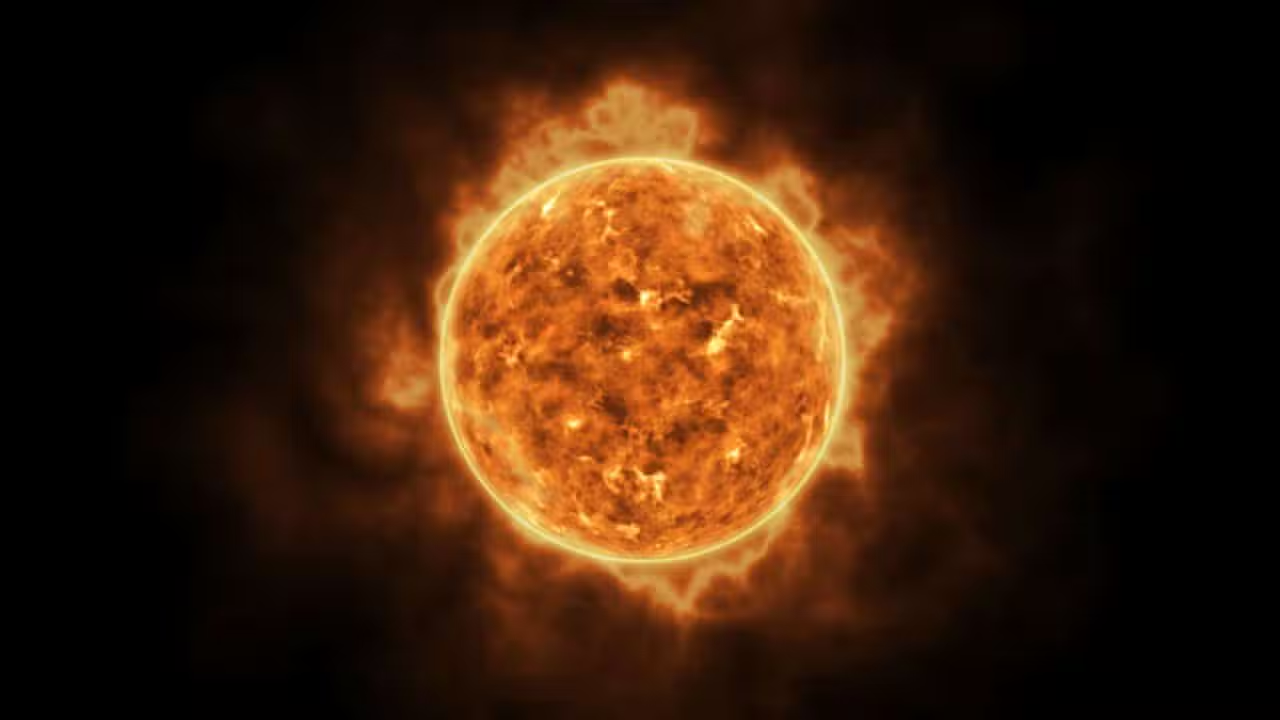
On December 8, 2024, the Sun unleashed an X2.3 solar flare from the AR3912 sunspot group, hurling billions of tons of charged particles toward Earth, as tracked by NOAA. This event, part of an intensifying solar cycle, reignites concerns about global preparedness for a catastrophic solar storm. Such phenomena, driven by coronal mass ejections, can disrupt power grids, satellites, and communication systems, with damages potentially costing trillions of dollars. Nations like Brazil still lack robust plans to counter these geomagnetic risks. The warning window, ranging from 15 hours to three days, limits effective responses. Why does the world remain vulnerable? Technological dependence and insufficient public policies exacerbate the issue.
While the December event caused no major damage, it underscores the Sun’s immense power. Every 11 years, the solar cycle peaks, heightening the risk of extreme storms.
- Historical events: The 1989 Quebec blackout and the 1859 Carrington event highlight destructive potential.
- Current risks: Satellites, GPS, and internet are fragile targets.
- Global challenges: Few nations have effective protocols.
Modern society, deeply interconnected, faces an unprecedented test from these cosmic forces.
Rising solar activity
The 25th solar cycle, which began in 2019, is escalating, with peaks expected through 2026. Solar flares, classified as C, M, or X, vary in intensity, with X being the most severe. The X2.3 flare in December, though moderate, signals a period of heightened instability. NASA data shows that coronal mass ejections (CMEs) release plasma and magnetic fields, which, upon colliding with Earth’s magnetic field, trigger geomagnetic storms. These storms induce currents in power grids, potentially burning transformers and causing cascading failures.
Past events have exposed vulnerabilities. In 2003, a solar storm temporarily disrupted satellites and networks in Europe. Today, with global digitalization, impacts would be exponentially greater.
Infrastructure at risk
Interconnected power grids are especially susceptible. A collapse in one region can spread rapidly, as seen in the Quebec blackout, which left 6 million people without power for 9 hours. In the U.S., studies estimate a severe solar storm could cost up to $2 trillion in the first months, with full recovery taking years.
- Affected sectors: Energy, communications, transportation, and healthcare.
- Human cost: Disruptions in hospitals and supply chains.
- Slow recovery: Replacing transformers can take months.
Brazil, with its vast power grid and reliance on internet, faces similar risks but lacks specific protections against geomagnetic storms.
Satellites under threat
Approximately 10,000 satellites orbit Earth, supporting everything from weather forecasts to financial transactions. During solar storms, charged particles can damage solar panels and electronic circuits. In 2022, SpaceX lost 40 Starlink satellites due to a moderate geomagnetic storm. An extreme event could disable hundreds of satellites at once.
Loss of GPS would disrupt air, sea, and land navigation, while satellite communication failures would hinder emergency services. Agencies like ESA and NASA monitor these threats, but replacing damaged satellites is costly and time-consuming.
Aviation and space impacts
Solar storms increase radiation at high altitudes, particularly on polar routes. During intense events, airlines reroute flights to avoid exposing passengers and crew to harmful ionizing radiation. In 2019, the U.S. Federal Aviation Administration issued alerts for transatlantic route adjustments due to a moderate storm.
Astronauts on the International Space Station (ISS) face even greater risks. During storms, they take shelter in shielded modules, but low-orbit or lunar missions may be halted. Radiation also threatens ISS electronics, requiring constant maintenance.

Environmental effects in focus
Recent studies explore indirect impacts of solar storms on the atmosphere. Solar particles can interact with the ozone layer, temporarily reducing its density. A 2023 University of Oxford study suggests extreme events could increase ultraviolet radiation for weeks, affecting sensitive ecosystems and human health.
Though transient, these effects, combined with stressors like climate change, raise concerns. Tropical regions, such as Brazil, may face greater exposure due to their geographic position.
Limited global preparedness
Developed nations, like the U.S., invest in solar monitoring and emergency protocols. NOAA’s Space Weather Prediction Center issues real-time alerts. However, the 15-hour to three-day window between flare detection and Earth impact is too short for complex actions, like preemptively shutting down power grids.
- Current measures: Reinforced transformers and satellite shielding.
- Gaps: Lack of international coordination and public policies.
- Cost: Resilience investments are high but essential.
Developing nations, including Brazil, lag behind. Brazil’s National Institute for Space Research (INPE) monitors space weather, but critical infrastructure remains exposed.
Raising awareness
Scientists push for greater focus on the issue. International forums, like the UN, are beginning to address space risks, but lack of consensus on funding and responsibilities slows progress. Educational campaigns aim to inform the public about technological dependence and the need for preparedness.
In Brazil, initiatives within the Brazilian Space Program include space weather studies, but practical measures are limited by budget constraints. Experts argue that solar storm protection should be treated as a national security priority.
Lessons from history
The 1859 Carrington event, the largest recorded solar storm, disrupted telegraphs and produced auroras visible as far as the Caribbean. At the time, limited technology minimized damage. Today, a similar event would be catastrophic.
In 2012, a coronal mass ejection narrowly missed Earth, with intensity comparable to Carrington’s. Had it hit, economic losses would have been immense. These near-misses underscore the urgency of preventive measures.
Building resilience
Investing in resilient technologies is critical. Transformers with geomagnetic current protection and satellites with advanced shielding are under development. Diversifying energy sources and decentralizing communication networks can also reduce vulnerability.
Public-private partnerships are gaining traction. Companies like SpaceX and Boeing collaborate with space agencies to mitigate risks. However, the challenge’s scale demands coordinated global efforts.
News summary
On December 8, 2024, an X2.3 solar flare highlighted the risks of catastrophic solar storms, which could cripple power grids, satellites, and communication systems. Monitored by NOAA, the flare caused no major damage but exposed global vulnerabilities. Nations like Brazil lack robust plans, and the 15-hour to three-day warning window limits responses. Losses could reach trillions, impacting billions. Technological reliance and insufficient investments heighten the stakes, demanding urgent action.