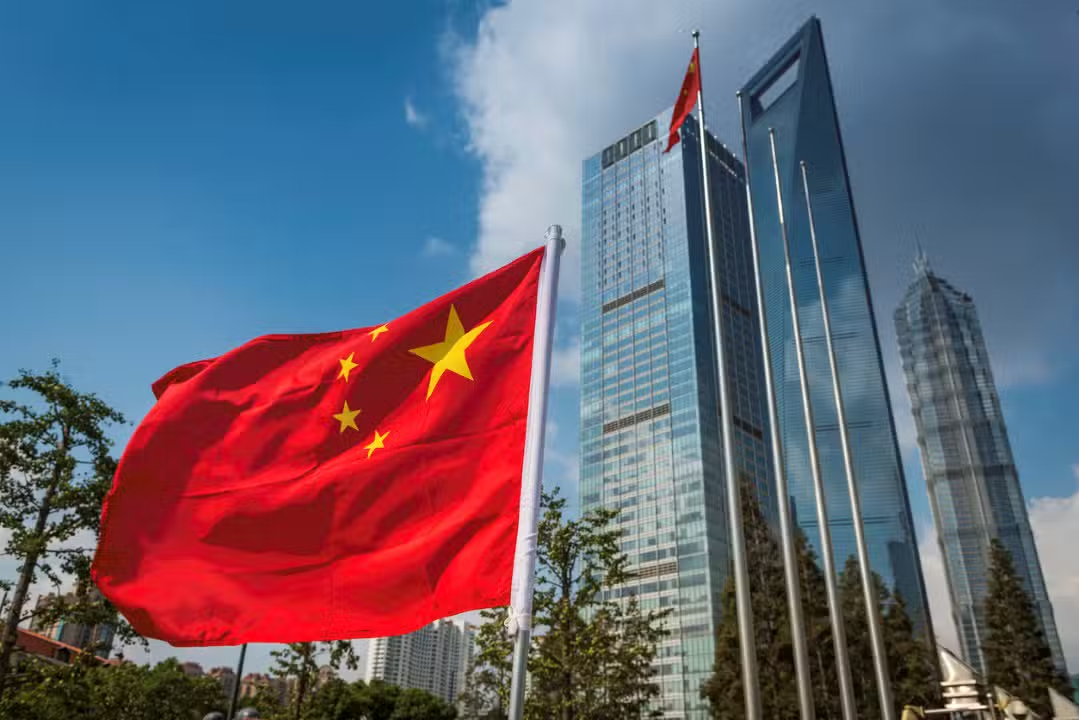
The BRICS nations, comprising Brazil, Russia, India, China, South Africa, and associate members, intensified discussions in 2025 to create a payment system that eliminates reliance on the U.S. dollar for international transactions. Leaders, including Brazilian President Luiz Inácio Lula da Silva, met at events like the Kazan summit in Russia in October 2024 to advance proposals such as the BRICS Bridge, a payment platform based on local currencies and blockchain technology. The initiative, backed strongly by the Lula administration, aims to reduce the influence of the Western-dominated financial system, particularly the dollar and the SWIFT network, but it divides experts on its feasibility and impacts. The move comes amid trade tensions with the United States, which has threatened tariffs against countries challenging the dollar’s hegemony. The proposal reflects the bloc’s desire for greater financial autonomy but faces significant economic and political challenges.
The idea of an alternative payment system is not new but gained momentum due to Western sanctions against Russia since 2022, which restricted its access to SWIFT. China seeks to expand the use of the yuan, while Brazil advocates for local currency transactions to cut costs. The BRICS Bridge, an evolution of the mBridge project, aims to connect member countries’ financial systems using central bank digital currencies and blockchain technology.
- Main objective: Create an alternative to SWIFT, reducing dollar dependency.
- Technology involved: Blockchain for secure and decentralized transactions.
- Participating countries: Brazil, Russia, India, China, South Africa, plus new members like Saudi Arabia, Egypt, and the UAE.
- Timeline: mBridge reached a viable stage in 2024, but full implementation lacks a set date.

BRICS Bridge proposal
The BRICS Bridge platform, discussed at the Kazan summit, is the cornerstone of the proposal. Unlike a single currency, it focuses on facilitating cross-border transactions in local currencies using blockchain for security and efficiency. According to Yuri Ushakov, a Kremlin advisor, in March 2024, the system will be “convenient for governments, businesses, and citizens, free from political pressures.” Saudi Arabia joined the project in 2024, and the mBridge, a precursor to BRICS Bridge, reached a minimum viable product stage, capable of processing real transactions.
Brazil, through its Local Currency Payment System (SML), already has experience with dollar-free transactions in Mercosur. In 2024, Brazil exported R$3.3 billion to Argentina via SML, though this represents a small fraction compared to the 95% of Brazilian exports still using the dollar. The Lula government sees the BRICS Bridge as a chance to expand this model, cutting currency conversion costs and exposure to sanctions.
Motivations behind the project
Each BRICS country has distinct interests in pursuing an independent system. Russia aims to circumvent sanctions that blocked its SWIFT access. China, with the world’s second-largest economy, wants to globalize the yuan, which accounts for just 4.5% of global trade compared to the dollar’s 84.3%. Brazil seeks to reduce transaction costs and strengthen ties with the Global South.
- Russia: Escape Western sanctions limiting global trade access.
- China: Expand yuan usage and challenge U.S. financial dominance.
- Brazil: Lower transaction costs and deepen ties with emerging nations.
- India: Seeks flexibility but fears yuan dominance in the system.
- South Africa: Supports the initiative but faces economic constraints.
Despite enthusiasm, the proposal faces skepticism. Experts note that economic disparities among members and the volatility of currencies like the ruble complicate implementation. “The idea of a common system is politically appealing but economically complex,” says Maria Elena Rodriguez, an economist at the University of São Paulo.
Reactions in Brazil and local impact
In Brazil, the government supports the proposal, but economists express concerns. President Lula, since 2023, has criticized dollar hegemony and advocated for financial sovereignty. At the Johannesburg summit in 2023, he stated that local currency use “increases payment options and reduces vulnerabilities.” Brazil’s Central Bank already uses the SML in Mercosur, but scaling it to BRICS requires regulatory adjustments and infrastructure investments.
Brazilian companies could benefit from lower costs in international transactions, particularly with China, Brazil’s largest trading partner. In 2024, Brazil exported $104 billion to China, nearly all in dollars. A system like BRICS Bridge could enable payments in reais or yuan, but analysts warn of risks.
- Potential benefits: Lower conversion costs and greater financial autonomy.
- Risks highlighted: Local currency instability and implementation costs.
- Consumer impact: Possible price hikes if local currencies lose value against the dollar.
- Estimated timeline: No set date, with tests ongoing until at least 2026.
Jurist Daniele Quintans dos Santos, in an analysis on Jus Brasil, warns that replacing the dollar could raise prices for imported goods if the new platform fails to stabilize local currencies. Additionally, the infrastructure needed for BRICS Bridge demands significant investments, which could strain smaller economies like South Africa’s.
Tensions with the United States
The BRICS proposal aligns with growing friction between Brazil and the U.S. In 2025, the United States imposed 50% tariffs on Brazilian products, seen as a response to Brazil’s alignment with sanctioned nations like Iran and Russia. U.S. President-elect Donald Trump, in November 2024, threatened 100% tariffs on countries challenging the dollar, escalating tensions. “If BRICS creates an alternative currency or system, they’ll face tariffs and lose U.S. market access,” Trump stated on Truth Social.
In Brazil, the opposition criticizes the government’s stance. Deputy Marcel van Hattem of the Novo party warns that aligning with sanctioned countries risks isolating Brazil globally. “Supporting anti-dollar initiatives without a clear strategy is risky,” he says. The Lula administration, however, argues that BRICS Bridge strengthens economic sovereignty and mitigates external pressures.
Technical and economic hurdles
Implementing BRICS Bridge requires overcoming significant obstacles. Economic disparities among BRICS members are a key challenge. China, with a GDP five times larger than Brazil’s, dominates intra-bloc trade, raising concerns in India about yuan dominance. Additionally, nations like South Africa lack the financial infrastructure to fully participate.
- Technical challenges: Need for interoperable systems and blockchain investments.
- Economic risks: Local currency volatility and trade imbalances.
- Limited integration: BRICS countries have limited trade among themselves, except with China.
- Viability timeline: Experts estimate at least five years for full operation.
Economist Ana Clara Costa from FGV notes that BRICS Bridge needs a compensation mechanism to address trade imbalances. “Without a stable intermediary currency, exchange rate fluctuations could raise transaction costs,” she explains. The euro model, cited by some, is unfeasible due to the lack of a banking or fiscal union among BRICS nations.
Role of blockchain technology
Blockchain is a key feature of BRICS Bridge. The technology enables secure, decentralized transactions, reducing reliance on Western financial intermediaries. The mBridge, tested in 2024, demonstrated capacity for real transactions between central banks, with compatibility with the Ethereum Virtual Machine. Saudi Arabia, a recent project member, highlights the system’s potential to cut costs and increase transparency.
However, implementation requires regulatory harmonization. Each country must adapt its financial laws, a process that could take years. Additionally, China’s leadership in blockchain technology may give it disproportionate influence, creating tensions within the bloc.
Global landscape and next steps
The BRICS Bridge reflects a shift in global financial dynamics. With 37% of global GDP, BRICS seeks greater influence, but faces internal and external resistance. India, for instance, remains cautious, favoring bilateral rupee-based agreements with countries like the UAE. Brazil, under Lula’s leadership, plans to prioritize the issue during its 2026 BRICS presidency, proposing a new bloc vision: “Building Resilience and Innovation for Cooperation and Sustainability.”
The proposal is unlikely to displace the dollar in the short term. The dollar dominates 90% of global currency transactions, and SWIFT connects over 200 countries efficiently. Economist Jim O’Neill, who coined the term BRICS, calls the idea more symbolic than practical. “They’d need a robust financial framework, which would take decades,” he says.
Despite skepticism, BRICS Bridge is a concrete step toward reducing dollar dependency. The 2026 summit, under India’s leadership, will be pivotal in defining next steps. Meanwhile, Brazil balances its Global South ambitions with U.S. pressures in an increasingly polarized economic landscape.