
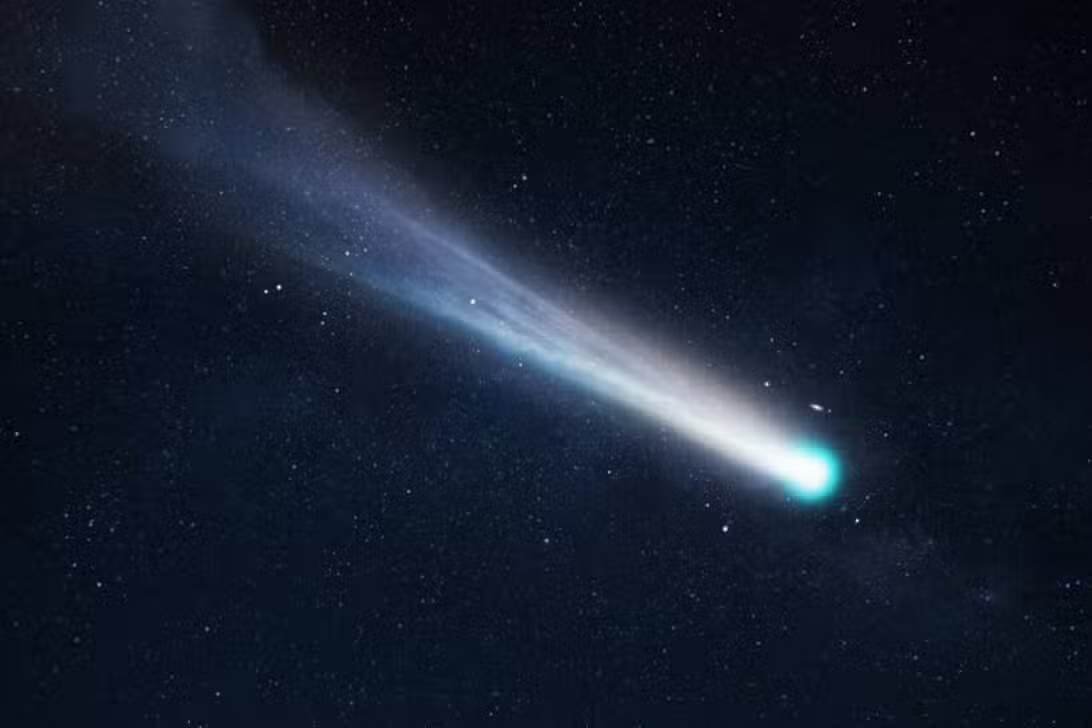
Amateur astronomer Gennady Borisov discovered comet C/2025 V1 on November 2, 2025, at the MARGO Observatory in Crimea. The object, identified during routine observations, was confirmed by international teams hours later and may be the fourth known interstellar object. Its hyperbolic orbit suggests origins outside the Solar System, but the absence of a visible tail raises questions. Astronomers monitor the celestial body to clarify its nature.
The comet passed 103 million kilometers from Earth on November 11 and will reach perihelion, the closest point to the Sun, on November 16, at 68 million kilometers. The International Astronomical Union cataloged the object, which displays a diffuse coma but no tail, intriguing researchers. Preliminary data indicates a possible origin in the Oort Cloud, although the open trajectory keeps the interstellar hypothesis under analysis.
- Apparent magnitude of 14.2 at discovery, visible only with telescopes.
- Core estimated to be between 1.4 km and 16 km in diameter.
- Speed relative to the Sun of 210 km/h, suggesting a hyperbolic orbit.
- Monitoring by NASA, ESA and telescopes in Chile, Austria and Japan.
C/2025 V1 does not pose a risk to Earth and remains under observation to confirm its classification.
Intensive monitoring
Terrestrial and space telescopes, such as those located in Chile and Austria, have been capturing images of comet C/2025 V1 since November 3. The absence of cAudacity is attributed to low initial sublimation, despite the proximity to the Sun.
Teams from NASA and ESA use radars and spectrometers to analyze the chemical composition of the object. Data collected indicates the presence of ice and dust, typical of comets from the Oort Cloud.

Unique features
The comet rotates for 13.2 days, detected by satellites such as NEOSSat. Its “ghostly” appearance suggests possible early disintegration, but without confirmation.
Images show a diffuse coma of 25 arc seconds, with no trace of an ionic tail.
The orbit, with an eccentricity of 1.0095, can be adjusted with new calculations.
The high speed reinforces the possibility of interstellar origin, under analysis.
Role of amateur astronomers
Gennady Borisov, known for the discovery of 2I/Borisov in 2019, reinforces the importance of independent observers. Your contributions expand astronomical knowledge.
Global network of amateur observatories, including in the Czech Republic, contributes crucial data.
The discovery of C/2025V1 highlights the impact of affordable equipment on modern science.
Comparison with other objects
C/2025 V1 follows patterns of interstellar comets such as 1I/Oumuamua and 2I/Borisov. Its hyperbolic orbit is similar, but the lack of a tail sets it apart. The mass loss, estimated at 0.4% before perihelion, is less than that of other comets.
Next steps in research
Post-perihelion observations, planned with Hubble and the James Webb Telescope, will look for radio emissions and brightness variations. This data will help confirm whether C/2025 V1 is interstellar or originating from the Oort Cloud, contributing to studies on the formation of stellar systems.