
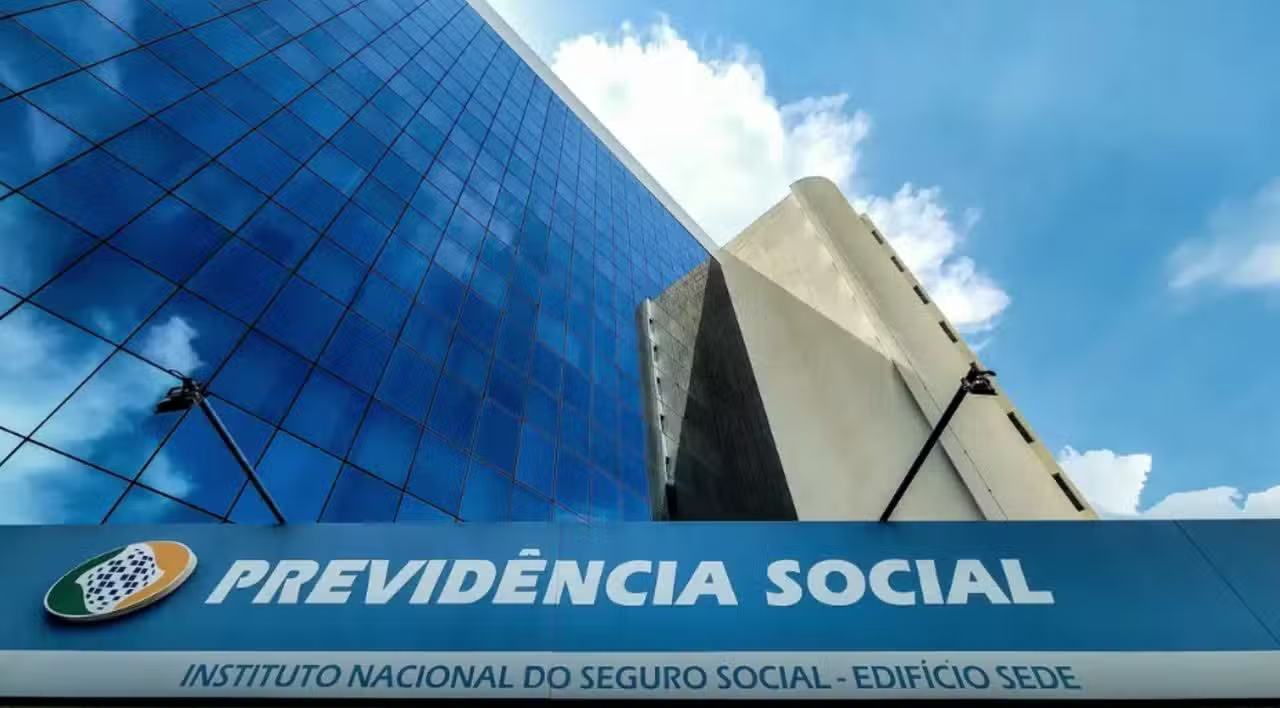
The Previdência Social system in Brasil continues its process of adaptation to new demographic and economic realities, with annual adjustments that directly impact workers planning retirement. The transition rules, created following the pension reform, continue to evolve, requiring increased attention from Instituto Nacional and Seguro Social (INSS) policyholders to ensure the best benefit at the right time.
The progressive changes mainly affect age requirements, contribution time and the points system, which are calculated annually. Para For those who are close to retiring, understanding these updates is essential to avoid surprises and carry out adequate financial planning. The objective of the changes is to guarantee the long-term sustainability of the system, balancing concessions with revenue.
In parallel with the adjustments to the rules, the INSS is advancing in the modernization of its services. The digitalization of processes, centralized on the Meu INSS platform, aims to simplify access to benefits and reduce bureaucracy, allowing citizens to resolve most of their issues remotely, without the need to travel to a physical branch.
The progression of the minimum age in the transition rule
One of the main transition rules affected by the annual adjustments is the progressive minimum age. Este model establishes a gradual increase of six months in the required age each year, until reaching a final level. Para the year 2026, women need to turn 59 years and six months of age, in addition to proving at least 30 years of contribution time to retire under this modality. The rule seeks to smooth the transition to the definitive minimum age stipulated by the reform.
For men, the requirement has also been updated. Agora, you must be 64 years and six months old, maintaining the requirement of 35 years of contribution. Este continuous increase requires workers to periodically recalculate their retirement expectations, as the date to request the benefit can be postponed with each new year. Acompanhar the contribution statement (CNIS) becomes an essential tool to ensure you don’t lose control over your own social security history.
How the new points system works
The points system is another important transition rule that undergoes annual increments, representing an alternative for those who wish to retire without necessarily reaching the minimum progressive age. The calculation is simple: the worker’s age is added to his contribution time. Each year, the minimum required score increases by one point. Para 2026, women need to reach the sum of 93 points, while men need 103 points to be entitled to the benefit. It is important to highlight that, within this sum, women must have contributed for at least 30 years and men, for 35 years. Essa regra favorece aqueles que começaram a trabalhar mais cedo e acumularam um longo período de contribuição, permitindo que se aposentem antes de atingir a idade mínima de outras modalidades. Planning is crucial, as a single point can define whether or not the insured will be able to request retirement that year. The simulator available on the Meu INSS portal is a valuable tool for workers to check whether they have already reached the required score and project when this will occur.
Toll rules as an alternative
For policyholders who were very close to retiring when the pension reform was enacted in 2019, toll rules of 50% and 100% were created. Elas work as an alternative for those who do not fit into the other transitions and offer specific conditions for granting the benefit.
The 50% toll rule requires the worker to complete an additional period corresponding to half of the time left to retire due to contribution time on the date of retirement. Já o pedágio de 100% requer o cumprimento do dobro do tempo que faltava, mas oferece em troca o valor integral do benefício, sem aplicação do fator previdenciário. Esta last also requires a minimum age of 57 for women and 60 for men.
The new floor and ceiling for social security benefits
With the annual adjustment of the minimum wage, the values of benefits paid by the INSS are also corrected. Para 2026, the social security floor, which corresponds to the minimum amount that a retiree or pensioner can receive, was established at R$1,621.
This value serves as a basis for the vast majority of Previdência Social beneficiaries, ensuring that payments follow, at least partially, the cost of living. The measure is essential for maintaining the purchasing power of millions of families that depend on these resources.
Likewise, the benefit ceiling, which is the maximum amount paid by the INSS, is also adjusted annually based on Índice Nacional from Preços to Consumidor (INPC). Essa update is extremely important for workers who contribute higher amounts, as it directly impacts the calculation of their future pensions.
The consolidation of digital services by Meu INSS
The digital transformation of the INSS has been a pillar for modernizing service and making life easier for policyholders. The Meu INSS platform, available via website and app, has established itself as the main channel for accessing more than 100 different services, ranging from simple consultation of statements to requesting pensions and aid.
This digital centralization allows citizens to carry out complex procedures without leaving home. It is possible to send documents, schedule medical examinations when necessary and monitor the progress of a request in real time. The tool drastically reduced dependence on in-person service and long queues at branches.
Another important innovation is Atestmed, a system that allows the analysis of requests for assistance due to temporary incapacity (formerly sickness benefit) by sending digital medical documents. In many cases, document analysis eliminates the need for in-person medical expertise, speeding up the granting of benefits to those who need it most.
The continuous investment in technology seeks not only to optimize the institute’s operational efficiency, but also to make Previdência Social more accessible and transparent. The guideline is that all policyholders familiarize themselves with the platform, as it is the gateway to guaranteeing their social security rights.
Updated procedures for proof of life
Proof of life, a mandatory procedure for retirees and pensioners to continue receiving their benefits, was also modernized. The process is now carried out automatically by the INSS, which uses data crossing from other government databases to confirm that the beneficiary is alive.
Acts such as vaccination, attendance at elections, issuing a passport or identity card, and even consultations at Sistema Único of Saúde (SUS) are recorded and used as proof of life. The insured will only be notified to carry out any additional procedure if no movement is identified in their name for a long period.
Criteria for other aid and pensions
In addition to pensions, other benefits such as death pensions and disability benefits follow specific criteria established by legislation. Embora the general rules have not undergone drastic changes, the values are updated annually and the application procedures are increasingly integrated into the Meu INSS digital environment, simplifying the process for applicants.
The importance of individual pension planning
Faced with a scenario of constant change, pension planning is no longer an option and has become a necessity. Cada worker has a unique contribution history, and the different transition rules can generate very different results for each case.
It is essential that the insured person uses official tools, such as the Meu INSS retirement simulator, to understand their current situation. The platform allows you to visualize how long it takes to retire in each of the available modalities, helping with decision making.
Regular consultation of the Cadastro Nacional of Informações Sociais (CNIS) is also essential. Verificar If all employment relationships and contributions are correctly recorded, you can avoid delays and headaches when requesting the benefit, ensuring that all time worked is properly accounted for in retirement.