
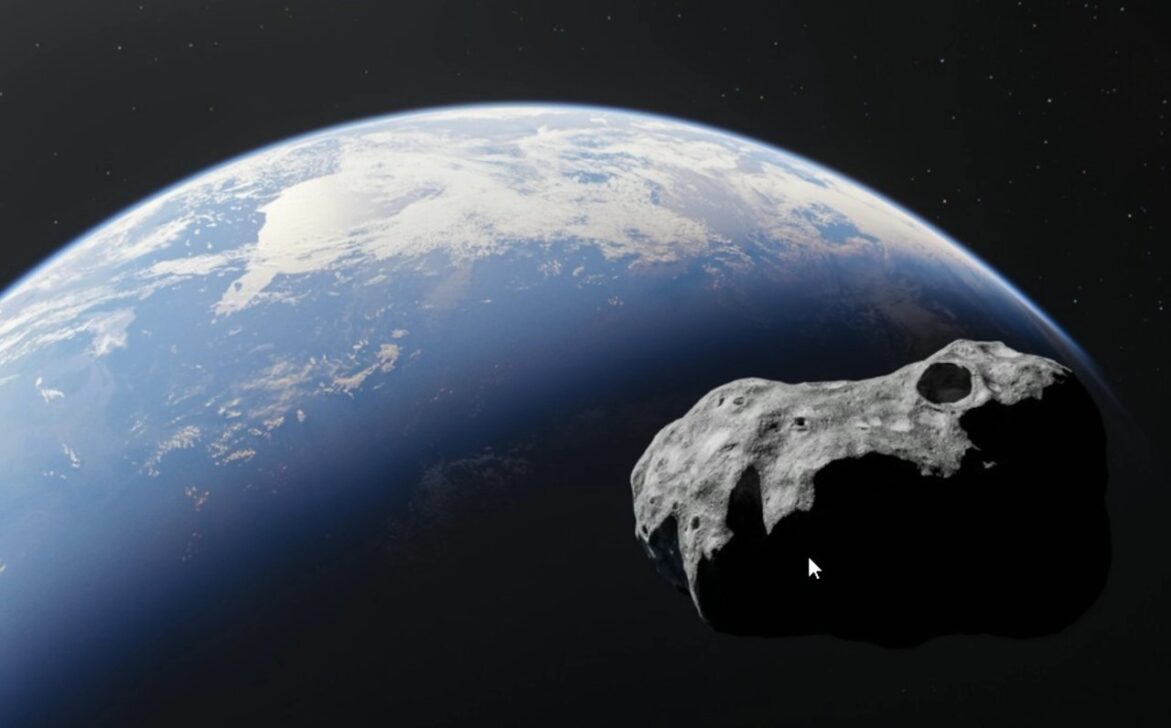
Asteroid 99942 Apophis, also called Deus or Caos, will pass approximately 32 thousand kilometers from the surface of Terra on April 13, 2029. The distance is smaller than that of many satellites in geostationary orbit. The object is about 375 meters in diameter and was discovered in 2004. Observações later phases eliminated any risk of impact with the planet for at least 100 years. The closest point occurs at around 6:45 pm at Brasília.
Space agencies are preparing missions to study the asteroid during and after its passage. The approach offers a unique opportunity for detailed observations of a potentially dangerous object.

Discovery and initial risk
Astronomers identified asteroid Apophis in June 2004 at Observatório Nacional of Kitt Peak, at Estados Unidos. Initial Cálculos indicated a small chance of a collision with Terra in 2029. The object has received worldwide attention because of the size and projected proximity.
Tracking teams performed additional observations with optical telescopes and radar. The refined data adjusted the orbit and ruled out the risk of impact in 2029 and 2036. The uncertainty about the trajectory decreased to a few kilometers.
On the same topic: Preparation for asteroid impact: NASA expert highlights the urgency of planetary defense
The asteroid remains classified as potentially dangerous due to its diameter exceeding 140 meters and its orbit approaching Terra. However, NASA analyzes indicate safety for more than a century.
- The asteroid has an elongated shape, similar to a peanut.
- The speed relative to Terra reaches around 7.4 km/s at the moment of closest proximity.
- The pass slightly changes the orbit of Apophis from class Aten to class Apolo.
Approximation details in 2029
Asteroid Apophis will reach its closest point to Terra on April 13, 2029. The minimum distance is around 32 thousand kilometers from the surface. Essa mark represents the closest approach ever recorded to an asteroid this size with advance notice.
Learn more: Asteroid named after Puerto Rican NASA scientist for space pioneering
During the event, Apophis will shine at magnitude 3.1. The object should be visible to the naked eye in rural or suburban areas with little light pollution from parts of Europa, África, and Ásia Ocidental. Visibility at Brasil has not yet been precisely confirmed. The apparent motion in the sky covers a significant arc in about a day.
Earth’s gravity accelerates the asteroid during its passage and then slows it down. The phenomenon allows scientists to observe gravitational effects in real time. Maximum brightness occurs around 5:30 pm at the time of Brasília.
Planned space missions
The European space agency ESA prepares mission Ramses for launch in 2028. The probe will follow the asteroid during its 2029 approach and collect data on possible changes in the surface or rotation caused by Terra’s gravity.
More on this story: Scientists develop technique to deflect asteroids and protect Earth from future impacts
NASA repurposed the OSIRIS-APEX spacecraft, formerly known as OSIRIS-REx, to find Apophis in June 2029. The mission will orbit the asteroid for about 18 months after the flyby. The objective includes mapping the rock composition and analyzing post-approach changes.
Other proposals involve small satellites and even landers from private companies to study the object up close. Essas initiatives transform the event into a global scientific opportunity.
Opportunity for science and observation
The close pass allows them to accurately measure the orbit and physical properties of Apophis. Cientistas want to better understand how Earth’s gravity affects nearby asteroids. The data helps refine planetary defense models against future objects.
Amateur and professional astronomers will monitor the event with telescopes and radars. Naked-eye visibility in several regions of the Eastern Hemisphere increases public interest in the topic.
The asteroid is a rocky object with an estimated diameter of between 340 and 375 meters. The mass reaches tens of millions of tons. Estudos previous studies have already mapped part of the surface, but the closer approach will allow for more detailed observations.
Learn more: New study indicates overheating of dinosaurs by asteroid dust
Continuous tracking and security
NASA maintains Centro from Estudos from Objetos Próximos to Terra to track asteroids like Apophis. The work combines observations from ground-based telescopes, radars and data from space missions.
Regular orbit updates confirm there is no risk of collision for decades to come. The current focus is on characterizing the asteroid for future missions and to improve understanding of cosmic threats.
The scientific community uses the case of Apophis as an example of how continuous tracking reduces uncertainty and transforms potential risks into research opportunities.