Preparation for asteroid impact: NASA expert highlights the urgency of planetary defense
Humberto Campins, a NASA asteroid expert, warned that humanity needs to develop technologies and response strategies for future impacts, despite there currently being no known threat to Earth. The statement, made on August 12, 2026, highlights the importance of continuous preparation for events that he considers inevitable in the long term.
In an interview with the EFE news agency, broadcast by DW during the Many Pathways to Space conference in Oviedo, Spain, Campins assured that individual people do not need to worry about an impact during their lives. However, he emphasized that civilization as a whole must organize itself to face threats that may arise in the future.
The expert recalled that major impacts are part of the history of our planet, such as the event that led to the extinction of the dinosaurs. According to their observations, incidents of this type will be inevitable if effective techniques, technologies and programs are not developed to divert asteroids into dangerous trajectories.
On the same topic: NASA simulates comet 3I/ATLAS collision with Madrid and projects catastrophic destruction in the city
NASA invests in studies and monitoring against space rocks
Campins detailed that NASA managed, at least three or four decades ago, to persuade the United States government about the seriousness of the threat posed by asteroids, promoting studies on the topic.
Since then, the American space agency has started to coordinate a vast international network of telescopes and scientists. This group is dedicated to identifying new objects and analyzing their trajectories, with the purpose of determining whether any of them may present a risk of collision with Earth.
To assess the likelihood of an impact, a model known as the Torino scale is employed. This tool allows you to classify the danger level of an asteroid, taking into account factors such as its size, its route and its potential proximity to the planet.
Learn more: Records from the DART probe prove natural transfer of rocks between binary asteroids
The expert clarified that, currently, no known asteroid is “lurking” with a direct collision course with Earth, and the chance of a significant impact in a person’s lifetime is very low. Even so, it reinforced the need for planetary defense for the survival of civilization in the long term.
Although humanity has never faced a confirmed cosmic impact threat, several space agencies maintain active collaboration. They participate in international exercises every three years, simulating scenarios and preparing action plans.
These exercises have the main goal of creating a robust institutional memory, enabling organizations to react to a real danger. Preparation involves essential coordination between scientific institutions, researchers and space agencies to define what measures would be adopted if an asteroid was on a collision course.
Campins also mentioned NASA’s DART program, which in 2022 demonstrated the feasibility of altering the orbit of a smaller asteroid through a kinetic impact. This technique, which may sound like science fiction, has already been successfully tested in space and represents a concrete advance in planetary defense.
See Also

Miss World Indonesia Putri Andriani Juficha dies on her 26th birthday

Pokémon Go users report massive failures with login and connection to the game server

Instability in the Nubank application affects customers and service is normalized in a few hours
More on this story: NASA announces increased probability of collision of asteroid 2024 YR4 with Earth
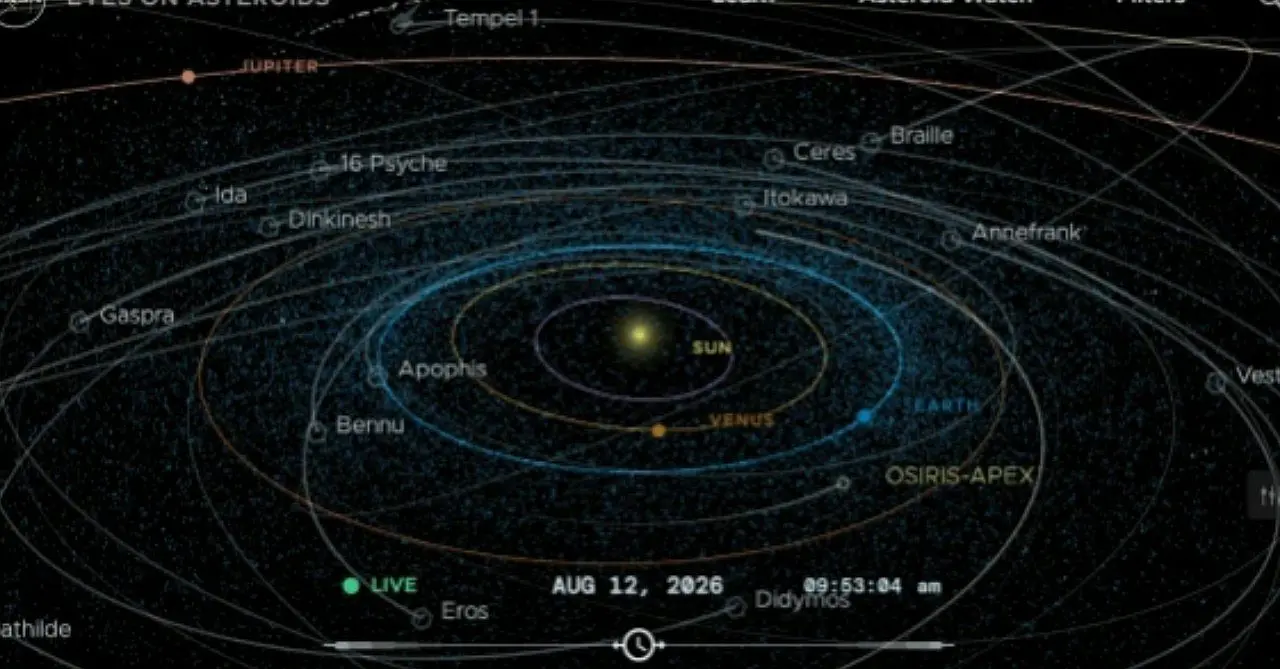
One of the objects that will be thoroughly studied in the coming years is Apophis, an asteroid measuring around 375 meters in diameter that will make a close pass to Earth in April 2029.
Campins explained that Apophis will approach at a distance of 32,000 kilometers from the Earth’s surface, smaller than the orbit of many communications satellites. This proximity will allow the asteroid to be observed from Earth without the need for professional equipment.
The expert emphasized that, during this encounter, there is no risk of Apophis deviating from its trajectory and colliding with the planet. However, he noted that, in the future, its orbit could change and pose a threat, making its continued observation of utmost importance.
NASA’s Osiris-Apex mission and the European Space Agency’s Ramses spacecraft, the latter still under construction, are planned to study the asteroid. Both missions will analyze, among other aspects, how Apophis deforms and transforms under the influence of Earth’s gravity.
The potential of asteroids as a source of resources
Campins also highlighted that near-Earth asteroids can have considerable strategic value due to the resources they contain inside.
The expert detailed that these objects reach speeds similar to those of the planet, which makes them ideal candidates for space mining. As an example, he cited NASA’s Osiris-Rex mission, which identified hydrated silicates — material similar to clay — on the asteroid Bennu.
Learn more: Study details chances of giant asteroid hitting Earth and explains real threats
Water can be extracted from this material, and Campins considers it the most valuable resource outside the Earth’s atmosphere. Water can be separated into hydrogen and oxygen, elements that would serve as fuel for satellites orbiting Earth.
Furthermore, asteroids can be rich in platinum, rare earth elements and other essential raw materials. These resources could be used to manufacture structures directly in space, reducing the need to transport non-essential materials from Earth.
Although asteroid mining is not yet a reality, Campins estimated that this activity could begin within a decade or two. It would be applied to build and sustain data centers and space bases on future missions.